Should You Stain or Paint Brick? A Complete Selection Guide
Deciding whether to stain or paint brick? Compare costs, durability, and breathability to choose the best masonry finish in this expert selection guide.

The Science of Masonry Finishes: Breathability vs. Opacity
Homeowners and commercial property managers frequently face a critical aesthetic and structural dilemma when updating masonry exteriors: should you stain or paint brick? While both methods alter the visual profile of clay masonry, their chemical interactions with the substrate are fundamentally opposed. Choosing incorrectly can lead to catastrophic moisture entrapment, freeze-thaw spalling, and costly remediation.
Brick is a highly porous, vapor-permeable material designed to absorb and subsequently release environmental moisture. According to the National Park Service guidelines on masonry coatings, altering the vapor transmission rate of brick can trap internal moisture, leading to structural degradation. The critical metric for evaluating any masonry finish is vapor permeability, measured in perms per ASTM E96. A high-perm finish allows the wall to 'breathe,' while a low-perm finish acts as a vapor barrier.
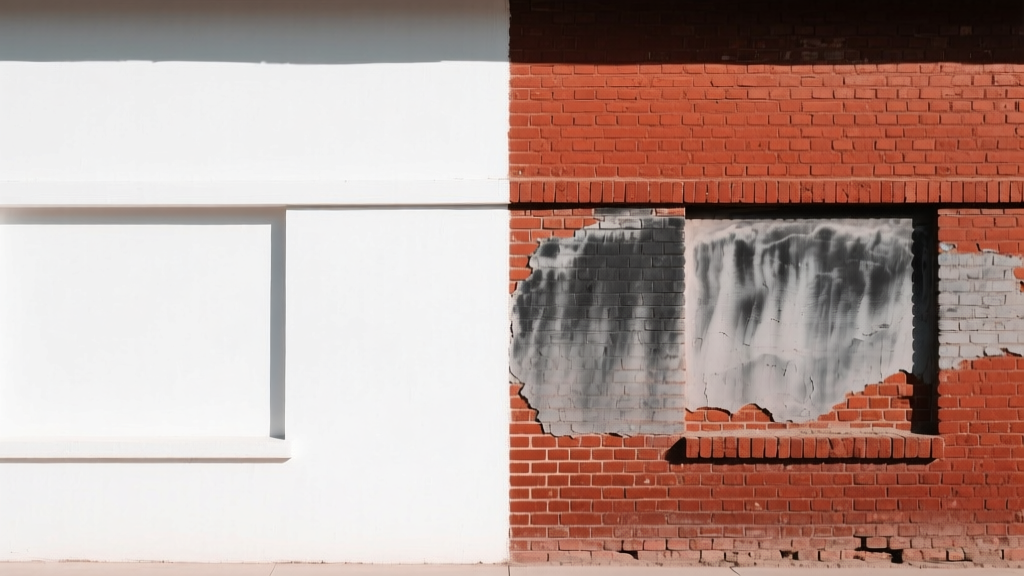
Brick Staining: Penetrating Mineral Silicates and Dyes
Mineral silicate brick stains (such as Nawkaw or Dyebrick) utilize a potassium silicate binder that chemically reacts with the silica in the clay brick. Instead of sitting on the surface, the stain penetrates 1/8 to 1/4 inch into the masonry pore structure. This process, known as petrification, permanently dyes the brick while leaving the pores entirely open.
Stain Profile: Pros and Cons
- Pro: Maintains vapor permeability (10+ perms), eliminating moisture entrapment risks.
- Pro: Zero peeling or flaking; the color becomes part of the brick itself.
- Pro: Preserves the natural texture and tactile feel of the masonry.
- Con: Cannot lighten dark brick; stains are translucent and can only add depth or darken the existing hue.
- Con: Requires highly porous, unsealed brick to penetrate properly.
Brick Painting: Acrylic Films and Mineral Limewashes
Painting brick involves applying a topical coating that bridges the surface pores. Modern masonry paints, such as Sherwin-Williams Loxon Concrete & Masonry Coating, are 100% acrylic elastomeric formulations. These are engineered to stretch and bridge hairline mortar cracks while providing a highly opaque, uniform color. Alternatively, mineral limewashes (like Romabio Classico) offer a middle ground: they provide opaque coverage but remain highly breathable due to their calcium hydroxide composition.
Paint Profile: Pros and Cons
- Pro: Complete opacity allows for drastic color changes, including painting dark red brick pure white.
- Pro: Elastomeric acrylics can bridge minor mortar cracking and seal against wind-driven rain.
- Pro: Limewash provides an opaque, breathable, and historically accurate finish for older structures.
- Con: Acrylic paints can trap moisture if the interior vapor barrier is compromised, leading to spalling.
- Con: Requires ongoing maintenance; acrylic paints typically require recoating every 7 to 10 years.
Head-to-Head Comparison Matrix
When specifying a finish for a 2026 exterior renovation, consider how these three primary systems perform across critical structural and aesthetic metrics.
| Feature | Mineral Silicate Stain | 100% Acrylic Paint | Mineral Limewash |
|---|---|---|---|
| Vapor Permeability | High (10+ perms) | Low to Moderate (1-5 perms) | High (15+ perms) |
| Expected Lifespan | 20+ Years (Permanent) | 7 - 10 Years | 10 - 15 Years |
| Color Options | Translucent, Darkening Only | Full Opaque Spectrum | Opaque, Earth Tones |
| Maintenance | Virtually None | Periodic Recoating | Occasional Touch-ups |
| Moisture Risk | Minimal | Moderate to High | Minimal |
Failure Modes: Why Masonry Coatings Spall and Peel
Understanding why brick finishes fail is crucial for making an informed selection. The most common failure mode in painted brick is efflorescence-driven delamination. When water moves through masonry, it dissolves soluble salts within the brick and mortar. As the water evaporates at the surface, the salts crystallize. If an impermeable acrylic paint is applied, these crystals form behind the paint film, generating crystallization pressures up to 2,000 psi—easily exceeding the tensile strength of the paint and causing it to blister and peel.
Another severe failure mode is freeze-thaw spalling. If moisture is trapped behind a low-perm acrylic paint during winter, the water freezes and expands by 9%. Because the moisture cannot escape outward through the paint film, the hydraulic pressure forces the face of the brick to pop off. The Brick Industry Association explicitly warns against applying non-breathable coatings to single-wythe masonry or historic structures prone to rising damp.
Cost Breakdown: Stain vs. Paint Pricing
Budgeting for a masonry finish requires looking beyond the initial material cost. While stain materials are often more expensive per gallon, the elimination of primer and the drastically reduced labor for surface preparation can balance the overall project cost.
| Finish Type | Material Cost (per sq ft) | Labor Cost (per sq ft) | Total Installed Cost |
|---|---|---|---|
| Mineral Silicate Stain | $0.40 - $0.80 | $1.50 - $2.50 | $1.90 - $3.30 |
| 100% Acrylic Paint | $0.30 - $0.60 | $2.00 - $3.50 | $2.30 - $4.10 |
| Mineral Limewash | $0.25 - $0.50 | $1.50 - $2.50 | $1.75 - $3.00 |
The Decision Framework: Which Finish Fits Your Project?
Use this practical decision matrix to determine the optimal specification for your specific masonry condition and aesthetic goal.
Choose Brick Stain If:
- You want to darken or enrich the existing brick color (e.g., turning faded pink brick into deep terracotta).
- The masonry is older, single-wythe, or shows signs of minor moisture retention.
- You want a permanent, zero-maintenance finish that will never peel.
- Preserving the natural, rugged texture of the clay is a priority.
Choose Brick Paint If:
- You require a drastic color change, specifically lightening the brick (e.g., painting dark brown brick pure white).
- The masonry is modern, cavity-wall construction with functional weep holes and flashing.
- You need to bridge and seal hairline cracks in the mortar joints.
- You prefer a uniform, solid-color aesthetic typical of modern farmhouse or contemporary designs.
Critical Preparation Steps for Long-Term Adhesion
Whether you choose to stain or paint brick, 80% of the finish's longevity is determined by surface preparation. Skipping these steps guarantees premature failure.
- Moisture Testing: Use a Tramex moisture meter to ensure internal masonry moisture content is below 12%. Applying any finish over damp brick traps water and initiates efflorescence.
- Efflorescence Removal: Remove white salt deposits using a stiff nylon brush. For stubborn deposits, apply a diluted sulfamic acid solution. Never use muriatic acid on colored brick, as it can bleach the natural iron oxides and alter the brick's base color.
- Biocide Treatment: Treat any organic growth (mold, mildew, algae) with a sodium hypochlorite solution, allowing it to dwell for 15 minutes before power rinsing at a maximum of 1,500 PSI to avoid etching the mortar.
- Priming (Paint Only): If painting, apply an alkali-resistant masonry primer. Fresh mortar and brick are highly alkaline (pH 12-13), which will saponify and destroy standard acrylic binders if a proper primer is not used. Stains do not require primer.
Warning: Pre-1978 Lead Paint Protocols
If you are removing old, peeling paint from a brick structure built before 1978, you must comply with EPA Lead Renovation, Repair and Painting (RRP) rules. Dry scraping or sanding old masonry paint can aerosolize lead dust. Always utilize wet-scraping methods and HEPA-filtered vacuum shrouds when preparing historic painted brick for a new coating.
Ultimately, the decision to stain or paint brick hinges on your tolerance for maintenance and the structural realities of your specific wall assembly. By prioritizing vapor permeability and adhering to rigorous preparation standards, you can achieve a stunning aesthetic update without compromising the structural integrity of your masonry.
Written by
Marcus ChenMarcus Chen is a licensed structural engineer (PE) and building materials analyst with over 12 years of experience across residential, commercial, and industrial construction. He holds a Master of Science in Civil Engineering from UC Berkeley and spent six years at Thornton Tomasetti before transitioning to independent consulting and technical writing. Marcus specializes in material selection for seismic-prone regions, concrete reinforcement strategies, and lifecycle cost analysis. His work has been cited by the American Concrete Institute (ACI) and the Structural Engineers Association of California (SEAOC). When he is not on a job site or at his desk, you will find him hiking the Sierra Nevada or restoring a 1920s craftsman bungalow in Oakland, CA.
More from Marcus Chen
View all
Construction Cost
How Much Did the Eiffel Tower Cost to Build?
How much did the Eiffel Tower cost to build in 1889? We adjust for inflation and compare its budget to modern skyscraper construction.
Aug 4, 2026

Fire Resistance
What Is a Fire Resistant Material? Testing & Certification Guide
Discover what is a fire resistant material through ASTM and UL testing. Learn how fire ratings, certifications, and assemblies work in construction.
Aug 4, 2026

Construction Cost
How Much Did the Burj Khalifa Cost to Build?
How much did the Burj Khalifa cost to build? We break down the $1.5B project and extract 5 money-saving strategies for your next build.
Jul 30, 2026