Should You Paint or Stain Brick? Repair & Maintenance
Deciding to paint or stain brick? Compare acrylics, dyes, and mineral silicates to prevent spalling, manage moisture, and reduce masonry repair costs.

The Vapor Permeability Imperative
When evaluating whether to paint or stain brick, the primary maintenance concern is not aesthetic; it is structural moisture management. Unpainted clay brick is essentially a rigid, porous sponge. It readily absorbs wind-driven rain and interior humidity, relying on its vapor permeability to release that moisture back into the atmosphere through evaporation. Applying the wrong finish disrupts this vapor drive, trapping moisture within the masonry wythe. During freeze-thaw cycles, trapped water expands by 9%, generating internal tensile forces that exceed the brick's structural capacity, resulting in catastrophic face spalling and mortar joint deterioration.
According to the National Park Service Preservation Brief on Cleaning and Waterproof Coatings, applying impermeable films to historic or porous masonry is a leading cause of accelerated decay. Therefore, the decision between paint, penetrating stain, and mineral silicate must be driven by the specific moisture profile of your building, the condition of the existing mortar, and your long-term maintenance tolerance.
Finish Matrix: Acrylics vs. Dyes vs. Mineral Silicates
Not all color-altering masonry coatings behave the same way at a microscopic level. The following matrix breaks down the three primary categories based on their physical interaction with the clay substrate and their long-term maintenance requirements.
| Feature | Film-Forming Acrylic Paint | Penetrating Dye Stain | Mineral Silicate Coating |
|---|---|---|---|
| Substrate Interaction | Sits on surface; bridges pores | Absorbs into capillary network | Chemically binds (petrifies) with silica |
| Vapor Permeability | Low to Moderate (10-40 perms) | High (Maintains original brick perm rating) | High (Micro-porous crystalline structure) |
| Primary Failure Mode | Peeling, blistering, chalking | UV fading over 10-15 years | Gradual erosion (20+ year lifespan) |
| Mortar Joint Impact | Obscures joint profile; traps joint moisture | Colors joint uniformly; no moisture trap | Hardens joint surface; highly durable |
| Reapplication Cycle | 5 to 8 years (requires scraping/prep) | 15 to 20 years (clean and recoat) | 20 to 30 years (minimal prep) |
Film-Forming Acrylics: The High-Maintenance Trap
Standard masonry paints, such as Sherwin-Williams Loxon Concrete & Masonry Coating, utilize 100% acrylic polymer resins. While these products are formulated with mildewcides and alkali-resistant binders to withstand the high pH of fresh mortar, they still create a continuous physical film over the brick face.
Acrylic Failure Modes and Repair
When acrylic paint fails on brick, it rarely does so gracefully. Moisture migrating from the interior or entering through micro-fissures in the mortar pushes against the back of the acrylic film. This causes blistering and delamination. Repairing a failing painted brick wall is labor-intensive. You cannot simply paint over peeling acrylic; the failing substrate must be mechanically or chemically stripped. Wire-brushing or sandblasting is strictly prohibited by the Brick Industry Association, as these methods destroy the vitrified outer crust of the fired clay, permanently compromising the brick's weather resistance.
Penetrating Stains and Potassium Silicates: The Breathable Alternative
If your goal is to alter the color of the brick without compromising its ability to shed moisture, penetrating systems are the superior choice for long-term masonry health.
Water-Based Dye Stains
Products like BrickImaging Masonry Stain utilize water-based, metallic oxide pigments designed to penetrate the capillary pores of the brick. Because they do not form a surface film, the brick retains 100% of its original vapor permeability. The primary maintenance drawback of dye stains is UV degradation. Over a 10 to 15 year period, the color will gradually fade, requiring a reapplication. However, reapplication requires only a low-pressure wash and a new coat, completely bypassing the scraping and peeling associated with acrylics.
Mineral Silicate Coatings (Petrification)
Potassium silicate coatings, such as Keim Concretal-Lasur, represent the gold standard for durable, breathable masonry coloration. When applied to a mineral substrate, the liquid potassium silicate reacts chemically with the free lime and silica in the brick and mortar. This process, known as petrification, creates a micro-porous crystalline matrix that becomes an integral part of the brick itself.
- Alkaline Resistance: Silicates are inherently immune to the high alkalinity of masonry, preventing the saponification (soap-like degradation) that destroys organic acrylic binders.
- UV Stability: The inorganic mineral pigments used in silicate systems are completely UV-stable and will not chalk or fade, even in high-sun exposure environments.
- Maintenance Profile: Silicate coatings do not peel. Over 20 to 30 years, they slowly erode at a microscopic level. Maintenance involves a simple biocidal wash and a fresh refresher coat without any mechanical removal.
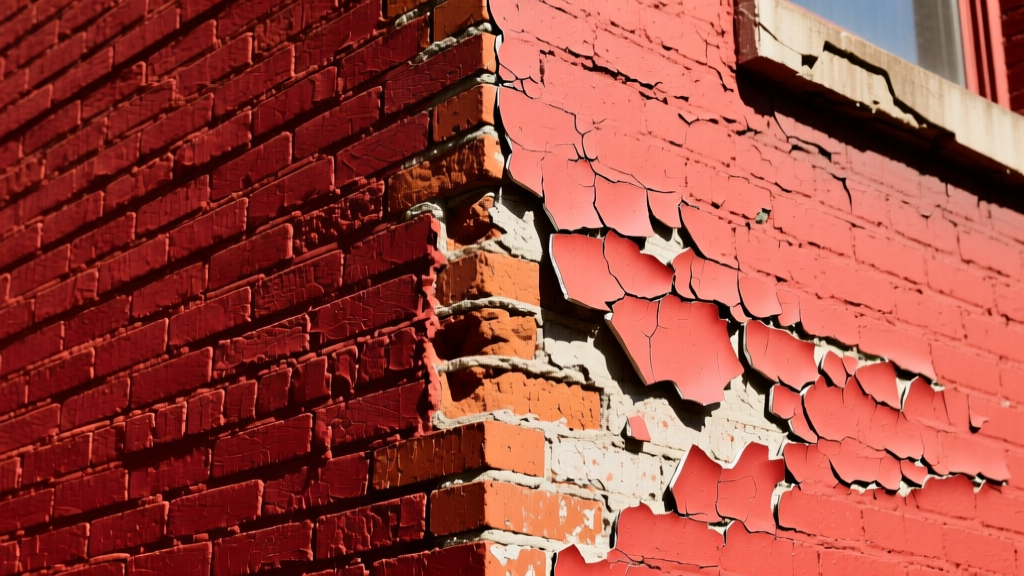
Remediation Protocol: Safely Stripping Failed Masonry Paint
If you are maintaining a property where previous owners applied an incompatible acrylic or elastomeric paint, removal is necessary to restore the masonry's breathability. Due to environmental regulations restricting methylene chloride, modern stripping requires specialized chemical gels and precise pressure washing techniques.
- Chemical Application: Apply a soy-based gel stripper (e.g., Soy Gel Professional) or a benzyl alcohol-based masonry stripper (e.g., Dumond SmartStrip Advanced). These thick gels cling to vertical surfaces and penetrate multiple layers of acrylic without raising the pH to damaging levels.
- Dwell Time and Agitation: Allow the stripper to dwell for 12 to 24 hours, covered with a specialized stripping paper to prevent evaporation. Agitate the softened paint using natural bristle brushes. Never use steel wire brushes, which leave behind iron particles that will rapidly oxidize and cause severe rust staining on the brick face.
- Controlled Rinsing: Rinse the substrate using a pressure washer calibrated to a maximum of 800 PSI, equipped with a 40-degree fan tip. Maintain a consistent 12-inch distance from the wall. Higher pressures will erode the mortar joints and scar the brick face.
- Neutralization: Some chemical strippers require a mild acidic rinse (such as a diluted muriatic acid or specialized masonry neutralizer) to balance the surface pH before any new breathable silicate or stain system is applied.
2026 Cost & Lifecycle Analysis
When budgeting for masonry finishes, initial application costs are misleading. The true cost of ownership must factor in the lifecycle maintenance, surface preparation for reapplication, and the risk of masonry damage.
| Finish Type | Initial Install Cost (per sq ft) | Expected Lifespan | Reapplication Prep Cost | 30-Year Total Cost Estimate (per sq ft) |
|---|---|---|---|---|
| Acrylic Masonry Paint | $1.50 - $3.00 | 5 - 8 Years | $1.00 - $2.00 (scraping/washing) | $8.50 - $18.00 |
| Penetrating Dye Stain | $2.50 - $4.50 | 10 - 15 Years | $0.50 (light washing) | $6.00 - $11.00 |
| Mineral Silicate | $4.00 - $7.00 | 20 - 30 Years | $0.75 (biocidal wash) | $5.50 - $9.50 |
| Paint Stripping (Remediation) | $4.00 - $9.00 | N/A | N/A | N/A (One-time penalty) |
The Masonry Finish Decision Framework
Use the following conditional framework to select the correct coating system for your specific masonry condition and architectural requirements.
- Choose Acrylic Paint ONLY if: You are coating a modern, concrete-masonry-unit (CMU) block wall with a sealed cavity system, or you require a specific high-gloss/sheen finish that mineral systems cannot achieve. Accept the mandatory 5-year maintenance cycle.
- Choose Penetrating Dye Stain if: You are working with historic, soft-fired brick that is highly susceptible to spalling, and you need to darken the masonry while maintaining absolute maximum vapor permeability with zero surface film buildup.
- Choose Mineral Silicate if: You are treating an exterior residential or commercial facade in a climate with severe freeze-thaw cycles, you want to lighten or drastically change the brick color, and you require a 20+ year maintenance-free lifecycle with zero risk of peeling or blistering.
Ultimately, respecting the porous nature of clay brick is the cornerstone of masonry maintenance. By prioritizing vapor permeability over initial material costs, you protect the structural integrity of the wall and eliminate the cyclical, expensive burden of scraping and repainting failed acrylic films.
Written by
Sarah WhitfieldSarah Whitfield is a chartered quantity surveyor (MRICS) and construction cost analyst with 15 years of experience in material pricing, procurement strategy, and project budgeting. She earned her degree in Construction Management from the University of Reading (UK) and has worked on projects ranging from $2M custom homes to $180M mixed-use developments across North America and Europe. Sarah currently leads cost estimating for BuildMat Insight, maintaining a proprietary database of 4,000+ material price points updated quarterly. She is a frequent contributor to RSMeans cost data panels and has presented at the International Cost Engineering Council (ICEC) congress. Based in Denver, CO, Sarah is an avid trail runner and volunteer mentor for Women in Construction.
More from Sarah Whitfield
View all
Wood & Lumber
What Are the Different Types of Wood? A Builder's Guide
Compare structural softwoods, finish hardwoods, and engineered lumber. Analyze Janka ratings, MOE values, and 2026 pricing for construction.
Aug 4, 2026

Walls & Panels
Steel Framing vs Wood Framing: Corrosion and Moisture Defense
Compare steel framing vs wood framing for moisture resistance. Learn about galvanized coatings, condensation risks, and corrosion protection strategies.
Jul 21, 2026

Stone & Masonry
How to Cut Stone Veneer: Wet Saw vs Grinder Comparison
Compare the best tools for cutting stone veneer. We review wet saws, angle grinders, and chop saws to help you achieve clean, chip-free cuts.
Jul 21, 2026