Selecting Face Brick: Portland or Clay Material Guide
Compare Portland cement concrete bricks and traditional clay bricks. Explore ASTM grades, shrinkage, structural limits, and masonry selection criteria.

The Core Distinction: Manufacturing and Composition
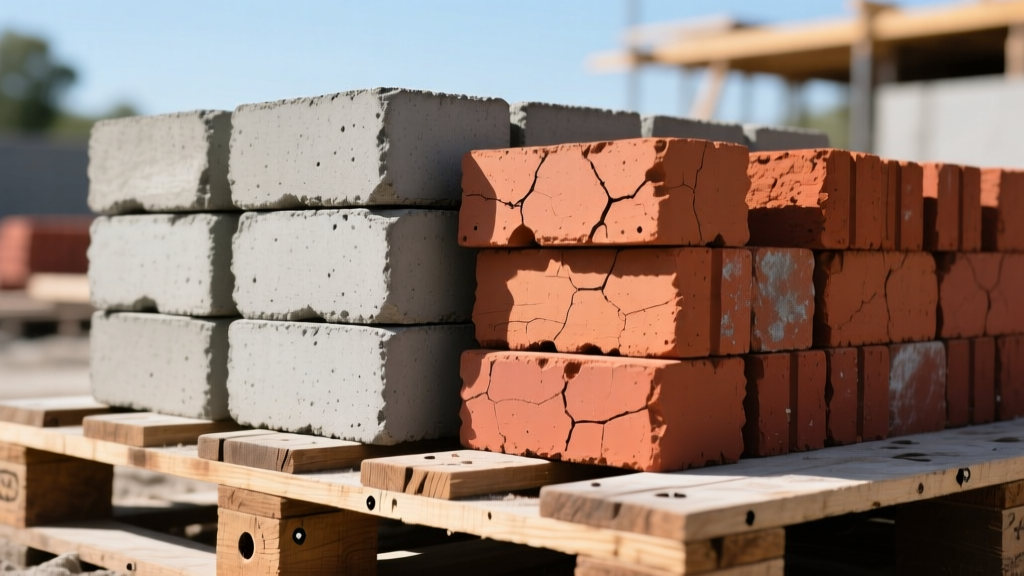
When specifying masonry units for structural or veneer applications, architects and builders face a fundamental material divergence. When evaluating a load-bearing brick, Portland or clay compositions dictate the structural behavior, moisture management, and aesthetic longevity of the wall assembly. Understanding the petrographic and chemical differences between these two unit types is critical for preventing premature facade failure.
Portland Cement Bricks (Concrete Bricks) are manufactured by mixing Portland cement, fine aggregates (sand), coarse aggregates (crushed stone or gravel), and water. The mixture is compacted into steel molds under high vibration and pressure, then cured in kilns or autoclaves using steam. This hydration process forms calcium silicate hydrate (C-S-H) gels, giving the brick its compressive strength without the need for extreme heat.
Traditional Clay Bricks are formed from extruded or molded shale and clay mixtures. They are dried and subsequently fired in kilns at temperatures ranging from 1,800°F to 2,400°F (980°C to 1,315°C). This vitrification process fuses the silica and alumina particles into a dense, ceramic matrix. According to the Brick Industry Association (BIA), this firing process is what grants clay brick its exceptional dimensional stability and near-zero water absorption rates in severe weathering grades.
Expert Insight: The fundamental difference in curing (chemical hydration vs. thermal vitrification) means that concrete bricks will continue to undergo slight chemical changes and moisture-related shrinkage long after installation, whereas clay bricks are dimensionally locked once they leave the kiln.
Performance Matrix: Concrete vs. Clay Masonry Units
Selecting the correct unit requires looking beyond initial cost. The following matrix breaks down the critical engineering properties of both materials based on standard testing protocols.
| Property | Portland Cement Brick (ASTM C55) | Clay Facing Brick (ASTM C216) |
|---|---|---|
| Compressive Strength (Avg) | 3,500 psi to 5,500+ psi | 3,000 psi to 8,000+ psi |
| Dimensional Movement | Shrinks (0.02% to 0.065%) | Expands (0.02% to 0.09%) |
| Water Absorption (Severe Grade) | Max 10 lbs/ft³ (cold water) | Max 12.5% by weight (boiling) |
| Thermal Mass (Density) | ~135 lbs/ft³ | ~120 to 140 lbs/ft³ |
| Embodied Carbon | Moderate (Cement production) | High (Kiln firing energy) |
| Acoustic Insulation (STC) | STC 45-50 (4-inch wythe) | STC 45-53 (4-inch wythe) |
Grade Classifications and ASTM Standards
Neither material is monolithic. Both Portland cement bricks and clay bricks are strictly categorized by ASTM International standards based on their intended exposure and structural demands. Specifying the wrong grade for a specific climate zone is a primary cause of spalling and freeze-thaw degradation.
Portland Cement Brick Grades (ASTM C55)
The National Concrete Masonry Association (NCMA) outlines that concrete bricks are primarily divided by compressive strength and absorption limits:
- Grade N (Normal): Minimum average compressive strength of 3,500 psi. Intended for general use where high strength and resistance to freezing and thawing are not the primary concerns.
- Grade S (Special): Minimum average compressive strength of 4,500 psi, with strict limits on water absorption. Required for structural load-bearing walls and regions with severe freeze-thaw cycling.
Clay Brick Grades (ASTM C62 / C216)
Clay bricks are graded by their durability and resistance to freezing action when saturated with water:
- Grade SW (Severe Weathering): High resistance to freezing and thawing. Mandatory for exterior applications in northern climates and below-grade foundations.
- Grade MW (Moderate Weathering): Used in exterior walls where freezing is unlikely, or as interior backup wythes.
- Grade NW (Negligible Weathering): Strictly for interior masonry or protected veneers where no freezing or moisture exposure will occur.
Moisture Management and Efflorescence Risks
Water migration through masonry assemblies dictates the lifespan of the facade. The two materials handle moisture and soluble salts very differently.
Warning: Concrete Brick Shrinkage Cracking
Because Portland cement bricks undergo irreversible drying shrinkage, long, uninterrupted concrete brick walls are highly susceptible to vertical step-cracking. Unlike clay brick, which requires expansion joints, concrete brick walls require control joints spaced at maximum intervals of 1.5 times the wall height (or typically every 12 to 18 feet) to force cracking to occur at predetermined, sealed locations.
Efflorescence Potential: Efflorescence occurs when water-soluble salts migrate to the brick surface and crystallize upon evaporation. Portland cement bricks inherently contain higher levels of soluble alkalis (calcium hydroxide) generated during the cement hydration process. If exposed to driving rain before a proper masonry sealer or weatherproofing coating is applied, concrete bricks can exhibit heavy white efflorescence. Clay bricks can also effloresce, but high-quality SW-grade clay bricks typically possess lower initial soluble salt content, making them slightly more forgiving during the construction phase.
Cost Analysis and Supply Chain Realities
Budgeting for masonry requires analyzing both unit cost and the logistical overhead of the supply chain.
- Unit Pricing: Standard modular concrete bricks (Portland-based) generally cost 15% to 25% less per thousand units than premium face-grade clay bricks. In 2026 market conditions, expect to pay $450–$600 per thousand for standard concrete face brick, compared to $650–$900+ per thousand for extruded clay face brick.
- Color Consistency: Concrete bricks rely on synthetic iron oxide pigments added to the mix. While highly consistent from batch to batch, the color can fade slightly over decades of UV exposure. Clay bricks derive color from the mineral content and kiln atmosphere, offering permanent, UV-stable color variations and flashes that many architects prefer for high-end residential projects.
- Lead Times: Concrete brick manufacturing is highly localized due to the weight of the aggregates and the lower profit margins per unit. Lead times are typically 2 to 4 weeks. Clay brick kilns are often centralized, requiring cross-country freight, pushing lead times to 8 to 14 weeks for custom runs.
Decision Framework: When to Specify Which
Use the following conditional framework to finalize your material selection for the construction documents phase:
- Specify Portland Cement Brick IF:
- The project requires highly uniform, solid-color masonry with tight dimensional tolerances.
- The budget is constrained, and local concrete masonry plants are within a 100-mile radius to minimize freight costs.
- The design incorporates extensive painted masonry, where the natural color variations of clay are unnecessary.
- Specify Traditional Clay Brick IF:
- The project is located in a severe freeze-thaw climate zone and the facade features complex detailing where shrinkage control joints would ruin the aesthetic.
- The design calls for historic matching, water-struck textures, or natural color flashing that cannot be replicated with concrete pigments.
- The wall assembly is a cavity wall where the clay brick's slight moisture expansion can be managed with standard expansion joints without risking structural cracking.
Ultimately, whether you select a concrete brick or a fired clay unit, success relies on matching the ASTM grade to the local microclimate and detailing the mortar joints and control/expansion joints to accommodate the specific volumetric changes of the chosen material.
Written by
Sarah WhitfieldSarah Whitfield is a chartered quantity surveyor (MRICS) and construction cost analyst with 15 years of experience in material pricing, procurement strategy, and project budgeting. She earned her degree in Construction Management from the University of Reading (UK) and has worked on projects ranging from $2M custom homes to $180M mixed-use developments across North America and Europe. Sarah currently leads cost estimating for BuildMat Insight, maintaining a proprietary database of 4,000+ material price points updated quarterly. She is a frequent contributor to RSMeans cost data panels and has presented at the International Cost Engineering Council (ICEC) congress. Based in Denver, CO, Sarah is an avid trail runner and volunteer mentor for Women in Construction.
More from Sarah Whitfield
View all
Wood & Lumber
What Are the Different Types of Wood? A Builder's Guide
Compare structural softwoods, finish hardwoods, and engineered lumber. Analyze Janka ratings, MOE values, and 2026 pricing for construction.
Aug 4, 2026

Walls & Panels
Steel Framing vs Wood Framing: Corrosion and Moisture Defense
Compare steel framing vs wood framing for moisture resistance. Learn about galvanized coatings, condensation risks, and corrosion protection strategies.
Jul 21, 2026

Stone & Masonry
How to Cut Stone Veneer: Wet Saw vs Grinder Comparison
Compare the best tools for cutting stone veneer. We review wet saws, angle grinders, and chop saws to help you achieve clean, chip-free cuts.
Jul 21, 2026