Choosing an Interior & Exterior Stone Veneer Supplier USA
Discover how to evaluate an interior & exterior stone veneer supplier USA professionals trust. Compare MSV, natural stone, pricing, and ASTM standards.

The 2026 Stone Veneer Market Landscape
Selecting the right interior & exterior stone veneer supplier USA contractors and architects rely on requires navigating a highly fragmented market. In 2026, the industry has shifted heavily toward high-fidelity manufactured stone veneer (MSV) and ultra-lightweight polyurethane panels, driven by stricter seismic building codes on the West Coast and structural load limits in multi-story residential builds. While natural stone remains a premium staple, modern MSV products now replicate the mineralogical variations of natural limestone, ledgestone, and fieldstone with near-perfect accuracy.
When sourcing materials for large-scale commercial facades or custom residential interiors, the supplier you choose dictates not only your material costs but also your project timeline, freight logistics, and long-term warranty coverage. This guide breaks down the material categories, evaluation metrics, and hidden cost structures you must understand before signing a purchase order.
Core Material Categories Supplied
Top-tier US suppliers typically segment their inventory into three distinct material categories, each governed by different manufacturing processes and building codes.
Manufactured Stone Veneer (MSV)
MSV is cast in molds taken from natural stone using a lightweight concrete mix and iron oxide pigments. High-quality suppliers ensure their MSV complies with the ASTM C1670 Standard Specification, which dictates strict tolerances for flexural strength, water absorption, and dimensional consistency. In 2026, premium MSV weighs between 10 to 15 pounds per square foot, making it suitable for standard wood-frame construction without requiring additional structural reinforcement.
Natural Thin Stone Veneer (NSV)
Sawn from natural quarried stone (such as sandstone, slate, or limestone) to a thickness of 1/2-inch to 1-1/4 inches, NSV is prized for its authentic mineral veining and thermal mass. Suppliers specializing in NSV must provide documentation proving the stone meets ASTM C616 (Sandstone) or ASTM C568 (Limestone) specifications. Because natural stone is heavier (often 20 to 35 pounds per square foot), exterior applications frequently require specialized structural ties and heavier gauge metal lath.
Polyurethane Faux Stone Panels
For interior accent walls and rapid exterior retrofits, high-density polyurethane panels have captured significant market share. These interlocking panels weigh less than 2 pounds per square foot and can be screwed directly into OSB or drywall without mortar or lath. Leading suppliers offer panels with integrated UV-inhibitors and Class A fire ratings (ASTM E84), making them ideal for commercial interiors and restaurant build-outs.
Supplier Evaluation Matrix
Not all distributors operate with the same logistical capabilities. Use this matrix to determine which supplier tier aligns with your project scope.
| Supplier Tier | Best For | Lead Times (2026) | Custom Color Matching | Minimum Order |
|---|---|---|---|---|
| National Manufacturer (e.g., Cultured Stone, Eldorado) |
Large commercial builds, nationwide franchises requiring exact color consistency. | 4-8 weeks (Standard) 12+ weeks (Custom) |
Available, but requires high MOQ and long lead times. | 1,500+ sq ft |
| Regional Fabricator (e.g., regional cast stone yards) |
Custom residential, local architects wanting unique regional blends. | 2-4 weeks | Highly flexible; small-batch pigment blending available. | 300-500 sq ft |
| Specialty Importer (Natural thin stone quarries) |
High-end luxury estates, historic restorations requiring authentic geology. | 6-12 weeks (Ocean freight variables) | Not applicable (natural material variation). | 1 full pallet (approx. 400 sq ft) |
Pricing & Freight Logistics (2026 Benchmarks)
When budgeting for stone veneer, novice estimators frequently make a critical error: assuming all materials are priced by the square foot. While flat stones are sold by the square foot, corner pieces and capstones are universally sold by the linear foot. Because corners require complex molding and thicker casting, they often cost 20% to 40% more per linear foot than flat pieces cost per square foot.
Current Material Pricing Ranges
- Manufactured Stone Veneer (MSV): $6.50 - $12.00 per sq. ft. (Corners: $9.00 - $16.00 per lin. ft.)
- Natural Thin Stone Veneer (NSV): $11.00 - $24.00 per sq. ft. (Corners: $15.00 - $30.00 per lin. ft.)
- Polyurethane Faux Panels: $8.50 - $14.50 per sq. ft. (Interlocking corners included or sold per piece)
The Hidden Cost of LTL Freight
Stone is incredibly dense. A standard pallet of MSV covers roughly 250 to 300 square feet but weighs between 2,800 and 3,500 pounds. If your supplier does not have a regional distribution hub within 300 miles of your job site, you will be subject to Less-Than-Truckload (LTL) freight surcharges. In 2026, expect to pay between $180 and $320 per pallet for regional LTL shipping. Always require the supplier to quote delivered pricing with a liftgate service included, as standard semi-trailers cannot unload 3,000-pound pallets without a forklift on-site.
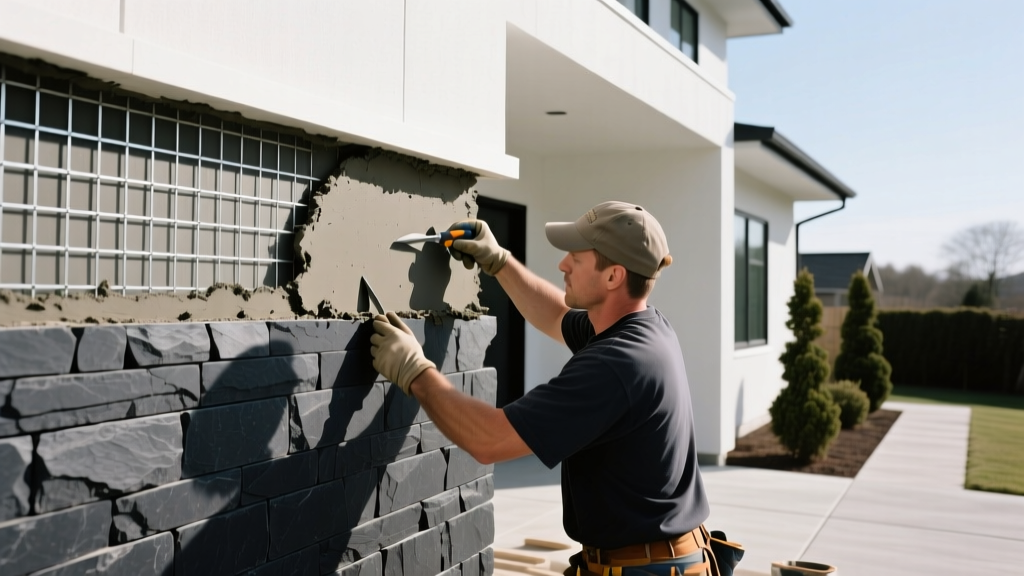
"The biggest point of failure in exterior veneer isn't the stone itself; it's the mortar mix and the lack of a weep screed. Always specify a Type N or Type S mortar that includes a latex bonding admixture, and never let your mason use a high-pressure washer to clean the facade before the mortar has fully carbonated."
— Director of Technical Services, Masonry Veneer Manufacturers Association (MVMA)
Vetting Checklist for US Suppliers
Before issuing a PO to any interior & exterior stone veneer supplier USA based, verify the following technical and compliance documentation. Reputable suppliers will have these readily available in their digital spec libraries.
- ICC-ES Evaluation Reports (ESR): For exterior MSV, the supplier must provide an active ESR report from the ICC Evaluation Service. This proves the product has been independently tested for wind load resistance, structural attachment, and fire separation.
- Freeze-Thaw Durability (ASTM C666): If you are building in USDA Hardiness Zones 6 or colder, the veneer must pass ASTM C666 Procedure A (rapid freezing and thawing in water) with a durability factor of at least 80%.
- Interior VOC & Fire Certifications: For interior applications, request the GREENGUARD Gold certification (for low VOC emissions) and the ASTM E84 Surface Burning Characteristics test report. Class A (Flame Spread Index 0-25) is mandatory for commercial egress corridors.
- Pigment Stability Warranty: Ensure the manufacturer offers a minimum 50-year limited warranty against iron oxide pigment fading, chipping, and spalling. Read the fine print regarding efflorescence, as most suppliers explicitly exclude natural white mineral deposits from their warranties.
Frequently Asked Technical Questions
Can I install stone veneer directly over painted brick or existing stucco?
No. Painted surfaces and smooth stucco do not provide adequate mechanical bonding for mortar. You must mechanically fasten a corrosion-resistant metal lath (meeting ASTM C847) directly into the structural framing through the existing substrate using masonry screws or lag shields, then apply a scratch coat before installing the veneer.
How do I prevent efflorescence on exterior MSV installations?
Efflorescence occurs when water-soluble salts within the concrete or mortar migrate to the surface and crystallize. To prevent this, ensure your supplier provides a low-alkali cement mix. On-site, keep all stone pallets covered and elevated off the dirt before installation, use clean washed sand for your mortar mix, and ensure your roof overhangs and gutters direct water away from the veneer facade.
What is the required clearance between stone veneer and the ground?
Building codes universally mandate a minimum 4-inch clearance between the bottom of the stone veneer and the final grade (soil, mulch, or concrete flatwork) to prevent ground moisture wicking and soil-borne pest intrusion. In areas with heavy snowfall, this clearance should be increased to 6 to 8 inches above the maximum anticipated snow line to prevent freeze-thaw spalling at the base course.
Written by
Sarah WhitfieldSarah Whitfield is a chartered quantity surveyor (MRICS) and construction cost analyst with 15 years of experience in material pricing, procurement strategy, and project budgeting. She earned her degree in Construction Management from the University of Reading (UK) and has worked on projects ranging from $2M custom homes to $180M mixed-use developments across North America and Europe. Sarah currently leads cost estimating for BuildMat Insight, maintaining a proprietary database of 4,000+ material price points updated quarterly. She is a frequent contributor to RSMeans cost data panels and has presented at the International Cost Engineering Council (ICEC) congress. Based in Denver, CO, Sarah is an avid trail runner and volunteer mentor for Women in Construction.
More from Sarah Whitfield
View all
Wood & Lumber
What Are the Different Types of Wood? A Builder's Guide
Compare structural softwoods, finish hardwoods, and engineered lumber. Analyze Janka ratings, MOE values, and 2026 pricing for construction.
Aug 4, 2026

Walls & Panels
Steel Framing vs Wood Framing: Corrosion and Moisture Defense
Compare steel framing vs wood framing for moisture resistance. Learn about galvanized coatings, condensation risks, and corrosion protection strategies.
Jul 21, 2026

Stone & Masonry
How to Cut Stone Veneer: Wet Saw vs Grinder Comparison
Compare the best tools for cutting stone veneer. We review wet saws, angle grinders, and chop saws to help you achieve clean, chip-free cuts.
Jul 21, 2026