Stone Veneer Foundation Cost: 2026 Material & Labor Guide
Discover the true stone veneer foundation cost for 2026. Breakdowns of manufactured vs. natural stone, prep work, labor rates, and hidden expenses.

The Real Cost of Stone Veneer Foundations in 2026
Applying stone veneer to a home's foundation is one of the most effective ways to elevate exterior aesthetics, but it requires specialized preparation that standard wall applications do not. Because foundations are in direct proximity to soil, moisture, and freeze-thaw cycles, the stone veneer foundation cost encompasses much more than just the price of the stone itself. In 2026, homeowners and contractors must budget for advanced waterproofing membranes, specialized weep screeds, and code-compliant grade clearances.
2026 National Average Cost Snapshot
- Total Installed Cost: $22 to $48 per square foot
- Typical Foundation Project Size: 150 - 300 sq. ft. (exposed perimeter)
- Average Total Project Cost: $4,500 to $11,500
- Primary Cost Drivers: Material choice (manufactured vs. natural), substrate prep, and regional masonry labor rates.
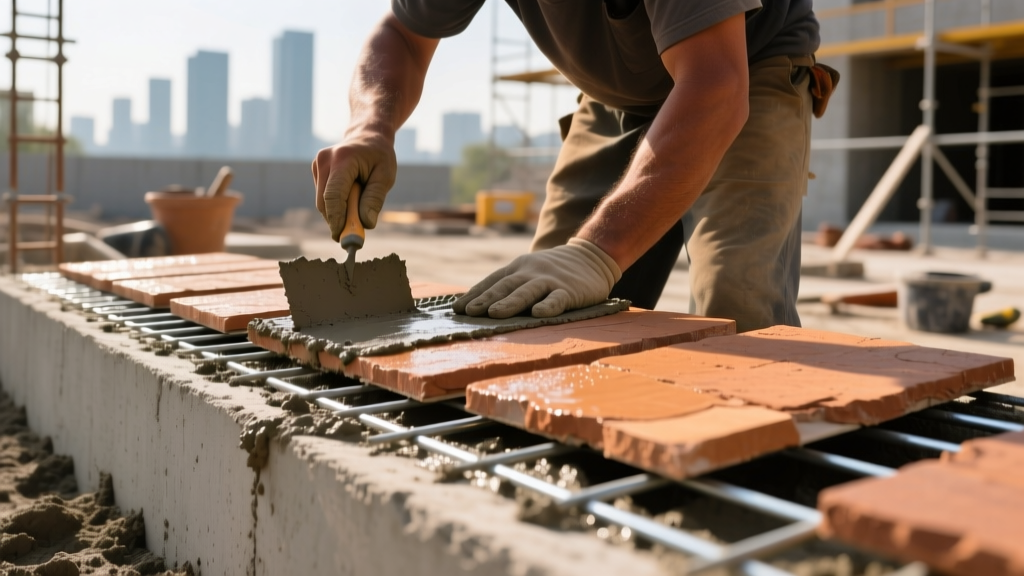
Material Costs: Manufactured vs. Natural Stone
The choice between Manufactured Stone Veneer (MSV) and Natural Stone Veneer (NSV) dictates your baseline material budget. While natural stone offers unmatched authenticity, modern manufactured stone has closed the visual gap significantly while offering structural advantages for foundation applications.
Manufactured Stone Veneer (MSV)
MSV is cast in molds taken from real stone and colored with iron oxide pigments. For foundations, MSV is often preferred because it is lighter (reducing the load on the foundation footing) and more uniform in thickness, which speeds up installation. High-density MSV products, such as those from Cultured Stone or Coronado Stone, are specifically engineered to resist the moisture wicking common at the ground line. Expect to pay between $6.50 and $13.00 per square foot for the material alone.
Natural Stone Veneer (NSV)
Natural stone (such as limestone, slate, or fieldstone) is quarried and sliced to a veneer thickness (typically 0.75 to 1.5 inches). It is heavier, requires a more robust mortar bed, and demands higher skill to install due to irregular shapes. Natural stone costs between $12.00 and $24.00 per square foot. According to industry comparisons detailed by Bob Vila, natural stone retains its color indefinitely and handles physical impacts better, but its porosity requires high-quality penetrating sealers when installed near soil.
| Material Type | Material Cost / Sq. Ft. | Weight / Sq. Ft. | Moisture Resistance |
|---|---|---|---|
| Manufactured (Standard) | $6.50 - $9.00 | 8 - 12 lbs | Good (Requires sealer) |
| Manufactured (High-Density) | $9.00 - $13.00 | 10 - 14 lbs | Excellent |
| Natural Limestone/Sandstone | $12.00 - $18.00 | 13 - 18 lbs | Fair (Highly porous) |
| Natural Slate/Granite | $16.00 - $24.00+ | 15 - 22 lbs | Excellent (Low porosity) |
The Hidden Costs: Prep, Waterproofing, and Substrates
The most common budgeting error in foundation veneer projects is ignoring the drainage plane and substrate preparation. A foundation wall is a below-grade or at-grade structure; applying stone directly to concrete without a drainage matrix guarantees trapped moisture, leading to efflorescence and interior basement leaks.
Budget for these mandatory prep layers:
- Fluid-Applied Waterproofing Membrane ($2.50 - $4.00 / sq. ft.): Products like PROSOCO R-Guard Cat 5 or Henry Blueskin are rolled directly onto the concrete foundation. This acts as the primary barrier against hydrostatic pressure.
- Drainage Matrix / Weep Mat ($1.50 - $2.50 / sq. ft.): A 3D dimpled mat (such as Keene Building Products Driwall) is applied over the waterproofing. This creates an air gap that allows any water penetrating the stone to drain downward.
- Corrosion-Resistant Metal Lath ($1.20 - $2.00 / sq. ft.): Must be ASTM C847 compliant galvanized steel, attached with concrete nails or tapcons. Do not use standard interior lath, as foundation moisture will rust it rapidly.
- Scratch Coat ($1.00 - $1.50 / sq. ft.): A 3/8-inch layer of Type S mortar applied to the lath and scored horizontally to provide a mechanical key for the final stone setting.
When combined, these prep materials add $6.20 to $10.00 per square foot to your stone veneer foundation cost before a single piece of stone is laid.
Labor Rates and Installation Timelines
Masonry labor is highly regional and heavily dependent on the complexity of the foundation layout. Foundations often feature outside corners, utility penetrations (hose bibbs, gas lines), and window wells that require meticulous cutting and fitting.
"Foundation stone installation takes roughly 30% longer than above-grade wall installations due to the required waterproofing steps, the physical strain of working at ground level, and the precision needed to maintain the code-mandated grade clearance."
— 2026 Masonry Contractors Association Labor Report
Labor Cost Breakdown
- Southern & Midwestern US: $12.00 - $18.00 per sq. ft.
- Northeast & West Coast: $18.00 - $28.00 per sq. ft.
- Minimum Call-Out Fees: Most professional masons will not mobilize for a foundation project under $3,500 in labor, even if the square footage is small, due to the setup time for mixing mortar and staging materials.
A typical 200 sq. ft. foundation perimeter will take a two-person masonry crew 3 to 5 days to complete, including the 24-hour curing time required between the scratch coat and the stone application.
Common Foundation Veneer Failures (And How to Avoid Them)
Understanding why foundation stone fails is crucial for protecting your investment. The proximity to the ground introduces unique stressors that standard wall veneers do not face.
1. Capillary Wicking and Efflorescence
The Problem: If the stone or mortar touches the soil, water wicks upward through the masonry. As the water evaporates, it leaves behind white, powdery salt deposits (efflorescence) that ruin the aesthetic and degrade the mortar.
The Fix: Install a Mortar Net WeepVent or similar weep screed at the very bottom of the assembly, exactly 4 inches above grade. Use a high-quality silane/siloxane penetrating sealer on the bottom 12 inches of the stone installation to repel ground splash-back.
2. Freeze-Thaw Spalling
The Problem: In northern climates, water absorbed by porous natural stone (like sandstone) freezes and expands, causing the face of the stone to pop off (spall).
The Fix: Avoid high-porosity natural stones for foundations in USDA Hardiness Zones 5 and below. Opt for high-density manufactured stone or low-porosity natural stones like slate. Furthermore, ensure your mason uses Type S Mortar (ASTM C270), which has higher tensile strength and flexibility than Type N, allowing it to absorb minor freeze-thaw movements without cracking.
3. Soil Settlement Cracking
The Problem: The backfilled soil around a foundation settles over the first 5-10 years. If the stone veneer is carried too far down into the soft topsoil, this settlement will pull the stone downward, cracking the mortar joints.
The Fix: The stone assembly must terminate at the weep screed, which must be anchored directly to the structural concrete foundation wall, not to the surrounding dirt or landscaping timbers.
FAQ: Stone Veneer Foundation Cost
Can I install stone veneer directly over cinder block or poured concrete?
Technically, mortar will bond to clean, unpainted concrete. However, doing so without a drainage plane and metal lath violates modern building science principles and most local codes. Direct application traps moisture against the foundation, leading to interior mold and structural degradation. Always use the full waterproofing and lath assembly detailed in guides by Family Handyman and industry experts.
Does stone veneer add structural value to the foundation?
No. Stone veneer is purely a decorative cladding. It adds zero load-bearing capacity to your foundation. In fact, the added weight (up to 15 lbs per sq. ft.) must be supported by the foundation's concrete footing. If your home is older and the footing is narrow or degraded, consult a structural engineer before adding heavy natural stone.
How do I calculate the square footage for my foundation?
Measure the linear perimeter of the house where the foundation is exposed above grade. Multiply the total linear feet by the average exposed height (in feet). For example, 120 linear feet of exposed foundation at an average height of 1.5 feet equals 180 square feet. Add 10% to this total to account for waste, cuts, and corner pieces.
Is manufactured stone cheaper than natural stone once labor is factored in?
Yes. While the material cost difference is obvious, manufactured stone also reduces labor costs by 15% to 20%. MSV features uniform thicknesses and interlocking edges, allowing masons to lay it significantly faster than natural stone, which requires constant chipping, shaping, and dry-fitting to achieve a level plane.
Written by
Sarah WhitfieldSarah Whitfield is a chartered quantity surveyor (MRICS) and construction cost analyst with 15 years of experience in material pricing, procurement strategy, and project budgeting. She earned her degree in Construction Management from the University of Reading (UK) and has worked on projects ranging from $2M custom homes to $180M mixed-use developments across North America and Europe. Sarah currently leads cost estimating for BuildMat Insight, maintaining a proprietary database of 4,000+ material price points updated quarterly. She is a frequent contributor to RSMeans cost data panels and has presented at the International Cost Engineering Council (ICEC) congress. Based in Denver, CO, Sarah is an avid trail runner and volunteer mentor for Women in Construction.
More from Sarah Whitfield
View all
Wood & Lumber
What Are the Different Types of Wood? A Builder's Guide
Compare structural softwoods, finish hardwoods, and engineered lumber. Analyze Janka ratings, MOE values, and 2026 pricing for construction.
Aug 4, 2026

Walls & Panels
Steel Framing vs Wood Framing: Corrosion and Moisture Defense
Compare steel framing vs wood framing for moisture resistance. Learn about galvanized coatings, condensation risks, and corrosion protection strategies.
Jul 21, 2026

Stone & Masonry
How to Cut Stone Veneer: Wet Saw vs Grinder Comparison
Compare the best tools for cutting stone veneer. We review wet saws, angle grinders, and chop saws to help you achieve clean, chip-free cuts.
Jul 21, 2026