Decorative Stone Veneer Cost Guide 2026: Prices & ROI
Analyze 2026 decorative stone veneer costs, including material prices per square foot, installation labor, and hidden expenses for projects.

The True Cost of Decorative Stone Veneer in 2026
When budgeting for exterior or interior cladding, decorative stone veneer offers the aesthetic weight of full-bed masonry at a fraction of the structural and financial cost. However, pricing fluctuates based on material composition, regional labor rates, and the stringent preparation required for moisture management. In 2026, the national average for a professionally installed decorative stone veneer project ranges from $16.50 to $34.00 per square foot, encompassing both materials and labor.
2026 Quick Cost Snapshot
- Manufactured Stone Veneer (MSV): $14.00 – $24.00 per sq. ft. (installed)
- Natural Thin Stone Veneer: $22.00 – $38.00 per sq. ft. (installed)
- Interior Fireplace Surround (50 sq. ft.): $900 – $1,800 total
- Full Exterior Facade (1,500 sq. ft.): $24,000 – $45,000 total
Material Cost Matrix: Manufactured vs. Natural Veneer
The term "decorative stone veneer" encompasses both architectural manufactured stone (cast from Portland cement and lightweight aggregates) and natural stone sliced to a 1-inch thickness. The choice between the two dictates not only the material budget but also the structural preparation required.
| Material Type | Prominent Brands / Sources | Material Cost (Per Sq. Ft.) | Weight (Per Sq. Ft.) | Best Application |
|---|---|---|---|---|
| Standard Manufactured Veneer | Cultured Stone, Eldorado Stone | $6.50 – $9.50 | 10 – 12 lbs | Large exterior facades, interior accent walls |
| Premium / Hand-Tooled MSV | Coronado Stone, Dutch Quality | $9.50 – $13.00 | 12 – 15 lbs | High-end custom homes, detailed wainscoting |
| Natural Thin Veneer (Sedimentary) | Regional quarries (Limestone, Sandstone) | $11.00 – $16.00 | 13 – 15 lbs | Historical restorations, rustic exteriors |
| Natural Thin Veneer (Igneous) | Regional quarries (Granite, Quartzite) | $15.00 – $22.00 | 15 – 18 lbs | Modern architectural features, high-impact zones |
| Polyurethane Faux Stone Panels | GenStone, NextStone | $4.00 – $7.00 | 1 – 2 lbs | DIY interior projects, non-masonry substrates |
Labor and Installation Expenses
Material costs represent only 40% to 50% of the total project budget. The remainder is absorbed by specialized masonry labor and substrate preparation. According to industry data tracked by Masonry Magazine, skilled masons charge between $85 and $130 per hour in 2026, translating to a labor rate of $8.00 to $15.00 per square foot for veneer installation.
The Non-Negotiable Preparation Phase
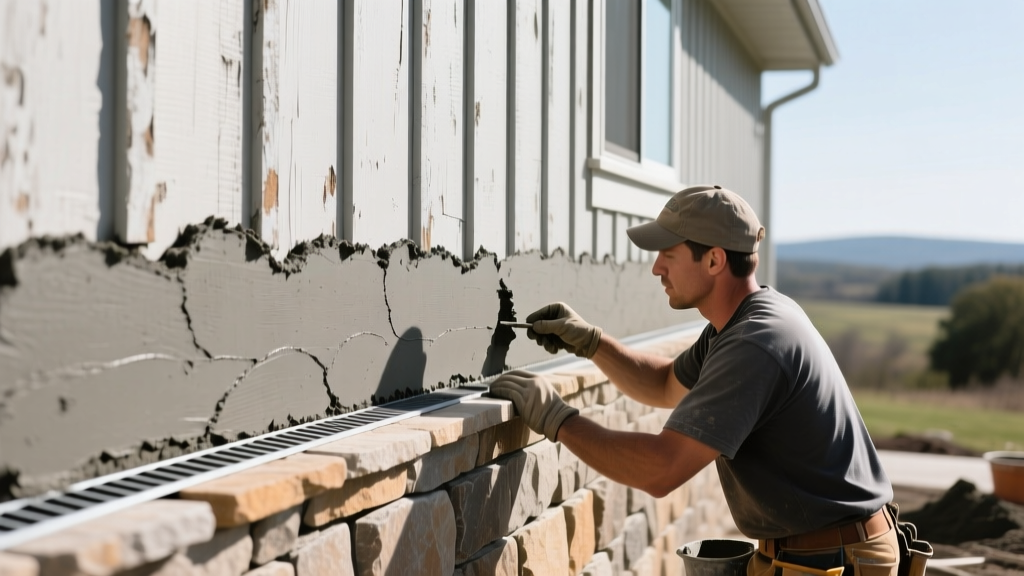
Exterior decorative stone veneer cannot be adhered directly to wood framing or standard drywall. Proper installation requires adherence to ASTM C1063 standards for lath and plaster. The preparation phase adds $3.50 to $6.00 per square foot and includes:
- Weather-Resistive Barrier (WRB): Two layers of Grade D building paper or a high-performance fluid-applied membrane over the structural sheathing.
- Corrosion-Resistant Lath: 2.5 lb self-furring galvanized steel lath (meeting ASTM A641) fastened directly into the wall studs, not just the sheathing, using 1.5-inch corrosion-resistant roofing nails.
- Weep Screed Installation: A code-mandated PVC or galvanized weep screed placed at the base of the wall, minimum 4 inches above grade or 2 inches above paved surfaces, to allow trapped moisture to escape.
- Scratch Coat: A 3/8-inch to 1/2-inch base coat of Type S mortar, scored horizontally to provide a mechanical key for the veneer mortar.
Hidden Costs That Blow Up Veneer Budgets
Contractors frequently underbid decorative stone veneer projects by omitting critical ancillary expenses. When auditing your estimates, ensure the following line items are explicitly addressed:
⚠️ Warning: Common Budget Traps
- Scaffolding and Boom Lifts: For second-story facade applications, scaffolding erection and rental add $1,200 to $3,500 to the project total. Boom lifts for hard-to-reach gables cost $300 to $500 per day.
- Mortar Color Matching and Integral Pigments: Standard gray mortar is included in base quotes. Custom integral pigments (like Solomon Colors or Davis Colors) to match the stone's undertones add $0.75 to $1.25 per square foot.
- Corner Pieces: Outside corners require specialized L-shaped veneer pieces to maintain the illusion of full-depth stone. Corners are priced by the linear foot ($12 to $28 per LF), not the square foot, and are often miscalculated in initial takeoffs.
- Efflorescence Remediation: If the mason fails to use a low-efflorescence veneer mortar or omits the weep screed, white salt deposits will bloom on the stone. Professional chemical cleaning and sealing to rectify this failure costs $3.00 to $5.00 per square foot post-installation.
Interior vs. Exterior: How Application Changes the Price
Applying decorative stone veneer to an interior fireplace or basement wall fundamentally alters the cost structure by eliminating the need for weatherproofing and structural drainage.
- Substrate Simplification: Interior applications over existing brick, concrete block, or properly prepared cement board do not require steel lath or a scratch coat. The veneer can be adhered directly using a polymer-modified thin-set mortar, saving $4.00 to $6.00 per square foot in labor and materials.
- Mortar Transition: Exterior projects require a breathable, Type N or specialized veneer mortar to accommodate thermal expansion and moisture vapor transmission. Interior projects can utilize high-strength, non-sag epoxy or acrylic-modified mastics, which speed up installation time by 20% but cost slightly more per bag.
- Sealing Requirements: Exterior stone in freeze-thaw climates requires a penetrating silane/siloxane sealer ($1.50 per sq. ft.) to prevent water ingress and spalling. Interior stone in living areas rarely requires sealing unless installed in a high-splash zone like a kitchen backsplash.
ROI and Home Value Impact
Decorative stone veneer is not merely an aesthetic upgrade; it is a high-yield capital improvement. According to the annual Cost vs. Value Report published by Remodeling Magazine, manufactured stone veneer consistently ranks among the top exterior projects for return on investment. In recent market analyses, replacing a section of vinyl siding with decorative stone veneer wainscoting recouped an average of 92% to 95% of the project cost at resale.
The ROI is driven by the immediate boost in curb appeal and the perceived durability of masonry. However, this high return is contingent on professional installation. DIY veneer applications with visible mortar smears, repetitive stone patterns, or missing corner returns can actually detract from the home's appraisal value by signaling deferred or substandard maintenance.
Strategic Buying Framework: When to Choose Which Veneer
Selecting the right decorative stone veneer requires balancing structural constraints, budget, and design intent. Use this decision framework to finalize your material specification:
Scenario A: The Budget-Conscious Exterior Facelift
Recommendation: Standard Manufactured Stone Veneer (e.g., Eldorado Stone's Heritage series).
Rationale: At $16.00 to $22.00 per square foot installed, MSV provides the most realistic depth and shadowing without the premium price tag of natural stone. It requires no additional structural footing reinforcement, as the 12 lb/sq. ft. weight is easily supported by standard wood framing and lath.
Scenario B: High-End Custom Build with Strict HOA Guidelines
Recommendation: Natural Thin Stone Veneer (e.g., regional fieldstone or limestone).
Rationale: Many upscale Homeowner Associations mandate natural materials. Natural thin veneer satisfies this requirement while avoiding the $40+ per square foot cost and massive structural footings required for full-bed (4-inch thick) natural stone. Budget $28.00 to $38.00 per square foot installed, factoring in higher waste rates (up to 15%) due to the irregular shapes of natural cleft stone.
Scenario C: Interior DIY Fireplace Makeover
Recommendation: Interlocking Polyurethane Faux Stone Panels.
Rationale: If you are bypassing professional masons, traditional cementitious veneer is highly prone to DIY failure due to improper mortar mixing and lath fastening. High-density polyurethane panels (like GenStone) weigh less than 2 lbs per square foot, cut with a standard wood saw, and attach directly to drywall or plywood using construction adhesive and screws. Total DIY cost: $6.00 to $9.00 per square foot.
For comprehensive guidelines on substrate preparation and moisture management in masonry veneer systems, always consult the Whole Building Design Guide (WBDG) maintained by the National Institute of Building Sciences to ensure your project meets local building codes and long-term durability standards.
Written by
Sarah WhitfieldSarah Whitfield is a chartered quantity surveyor (MRICS) and construction cost analyst with 15 years of experience in material pricing, procurement strategy, and project budgeting. She earned her degree in Construction Management from the University of Reading (UK) and has worked on projects ranging from $2M custom homes to $180M mixed-use developments across North America and Europe. Sarah currently leads cost estimating for BuildMat Insight, maintaining a proprietary database of 4,000+ material price points updated quarterly. She is a frequent contributor to RSMeans cost data panels and has presented at the International Cost Engineering Council (ICEC) congress. Based in Denver, CO, Sarah is an avid trail runner and volunteer mentor for Women in Construction.
More from Sarah Whitfield
View all
Wood & Lumber
What Are the Different Types of Wood? A Builder's Guide
Compare structural softwoods, finish hardwoods, and engineered lumber. Analyze Janka ratings, MOE values, and 2026 pricing for construction.
Aug 4, 2026

Walls & Panels
Steel Framing vs Wood Framing: Corrosion and Moisture Defense
Compare steel framing vs wood framing for moisture resistance. Learn about galvanized coatings, condensation risks, and corrosion protection strategies.
Jul 21, 2026

Stone & Masonry
How to Cut Stone Veneer: Wet Saw vs Grinder Comparison
Compare the best tools for cutting stone veneer. We review wet saws, angle grinders, and chop saws to help you achieve clean, chip-free cuts.
Jul 21, 2026