Slate Roofing Materials: 2026 Buyer's Selection Guide
Compare slate roofing materials, grades, and origins. This 2026 buyer's guide covers ASTM standards, structural loads, and exact installation costs.

The Structural Reality: Weight and Framing Requirements
Before evaluating aesthetics or geological origins, buyers must address the primary limiting factor of slate roofing materials: structural load. Natural slate weighs between 800 and 1,500 pounds per square (100 square feet), depending on the thickness and stone density. By comparison, standard architectural asphalt shingles weigh roughly 250 pounds per square.
Furthermore, the roof deck must be solid. Slate requires a continuous deck, typically 1-inch thick rough-sawn lumber or minimum 5/8-inch CDX plywood. Spaced sheathing (skip sheathing) is historically accurate for wood shakes but is entirely unacceptable for modern slate installations due to wind-uplift vulnerabilities and underlayment support requirements.
Decoding ASTM C406: The Only Slate Grade That Matters
The natural stone roofing industry is regulated by the ASTM International standard C406. This standard evaluates slate based on modulus of rupture (breaking strength), water absorption, and weather resistance. When sourcing slate roofing materials, you must specify the grade explicitly in your contract. Accept nothing less than S1 for a primary residence.
| Grade | Expected Lifespan | Water Absorption Limit | Best Application |
|---|---|---|---|
| S1 | 75 to 150+ years | Maximum 0.25% | Primary residences, historic restorations, commercial |
| S2 | 40 to 75 years | Maximum 0.45% | Secondary structures, budget-constrained historical matching |
| S3 | 20 to 40 years | Maximum 0.60% | Temporary structures, decorative interior veneers only |
Water absorption is the critical metric. Slate with higher absorption allows moisture to penetrate the stone's micro-fissures. In freeze-thaw climates, this trapped water expands, causing the slate to delaminate, spall, and eventually crumble. Always request the supplier's ASTM C406 test certificates before releasing payment.
Geological Origins: North American vs. Imported Slate
The mineral composition of the quarry dictates the long-term performance of the stone. According to the National Slate Association, the geological origin is the strongest indicator of whether a slate will remain colorfast or degrade prematurely.
North American Slate (Vermont, New York, Virginia)
Quarries in the Taconic and Appalachian mountain ranges produce slate primarily composed of chlorite and illite. These minerals are highly stable. 'Unfading' Vermont slate, for example, retains its original color indefinitely because it lacks reactive iron sulfides. 'Weathering' slate from these same regions contains small amounts of iron sulfide that oxidize over time, shifting the stone's color to warm browns and buffs, but without compromising the structural integrity of the tile.
Imported Slate (China, India, Spain)
Imported slate roofing materials are often marketed at a 30% to 50% discount compared to North American stone. However, buyers must exercise extreme caution. Many overseas quarries extract slate with high concentrations of calcium carbonate (calcite) and reactive iron pyrite.
- The Pyrite Problem: Reactive iron sulfide causes severe rust bleeding, staining the roof and eventually rusting entirely through the tile, creating holes.
- The Calcite Problem: Calcium carbonate reacts with acid rain, causing the slate to dissolve, soften, and lose its structural cohesion over a 15-to-20-year period.
2026 Cost Breakdown: Material, Labor, and Ancillaries
Budgeting for slate requires looking beyond the per-square-foot cost of the stone itself. The National Roofing Contractors Association (NRCA) emphasizes that specialized labor and premium flashings constitute the majority of the total investment. Below is a realistic 2026 cost matrix for a standard 2,500 sq. ft. roof (25 squares).
| Project Component | Cost Per Square (100 sq ft) | Total Cost (25 Squares) |
|---|---|---|
| Tear-off & Disposal (Existing Roof) | $150 - $250 | $3,750 - $6,250 |
| Decking Repair / Reinforcement | $100 - $300 | $2,500 - $7,500 |
| High-Temp Synthetic Underlayment | $80 - $120 | $2,000 - $3,000 |
| S1 Grade Slate Material | $1,200 - $2,200 | $30,000 - $55,000 |
| Copper Flashing & Valley Metal | $300 - $500 | $7,500 - $12,500 |
| Specialized Slate Labor | $1,500 - $2,500 | $37,500 - $62,500 |
| Estimated Total Project Cost | $3,330 - $5,870 | $83,250 - $146,750 |
Critical Installation Specifications: Fasteners and Flashings
A slate roof will easily outlast its fasteners and flashings if inferior materials are used. The stone may be rated for 100 years, but a roof failure at year 25 is almost always due to metal degradation.
Fastener Requirements
Every slate tile must be secured with exactly two nails. The nails must be solid copper or hot-dipped galvanized steel, minimum 11-gauge, with a 3/8-inch head. The nail length must penetrate the roof decking by a minimum of 3/4 inch. Aluminum or electroplated nails are strictly prohibited; they will corrode and snap under wind loads within two decades. When driving the nail, the roofer must leave a 1/32-inch gap between the nail head and the slate surface. Overdriving the nail creates a stress fracture that will cause the tile to slide off the roof.
Flashing and Valley Metals
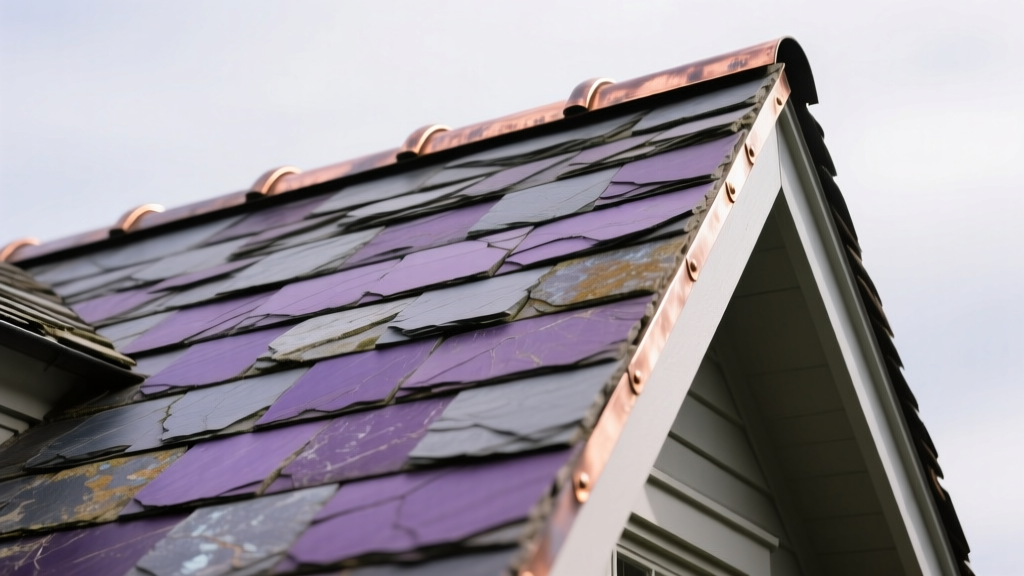
Because slate cannot be bent or formed around intersections, all valleys, chimneys, and dormers require custom-fabricated metal flashing. Use minimum 16-ounce cold-rolled copper or 20-ounce lead-coated copper. Avoid aluminum flashing entirely, as the alkaline runoff from certain masonry chimneys and the natural acidity of rain will rapidly pit and destroy aluminum. For open valleys, the copper pan should be a minimum of 18 inches wide, increasing to 24 inches on lower-pitch roofs to handle high-volume water runoff.
Underlayment Selection
Traditional #30 organic asphalt felt has been the standard for a century, but it is prone to tearing during the prolonged installation process of slate. Modern high-temperature synthetic underlayments (rated for continuous exposure up to 240°F) are now the preferred choice for premium installations. These woven synthetics provide superior slip resistance for the installers and will not degrade under the intense heat trapped beneath the dense slate canopy.
Buyer's Decision Framework
Use this matrix to determine if natural slate is the correct specification for your project, or if an alternative is required:
- Is the roof pitch 4:12 or greater? Slate requires a minimum 4:12 pitch for standard headlap (3 inches). If your pitch is lower, you must increase the headlap to 4 inches and apply a waterproofing membrane under every course, which increases material usage by 30%. If the pitch is below 3:12, abandon slate and use standing seam metal.
- Does the project budget exceed $35 per square foot fully installed? If your hard cap is below this threshold, natural S1 slate is financially unfeasible. Consider high-end synthetic slate (like polymer or rubber composites) which mimics the aesthetic at 40% of the structural and material cost.
- Is the building historically registered or in a strict architectural review district? If yes, synthetic alternatives will likely be rejected. You must specify North American S1 slate and provide the quarry origin certificates to the review board prior to permitting.
Selecting slate roofing materials is an exercise in geological and structural due diligence. By enforcing ASTM C406 grading, conducting field tests on imported stone, and mandating copper fasteners, buyers secure a roofing system that functions as a permanent, multi-generational asset rather than a recurring maintenance liability.
Written by
Elena RodriguezElena Rodriguez is a civil engineer and technical writer specializing in concrete technology, masonry systems, and ASTM/ACI compliance. She earned her B.S. in Civil Engineering from Texas A&M University and spent a decade at a materials testing laboratory, performing over 2,000 concrete compressive strength tests and masonry prism evaluations. Elena is an ACI-certified Field Testing Technician (Grade I) and a member of ASTM Committee C12 on Natural Building Stone. She currently consults on forensic engineering cases involving concrete failures and moisture intrusion. Based in San Antonio, TX, Elena is a proud member of the Society of Women Engineers (SWE) and coaches her daughter's FIRST Robotics team.
More from Elena Rodriguez
View all
Walls & Panels
Cost Analysis: Light Gauge Steel Framing Advantages and Disadvantages
Evaluate light gauge steel framing advantages and disadvantages through a strict cost analysis lens, comparing material, labor, and lifecycle expenses.
Aug 4, 2026

Walls & Panels
Gypsum Board Types: Exact Specifications, Thickness & Dimensions
Compare standard, Type X, and moisture-resistant gypsum board types. Get exact specifications, thicknesses, dimensions, and ASTM standards for your project.
Aug 4, 2026

Fire Resistance
Best Fire-Resistant Outdoor Decking Materials: 2026 Buyer Guide
Discover the best fire-resistant outdoor decking materials for 2026. Compare Class A PVC, aluminum, and hardwood options for WUI compliance and safety.
Aug 4, 2026