Dry Stack Stone Veneer Buyer's Guide: Top Picks 2026
Compare natural, manufactured, and polyurethane dry stack stone veneer. Expert 2026 buyer's guide covering costs, top brands, and installation specs.

The Profile vs. Installation Misconception
The most critical error buyers make when selecting dry stack stone veneer is confusing the visual profile with the installation method. In the masonry industry, 'dry stack' primarily refers to a visual aesthetic where stones are stacked tightly together without visible mortar joints, creating a clean, modern, and linear shadow line. However, 90% of the products marketed as 'dry stack stone' (including premium manufactured concrete and natural stone) still require a traditional mortared installation. The mason simply applies Type S or Type N mortar to the back of the stone and presses it against the substrate, wiping away any squeeze-out to maintain the illusion of a dry-stacked wall.
True mortarless dry stack systems are almost exclusively limited to high-density polyurethane (HDPU) panels or specialized modular interlocking concrete systems. Understanding this distinction is vital for budgeting, structural load calculations, and substrate preparation. If you are planning a DIY installation on a weekend, a mortared concrete dry stack profile will require mixing mortar, installing metal lath, and executing a scratch coat. If you need a lightweight, mortarless solution, you must pivot to HDPU panels.
Material Matrix: Natural vs. Manufactured vs. Polyurethane
Selecting the right material depends on your structural constraints, budget, and authenticity requirements. Below is a comparative analysis of the three primary dry stack material categories available in the 2026 market.
| Material Type | Avg. Weight | Material Cost (per sq. ft.) | Installation Method | Authenticity & ROI |
|---|---|---|---|---|
| Natural Stone (Quartzite/Slate) | 8 - 14 lbs | $14.00 - $24.00 | Mortared (Requires structural footing) | Highest (100% authentic, premium ROI) |
| Manufactured Concrete Veneer | 4 - 6 lbs | $8.00 - $12.00 | Mortared (Lath and scratch coat required) | High (Excellent visual replication) |
| High-Density Polyurethane (HDPU) | 0.8 - 1.2 lbs | $6.00 - $9.50 | Mortarless (Direct-to-stud adhesive/screws) | Moderate (Visible seams upon close inspection) |
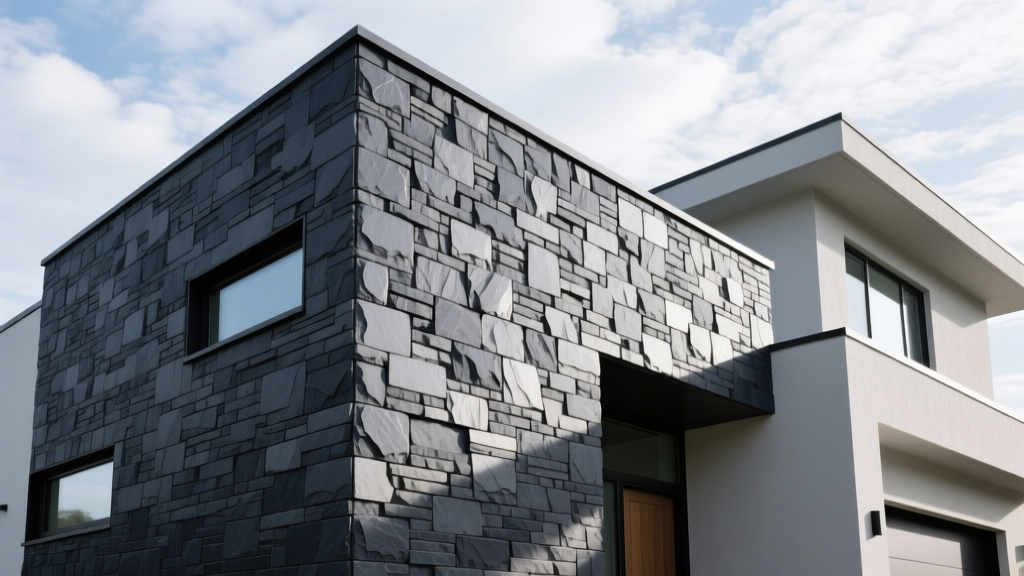
Top Dry Stack Profiles & Panel Systems
Eldorado Stone: Dry Stack Profile (Manufactured)
Eldorado Stone’s 'Dry Stack' profile remains the benchmark for manufactured concrete veneers. Cast from real stone molds, the panels feature varying thicknesses (0.5 to 1.5 inches) to create deep, natural shadow lines. It requires a standard masonry installation over a weather-resistant barrier (WRB) and metal lath. While it is a mortared system, the interlocking edges are designed to hide the mortar joint completely when installed by a certified mason.
Environmental StoneWorks: Pro-Fit Modular System
For contractors looking to reduce labor time on large commercial or residential facades, Environmental StoneWorks offers modular, interlocking dry stack ledgestone panels. These manufactured concrete panels are pre-assembled in 6x24-inch sections. Because they interlock horizontally and vertically, they drastically reduce layout time and ensure consistent joint spacing, though they still require a traditional mortar bed for adhesion to the wall.
GenStone: Dry Stack HDPU Panels
If your project demands a true mortarless installation, GenStone’s high-density polyurethane panels are the leading choice. Weighing roughly 1 lb per square foot, these panels screw directly into OSB, plywood, or existing siding using 2.5-inch exterior-grade structural screws with neoprene washers. The panels feature a shiplap edge design that hides fasteners and creates a continuous dry stack illusion without the need for masonry tools or wet trades.
When installing HDPU panels directly over existing siding or plywood, you must ensure a proper drainage plane is present. According to the U.S. Department of Energy, skipping a water-resistant barrier (WRB) behind exterior cladding can trap moisture against the sheathing, leading to catastrophic wood rot. If installing over bare studs, apply a house wrap (like Tyvek) and tape all seams before attaching the polyurethane panels.
Substrate Preparation & Hidden Costs
Buyers frequently underestimate the 'hidden' costs of substrate preparation. The material cost per square foot is only half the equation. Here is what you must budget for based on your chosen material:
- Manufactured/Natural Stone Prep: Requires 15 lb roofing felt or a synthetic WRB, 2.5 lb galvanized diamond mesh metal lath, and a 0.5-inch Portland cement scratch coat. Add approximately $2.50 to $3.50 per square foot for these prep materials.
- HDPU Panel Prep: Requires a flat, structurally sound surface. If installing over uneven brick or block, you may need to fur out the wall with 1x3 pressure-treated wood strapping to ensure the panels sit flush. Add $1.20 per square foot for strapping and fasteners.
- Corner Pieces: Dry stack profiles require specialized 90-degree corner pieces to maintain the illusion of solid stone. Corners are typically sold by the linear foot, not the square foot, and cost 30% to 50% more per linear foot than flat pieces cost per square foot.
Code Compliance and ASTM Standards
When specifying dry stack veneer for commercial projects or multi-family dwellings, building inspectors will require documentation of material testing. For manufactured stone veneer (MSV), the governing standard is ASTM C1670, which dictates water absorption, freeze-thaw durability, and flexural strength. According to technical data published by Eldorado Stone, premium MSV products must pass ASTM C666 freeze-thaw cycling without degradation to be approved for exterior use in northern climate zones.
For natural stone veneers, the Natural Stone Institute recommends verifying that the stone meets ASTM C503 (for marble) or ASTM C568 (for limestone) and ensuring the anchoring system complies with local seismic codes. In high-wind or seismic regions, natural dry stack stone may require hidden mechanical pinning in addition to mortar adhesion to prevent delamination during structural shifting.
Real-World Cost Breakdown (Per 100 Sq. Ft. Accent Wall)
To provide actionable budgeting data, here is a fully loaded cost estimate for a 100-square-foot exterior accent wall in 2026, including materials, prep, and professional labor.
| Cost Category | Manufactured Concrete (Eldorado) | Natural Quartzite | HDPU Panels (GenStone) |
|---|---|---|---|
| Material (Flats & Corners) | $950.00 | $1,800.00 | $750.00 |
| Substrate Prep (WRB, Lath, Mortar) | $300.00 | $350.00 | $85.00 |
| Professional Labor | $1,200.00 | $2,500.00 | $400.00 |
| Total Estimated Cost | $2,450.00 | $4,650.00 | $1,235.00 |
Buyer's Decision Framework
Use this diagnostic framework to finalize your dry stack stone veneer selection based on your specific project constraints:
- Choose Natural Stone IF: You are building a custom luxury home, require a 100% unique facade with no repeating patterns, and have the budget for structural footings and premium masonry labor.
- Choose Manufactured Concrete IF: You want the authentic shadow lines and weight of real stone but need to reduce material costs by 40% and lower the structural load requirements on your wall ties.
- Choose HDPU Panels IF: You are executing a DIY renovation, retrofitting over existing siding without tearing it down, or working on an interior feature wall where weight restrictions and dust mitigation (from mixing mortar) are primary concerns.
When installing manufactured dry stack profiles, always use a mortar color that exactly matches the darkest shade in the stone veneer. If squeeze-out occurs and is not immediately wiped away, a matching mortar color will render the mistake invisible, preserving the 'dry stack' illusion. Never use standard white or light gray mortar for dry stack profiles, as any residue will instantly ruin the seamless aesthetic.
Written by
Marcus ChenMarcus Chen is a licensed structural engineer (PE) and building materials analyst with over 12 years of experience across residential, commercial, and industrial construction. He holds a Master of Science in Civil Engineering from UC Berkeley and spent six years at Thornton Tomasetti before transitioning to independent consulting and technical writing. Marcus specializes in material selection for seismic-prone regions, concrete reinforcement strategies, and lifecycle cost analysis. His work has been cited by the American Concrete Institute (ACI) and the Structural Engineers Association of California (SEAOC). When he is not on a job site or at his desk, you will find him hiking the Sierra Nevada or restoring a 1920s craftsman bungalow in Oakland, CA.
More from Marcus Chen
View all
Construction Cost
How Much Did the Eiffel Tower Cost to Build?
How much did the Eiffel Tower cost to build in 1889? We adjust for inflation and compare its budget to modern skyscraper construction.
Aug 4, 2026

Fire Resistance
What Is a Fire Resistant Material? Testing & Certification Guide
Discover what is a fire resistant material through ASTM and UL testing. Learn how fire ratings, certifications, and assemblies work in construction.
Aug 4, 2026

Construction Cost
How Much Did the Burj Khalifa Cost to Build?
How much did the Burj Khalifa cost to build? We break down the $1.5B project and extract 5 money-saving strategies for your next build.
Jul 30, 2026