Faux Stacked Stone Veneer: Modern Interior Design & Styling Guide
Discover how to style faux stacked stone veneer in modern interiors. Explore lighting matrices, material comparisons, and expert design applications.

The Architectural Appeal of Faux Stacked Stone
Faux stacked stone veneer has transcended its origins as a budget-friendly alternative to become a staple in high-end interior design. Modern manufacturing techniques utilize high-density polyurethane (HDPU) and advanced Portland cement blends to replicate the exact mineral veining, shadow lines, and color variations of natural quarried stone. The primary design advantage lies in its physical profile: while natural stacked stone typically weighs 12 to 15 pounds per square foot and requires a masonry substrate or structural reinforcement, faux alternatives weigh between 1 and 2.5 pounds per square foot. This dramatic weight reduction allows designers to install heavy-texture visual elements on standard 1/2-inch drywall, suspended ceilings, and non-load-bearing partition walls without engineering modifications.
According to industry data on stone veneer manufacturing, the thickness of faux panels generally ranges from 0.75 to 1.5 inches, compared to the 3 to 4 inches required for natural stone and mortar beds. This slim profile preserves valuable floor space in compact urban interiors and allows for seamless integration with existing trim and baseboards.
Signature Design Applications & Styling Frameworks
The Floating Hearth & Statement Fireplace
The fireplace surround remains the most prevalent application for faux stacked stone veneer. For a contemporary aesthetic, designers are moving away from full-wall applications and instead utilizing "floating hearth" designs. This involves cladding a recessed, cantilevered firebox frame with a linear Ledgestone profile. The horizontal lines of Ledgestone draw the eye laterally, widening the visual footprint of the room. To maintain a premium look, specify factory-molded outside corner pieces rather than attempting to miter the panels on-site, which often exposes the lightweight core material and breaks the visual illusion.
Kitchen Island Waterfalls & Bar Fronts
Applying faux stone to kitchen island knee-walls introduces critical textural contrast against smooth quartz or porcelain countertops. When designing a stone-clad island, account for the veneer thickness in your overhang calculations. If the countertop requires a 1.5-inch overhang for seating, and you are using a 1-inch thick faux stone panel over a 1/2-inch plywood substrate, you must extend the countertop overhang to 3 inches to maintain proper knee clearance. The National Kitchen & Bath Association (NKBA) frequently highlights the importance of balancing heavy, opaque base materials with light-reflecting upper surfaces to maintain visual equilibrium in kitchen design.
High-Moisture Spa Bathrooms
Stacked stone in wet environments requires meticulous substrate management. While HDPU faux stone is inherently waterproof, the seams between panels are vulnerable to moisture intrusion. In shower enclosures or steam rooms, install the veneer over a cementitious backer board (such as HardieBacker or Durock) sealed with a liquid waterproofing membrane like RedGard. Use a high-quality, color-matched polyurethane sealant in the horizontal joints rather than traditional cementitious grout, which can crack due to the slight thermal expansion and contraction of the faux panels.
Lighting Matrix: Shadow Depth & Texture Control
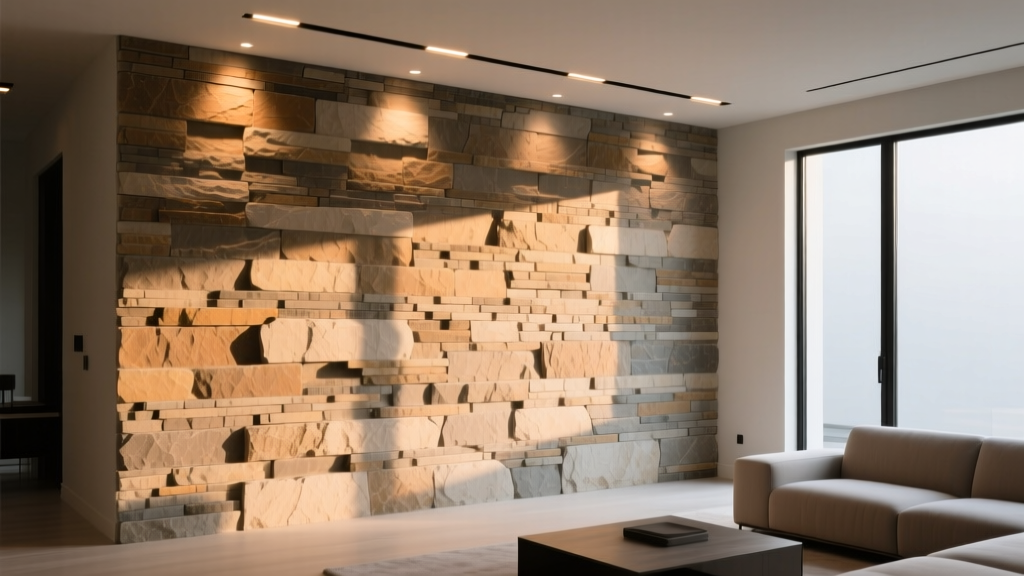
The visual success of faux stacked stone veneer relies entirely on shadow generation. Flat, ambient lighting will wash out the texture, making the installation appear artificial. Lighting must be engineered to interact with the specific stone profile.
| Lighting Technique | Fixture Distance from Wall | Beam Angle | Visual Effect | Best Stone Profile Match |
|---|---|---|---|---|
| Grazing | 4 - 8 inches | Narrow (15° - 25°) | Maximizes shadow depth; highly dramatic; highlights every ridge and crevice. | Ledgestone, Ashlar, Slate |
| Wall Washing | 24 - 36 inches | Wide (40° - 60°) | Softens texture; provides even illumination; reduces harsh shadows. | Fieldstone, River Rock |
| Spotlighting | 48+ inches (Ceiling mounted) | Pin (5° - 10°) | Creates isolated focal pools; leaves negative space; highly theatrical. | Large format stacked boulders |
Material Composition: Polyurethane vs. Cementitious
Not all faux stacked stone veneer is created equal. The market is divided into two primary material categories, each dictating a different installation methodology and design outcome.
High-Density Polyurethane (HDPU)
Brands like GenStone and NextStone utilize closed-cell HDPU molded from actual stone casts.
- Installation: Screwed directly into drywall or wood studs using 2.5-inch exterior-grade screws. No mortar or wet adhesives required.
- Weight: ~1 lb per square foot.
- Design Edge: Panels feature interlocking shiplap edges that hide fasteners and create seamless, continuous runs without visible joint lines.
- Limitation: Cannot be used in direct contact with high-heat sources (e.g., inside the firebox or immediately surrounding unshielded wood stoves) due to melting points.
Cementitious Blends
Products like AirStone or Texture Plus rely on Portland cement, aggregates, and iron oxide pigments.
- Installation: Adhered using specialized polymer-modified thin-set mortar or proprietary mastic. Requires troweling and jointing, mimicking traditional masonry.
- Weight: ~2.5 to 4 lbs per square foot.
- Design Edge: Can be custom-cut with a wet saw for precise, seamless integration around electrical outlets and HVAC registers. Tolerates higher ambient heat.
- Limitation: Messier installation process; requires curing time; heavier weight may require backing on suspended ceilings.
Substrate Preparation & Edge Case Troubleshooting
The most common failure mode in faux stone installation is not the material itself, but substrate deflection. Faux stone panels, particularly rigid HDPU, will telegraph any unevenness in the underlying wall.
If your drywall has a variance of more than 1/8-inch over a 4-foot span, rigid faux stone panels will bow, causing the interlocking seams to separate and cast unnatural shadow lines. The Fix: Shim the studs behind the drywall prior to boarding, or install a 1/2-inch OSB or plywood backer over the existing drywall to create a perfectly plumb, rigid nailing surface.
Handling Outside Corners: The hallmark of amateur faux stone installation is poorly executed outside corners. Never attempt to butt two flat panels together at a 90-degree angle and fill the seam with caulk. Always purchase the manufacturer's dedicated outside corner blocks. These are molded to wrap the 90-degree turn seamlessly, maintaining the continuous stone pattern and hiding the core material.
Budgeting & Cost Analysis
When evaluating the ROI of faux stacked stone veneer against natural stone, the material cost is only a fraction of the equation. The elimination of structural reinforcement, specialized masonry labor, and heavy-duty mortar yields significant project savings.
| Cost Category | Faux Stacked Stone (HDPU) | Faux Stacked Stone (Cement) | Natural Quarried Stone |
|---|---|---|---|
| Material Cost (per sq. ft.) | $4.50 - $8.00 | $3.50 - $6.50 | $12.00 - $28.00 |
| Substrate Prep | Minimal (Standard drywall) | Moderate (Cement board) | Heavy (Metal lath, scratch coat) |
| Professional Installation (per sq. ft.) | $4.00 - $7.00 | $8.00 - $12.00 | $18.00 - $30.00 |
| Total Installed Cost (per sq. ft.) | $8.50 - $15.00 | $11.50 - $18.50 | $30.00 - $58.00 |
For a standard 50-square-foot fireplace surround, utilizing HDPU faux stacked stone veneer will typically cost between $425 and $750 fully installed, compared to $1,500 to $2,900 for natural stone. This cost efficiency allows designers to allocate budget toward higher-impact elements, such as premium lighting fixtures or custom millwork mantels, ultimately elevating the overall design execution.
Written by
David NakamuraDavid Nakamura is a licensed architect (AIA) and construction technology writer focused on sustainable building methods, mass timber engineering, and high-performance building envelopes. He holds a Master of Architecture from the University of Washington and is a certified Passive House Consultant (CPHC). David spent eight years at the Seattle firm Mithun, where he led the design of three LEED Platinum projects, before founding his own practice specializing in net-zero residential design. He serves on the editorial advisory board of GreenBuilder Magazine and has authored peer-reviewed papers on cross-laminated timber (CLT) connections for the Journal of Structural Engineering. In his spare time, David teaches woodworking at Pratt Fine Arts Center and kayaks the Puget Sound.
More from David Nakamura
View all
Construction Cost
Labor Cost to Build a Deck Per Sq Ft: 2026 Installation Guide
Discover the exact labor cost to build a deck per sq ft in 2026. This installation guide breaks down contractor rates, complexity factors, and hidden fees.
Aug 4, 2026

Construction Cost
How Much Does It Cost to Build a 3 Bedroom House? Financing Guide
Learn exactly how much it costs to build a 3 bedroom house and explore 2026 financing options, construction loan types, and budget frameworks for your build.
Aug 4, 2026

Construction Cost
Cost to Build a Tennis Court: 2026 Guide
How much does it cost to build a tennis court in 2026? Breakdowns for asphalt, concrete, and synthetic surfaces plus fencing and lighting.
Jul 30, 2026