Flexible Stone Veneer Panels: Technical Specs & Tolerances
Explore the exact technical specifications for flexible stone veneer panels, including bending radii, weight limits, adhesive requirements, and fire ratings.

Core Material Composition and Backing Matrix
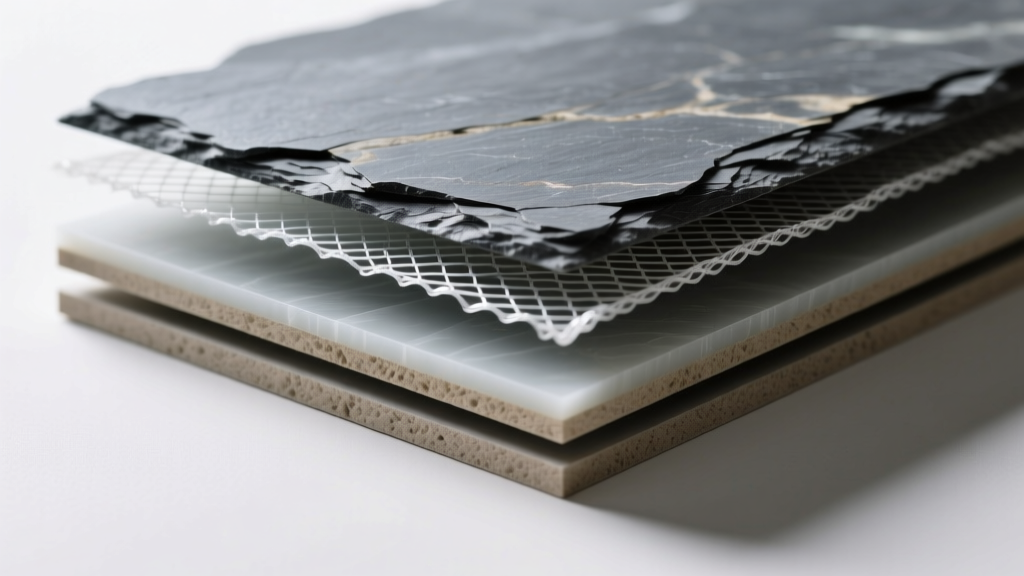
Flexible stone veneer panels (FSVP) are composite surfacing materials engineered to provide the aesthetic of natural stone with the pliability of high-pressure laminates. The face layer consists of micro-sliced natural stone—predominantly slate, mica schist, or quartzite—ranging from 1.0mm to 2.5mm in thickness. This stone layer is not a printed simulation; it is a genuine geological cross-section extracted via proprietary splitting or rotary peeling processes.
The structural integrity and flexibility of the panel are dictated by the backing matrix. Standard architectural-grade panels utilize a dual-layer backing system:
- Primary Binder: An unsaturated polyester resin (UPR) or modified epoxy that penetrates the porous stone face, locking the micro-fissures in place.
- Reinforcement Mesh: A woven, alkali-resistant fiberglass mesh (typically 160 g/m² to 220 g/m² weight) embedded within the resin. This mesh provides the tensile strength required to prevent the stone from fracturing under bending loads.
Fiberglass vs. Polymer Backings
While fiberglass-reinforced polyester is the industry standard for interior and exterior applications, translucent flexible stone veneers utilize a specialized optical-grade polyurethane or acrylic polymer backing. This polymer matrix lacks the opaque fiberglass mesh, allowing light transmission rates of 12% to 18%, but sacrifices approximately 30% of the tensile strength found in standard opaque panels.
Dimensional Tolerances and Physical Properties
Manufacturing tolerances for flexible stone veneer panels are strictly governed by the natural variance of the stone face. Specifiers must account for these physical parameters when calculating substrate load limits and joint detailing.
| Property | Standard Specification | Acceptable Tolerance |
|---|---|---|
| Total Thickness | 1.5mm - 3.0mm | ± 0.5mm across a single sheet |
| Areal Weight | 1.5 kg/m² - 2.2 kg/m² | ± 0.2 kg/m² |
| Standard Sheet Dimensions | 1220mm x 610mm or 2440mm x 1220mm | ± 2.0mm on length/width |
| Water Absorption (ASTM C97) | < 3.0% by weight | Requires secondary sealant for wet areas |
| Tensile Strength (Warp) | > 1,200 N/50mm | Dependent on fiberglass mesh density |
Bending Radius and Substrate Conformity
The defining mechanical advantage of FSVP is its ability to conform to curved substrates. The minimum bending radius is not a single fixed number; it varies based on the stone type, panel thickness, and the axis of the bend relative to the stone's natural cleavage planes.
Calculating Minimum Bend Radii
For standard 2.0mm slate-backed panels, the minimum cold-bending radius is 150mm when bending parallel to the primary grain, and 250mm when bending perpendicular to it. Attempting to force a tighter radius cold will result in micro-fracturing of the stone face and delamination of the resin.
To achieve tighter radii (down to 40mm for ultra-thin 1.0mm variants), thermal softening is required. Applying heat via an industrial heat gun to the backing side softens the polyester resin. The substrate temperature must be strictly monitored and kept between 50°C and 65°C. Exceeding 80°C will degrade the polymer matrix, causing permanent embrittlement and loss of tensile memory once cooled.
Adhesive Chemistry and Bonding Specifications
Selecting the correct adhesive is the most critical variable in FSVP installation. Because the backing is a non-porous polymer/fiberglass composite, and the substrate may range from MDF to exterior-grade cement board, the adhesive must bridge varying surface energies while accommodating the CTE mismatch mentioned above.
- MS Polymer (Modified Silane) Adhesives: The preferred specification for interior and exterior applications. They offer high initial grab (typically >2.5 N/mm²), remain permanently elastic (Shore A hardness 40-50), and do not require a primer on most substrates. Open time is generally 15-20 minutes.
- Polyurethane (PU) Construction Adhesives: Suitable for exterior applications where high moisture resistance is required. PU adhesives expand slightly during curing, which can telegraph through the thin stone face if not applied in precise, calibrated beads. A 10mm gap between beads is mandatory to allow for expansion.
- Solvent-Based Contact Cements: Only specified for vertical, interior, non-critical applications on stable substrates like MDF. They offer zero gap-filling properties and require 100% surface coverage, increasing the risk of volatile organic compound (VOC) entrapment behind the veneer.
Fire, Thermal, and UV Performance Standards
When specifying flexible stone veneer panels for commercial or multi-family residential projects, compliance with surface burning characteristics is mandatory. According to the International Building Code (IBC) Chapter 14, interior wall coverings must meet specific flame spread and smoke-developed indices.
Standard FSVP products, utilizing fire-retardant additives in the polyester resin, typically achieve a Class A rating (Flame Spread Index 0-25, Smoke Developed Index 0-450) when tested in accordance with the ASTM E84 Standard Test Method. However, translucent variants utilizing optical-grade acrylic backings often only achieve a Class B or Class C rating due to the chemical limitations of the transparent polymers. Always request a specific UL or Intertek certification report for the exact SKU being specified.
'While the natural stone face of a flexible veneer is entirely non-combustible, the composite backing matrix dictates the overall assembly's fire rating. Specifiers must verify that the adhesive system used does not downgrade the fire performance of the tested panel assembly.' — Whole Building Design Guide (WBDG) Stone Cladding Resource
Regarding UV stability, the natural stone face is impervious to ultraviolet degradation. However, prolonged UV exposure can degrade the resin backing if the panel edges are left exposed or if the panel is installed in a high-transmission glazing application. For exterior applications, a secondary UV-stable edge sealer (such as a silicone-based masonry caulk) must be applied to all perimeter cuts.
Common Failure Modes and Engineering Mitigations
Understanding how flexible stone veneer panels fail in the field allows specifiers to design preventative details into the construction documents.
1. Adhesive Telegraphing
Cause: Applying adhesive in thick, uneven blobs or using high-shrinkage solvent adhesives. As the adhesive cures and shrinks, it pulls on the flexible backing, creating visible ridges or 'ghost lines' on the stone face.
Mitigation: Mandate the use of MS Polymer adhesives applied with a 3mm notched trowel for 100% coverage, or in strict 10mm vertical beads with a 2mm shim used during the curing phase to maintain uniform pressure.
2. Edge Delamination in High-Humidity Environments
Cause: Moisture vapor migrates through the substrate (e.g., exterior cement board) and becomes trapped behind the impermeable fiberglass/resin backing, breaking the adhesive bond at the panel edges.
Mitigation: Incorporate a vapor-permeable drainage mat behind the substrate in exterior assemblies, or specify a vapor-retarding primer (e.g., epoxy-based) on the substrate face prior to adhesive application to block moisture migration.
3. Micro-Fracturing at Fastener Points
Cause: Attempting to mechanically fasten the panel with screws or brad nails. The localized stress concentrates around the fastener head, cracking the stone face and compromising the fiberglass mesh.
Mitigation: Strictly prohibit mechanical fasteners in the field of the panel. FSVP must be installed exclusively via chemical bonding. If temporary mechanical holding is required during adhesive cure, use specialized pneumatic pinners with 23-gauge headless micro-pins, ensuring they are driven only into the thickest stone ridges, not the valleys.
Written by
Sarah WhitfieldSarah Whitfield is a chartered quantity surveyor (MRICS) and construction cost analyst with 15 years of experience in material pricing, procurement strategy, and project budgeting. She earned her degree in Construction Management from the University of Reading (UK) and has worked on projects ranging from $2M custom homes to $180M mixed-use developments across North America and Europe. Sarah currently leads cost estimating for BuildMat Insight, maintaining a proprietary database of 4,000+ material price points updated quarterly. She is a frequent contributor to RSMeans cost data panels and has presented at the International Cost Engineering Council (ICEC) congress. Based in Denver, CO, Sarah is an avid trail runner and volunteer mentor for Women in Construction.
More from Sarah Whitfield
View all
Wood & Lumber
What Are the Different Types of Wood? A Builder's Guide
Compare structural softwoods, finish hardwoods, and engineered lumber. Analyze Janka ratings, MOE values, and 2026 pricing for construction.
Aug 4, 2026

Walls & Panels
Steel Framing vs Wood Framing: Corrosion and Moisture Defense
Compare steel framing vs wood framing for moisture resistance. Learn about galvanized coatings, condensation risks, and corrosion protection strategies.
Jul 21, 2026

Stone & Masonry
How to Cut Stone Veneer: Wet Saw vs Grinder Comparison
Compare the best tools for cutting stone veneer. We review wet saws, angle grinders, and chop saws to help you achieve clean, chip-free cuts.
Jul 21, 2026