Gemstone Stone Veneer Design: Backlit Agate & Onyx Walls
Discover how to design with gemstone stone veneer. Explore backlit agate and onyx applications, installation tips, and luxury interior styling ideas.

Gemstone stone veneer represents the apex of luxury interior cladding. Unlike traditional stacked stone or opaque slate, gemstone veneers—comprising thinly sliced semi-precious minerals like agate, onyx, amethyst, and quartz—rely on translucency and crystalline structure to transform spaces. When paired with modern backlighting, these materials shift from static wall coverings to dynamic, luminous architectural features. As of 2026, advancements in micro-LED panel technology and optically clear structural adhesives have made backlit gemstone installations more reliable and accessible for high-end residential and commercial projects.
The Anatomy of Gemstone Stone Veneer
Natural semi-precious stones are inherently brittle and heavy. To function as a veneer, raw gemstone blocks are gang-sawn into ultra-thin slices, typically measuring 3mm to 5mm in thickness. Because a 4mm slice of agate cannot support its own weight, it is immediately bonded to a structural backing.
- Fiberglass Mesh Backing: The most common and cost-effective substrate. It provides flexibility for curved walls but offers lower impact resistance.
- Aluminum Honeycomb Backing: Used for high-traffic areas, elevator cabs, and large-format panels. It adds rigidity and reduces overall weight to approximately 2.5 to 3.5 pounds per square foot, compared to 12+ pounds for solid stone slabs.
- Optical Resin Interlayers: Premium 2026 manufacturing techniques inject UV-stable, optically clear resins between the stone and the backing to maximize light transmission without scattering.
Design Applications: Where Translucency Matters
Gemstone stone veneer is rarely used for full-room coverage. Its high cost and visual intensity dictate strategic, high-impact placements.
• Wet Bars and Island Waterfalls: Backlit agate creates a striking focal point. Requires a poured epoxy topcoat if used horizontally to prevent alcohol and citrus etching.
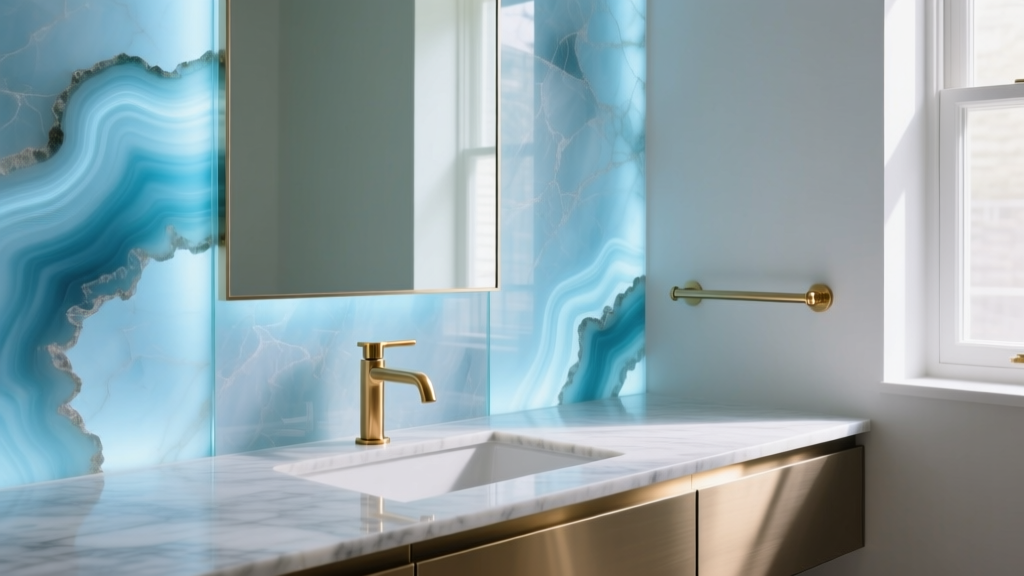
• Powder Rooms: Full-wall backlighting behind the vanity mirror eliminates the need for harsh sconce lighting while providing a dramatic, jewelry-box aesthetic.
• Elevator Cabs: The lightweight nature of honeycomb-backed gemstone veneer (under 3 lbs/sq ft) makes it one of the few natural stones that comply with strict elevator weight restrictions.
• Retail Display Plinths: Used in luxury boutiques to illuminate merchandise from beneath and behind.
The Art of Backlighting: LED Integration Matrix
The success of a gemstone stone veneer installation hinges entirely on the lighting design. Semi-precious stones have varying degrees of opacity and crystalline density. Using the wrong color temperature or LED density will result in 'hot spots' (visible individual LED dots) or washed-out mineral colors.
According to guidelines from the Illuminating Engineering Society, achieving true color fidelity in natural materials requires a high Color Rendering Index (CRI). For gemstone veneers, a CRI of 95+ is non-negotiable to accurately render the complex banding in agate or the deep veining in onyx.
| Stone Type | Optimal Color Temp | Light Transmission | Required LED Density |
|---|---|---|---|
| White/Pink Onyx | 3000K - 3500K | High (60-80%) | Standard (60 LEDs/sq ft) |
| Blue/Green Agate | 4000K - 5000K | Medium (30-50%) | High (120+ LEDs/sq ft) |
| Amethyst / Quartz | 3500K - 4000K | Low (15-30%) | Ultra-High (Micro-LED panels) |
To prevent hot-spotting through highly translucent onyx, install diffusing acrylic sheets (minimum 3mm thick) between the LED panel and the stone veneer. For denser stones like amethyst, micro-LED panels must be placed directly against the backing to maximize lumen output.
Installation Specifications & Critical Edge Cases
The most common failure mode in translucent stone installation is adhesive shadowing. Standard cementitious thinsets or opaque construction adhesives will completely block light transmission and create dark, mottled patches across the illuminated wall.
Never use standard polymer-modified thinset, mastic, or polyurethane construction adhesives for backlit gemstone stone veneer. These materials will yellow over time, block light, and potentially stain the porous mineral structure. You must specify optically clear, non-yellowing structural epoxies (such as Tenax AGLU or Akemi clear stone adhesives) or optically clear structural silicones.
Seaming and Joint Treatment:
Because gemstone veneers are book-matched or slip-matched to create continuous patterns, the seams must be virtually invisible. Installers must use UV-cured, color-matched optical resins to fill the micro-gaps between panels. Standard caulking will refract light differently than the stone, creating visible dark lines when the backlighting is engaged.
Driver Accessibility (The 2026 Standard):
LED drivers inevitably fail before the stone does. A critical edge case often missed by novice designers is embedding the LED power supply directly behind a sealed stone panel. Always route the low-voltage wiring to a remote, accessible junction box or design a hidden magnetic access panel in the adjacent millwork. According to the Natural Stone Institute, preserving the integrity of the stone installation requires planning for the maintenance of underlying mechanical and electrical systems without destroying the cladding.
Natural vs. Engineered Gemstone Veneers
While natural semi-precious slices offer unparalleled authenticity, engineered alternatives have gained significant market share in commercial projects where budget and consistency are paramount.
- Natural Semi-Precious Veneer: Sourced from Brazil, Madagascar, and Uruguay. Every panel is unique. Susceptible to natural fissures and requires careful handling. Cost: $150 to $350+ per square foot (material only).
- Engineered / Printed Gemstone Veneer: Created using high-resolution 3D printing on translucent acrylic or glass substrates, sometimes embedded with crushed stone fragments. Offers perfect consistency, larger panel sizes (up to 5x10 feet), and higher impact resistance. Cost: $45 to $95 per square foot.
Maintenance and Sealing Protocols
Gemstone veneers are not maintenance-free. Onyx and calcite-based stones are highly reactive to acidic substances. Even the ambient acidity in certain bathroom cleaning aerosols can etch the surface over time, dulling the polish and reducing light transmission.
Before installation, treat the face of natural gemstone veneer with a high-quality, non-film-forming impregnating sealer (such as Miracle Sealants 511 Porous Plus). Film-forming sealers will create a plastic-like surface reflection that ruins the backlighting effect. For horizontal applications like bar tops, a two-part optical epoxy flood coat is mandatory to provide a sacrificial, chemical-resistant wear layer that protects the delicate stone beneath.
For long-term upkeep, specify pH-neutral stone cleaners only. Research from the Lighting Research Center highlights that dust accumulation on the backside of translucent panels can significantly reduce lumen output over time; therefore, designing removable panels or incorporating positive air pressure behind the veneer can mitigate dust buildup in commercial environments.
Written by
Sarah WhitfieldSarah Whitfield is a chartered quantity surveyor (MRICS) and construction cost analyst with 15 years of experience in material pricing, procurement strategy, and project budgeting. She earned her degree in Construction Management from the University of Reading (UK) and has worked on projects ranging from $2M custom homes to $180M mixed-use developments across North America and Europe. Sarah currently leads cost estimating for BuildMat Insight, maintaining a proprietary database of 4,000+ material price points updated quarterly. She is a frequent contributor to RSMeans cost data panels and has presented at the International Cost Engineering Council (ICEC) congress. Based in Denver, CO, Sarah is an avid trail runner and volunteer mentor for Women in Construction.
More from Sarah Whitfield
View all
Wood & Lumber
What Are the Different Types of Wood? A Builder's Guide
Compare structural softwoods, finish hardwoods, and engineered lumber. Analyze Janka ratings, MOE values, and 2026 pricing for construction.
Aug 4, 2026

Walls & Panels
Steel Framing vs Wood Framing: Corrosion and Moisture Defense
Compare steel framing vs wood framing for moisture resistance. Learn about galvanized coatings, condensation risks, and corrosion protection strategies.
Jul 21, 2026

Stone & Masonry
How to Cut Stone Veneer: Wet Saw vs Grinder Comparison
Compare the best tools for cutting stone veneer. We review wet saws, angle grinders, and chop saws to help you achieve clean, chip-free cuts.
Jul 21, 2026