Maintaining Sandstone as a Building Material: Expert Care Guide
Learn expert maintenance and care protocols for sandstone as a building material, including sealing, cleaning limits, and efflorescence treatment.

The Petrology of Sandstone: Why It Demands Specialized Care
Utilizing sandstone as a building material offers unmatched aesthetic warmth, natural textural variation, and historical authenticity. However, its sedimentary origins dictate a highly specific maintenance paradigm that differs radically from igneous stones like granite or metamorphic stones like marble. Sandstone is composed primarily of quartz and feldspar grains bound together by silica, calcium carbonate, or iron oxide cements. This matrix creates a highly capillary, porous structure.
According to ASTM C97 standard test methods, the water absorption rate for sandstone typically ranges from 3% to 8% by weight. When the clay binders within the stone absorb moisture, they expand. If this moisture freezes before evaporating, the resulting hydraulic pressure exceeds the tensile strength of the stone, leading to micro-fractures and eventual spalling. Understanding this petrological vulnerability is the first step in establishing an effective, long-term maintenance protocol.
- Porosity: 10% - 25% (requires vapor-permeable treatments only)
- Water Absorption: 3% - 8% by weight (ASTM C97)
- Compressive Strength: 4,000 - 10,000 PSI (highly variable based on cementing agent)
Routine Cleaning Protocols for Sandstone Facades
The most common cause of accelerated sandstone degradation is improper cleaning. Because the binding cements (particularly calcium carbonate and clay) are highly reactive to low-pH chemicals, standard masonry cleaners will literally dissolve the stone's structural glue. Furthermore, the National Park Service Preservation Briefs explicitly warn against aggressive mechanical cleaning methods on historic and soft masonry.
The Low-Pressure Washing Standard
If water washing is required to remove atmospheric soiling, strictly adhere to the following parameters to prevent scarring the stone's face:
- Maximum Pressure: 400 PSI. Anything higher will erode the softer matrix between the quartz grains, creating a pitted, 'sugared' surface.
- Standoff Distance: Maintain a minimum 12-inch distance between the nozzle and the stone surface.
- Nozzle Tip: Use a 40-degree (white) or 25-degree (green) fan tip. Never use a 0-degree (red) rotary tip.
- Pre-Wetting: Always pre-soak the sandstone with clean water before applying any cleaning solution. This prevents the dry, porous stone from instantly absorbing the chemical cleaner deep into the masonry core.
Sealing and Water Repellent Strategies
A pervasive myth in masonry maintenance is that sandstone should be 'sealed' to keep water out. Film-forming sealers (acrylics, urethanes, and epoxies) are disastrous for sandstone. They trap moisture vapor inside the wall assembly. When the sun heats the facade, the trapped vapor expands, blowing the face off the stone—a failure mode known as spalling.
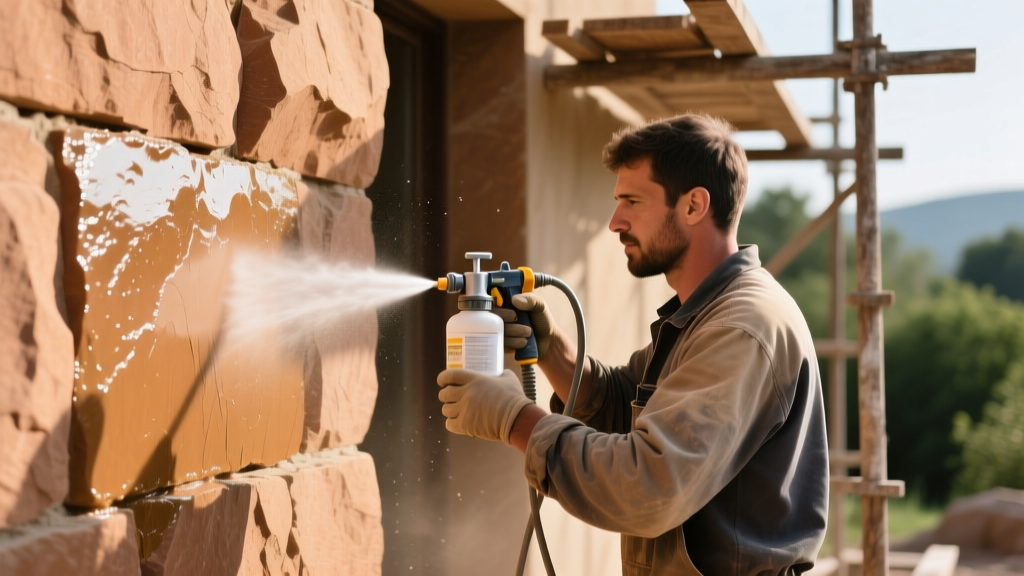
Instead, maintenance professionals must use penetrating water repellents. These do not block the pores; rather, they line the capillary walls, increasing the contact angle of water droplets so they bead up and roll off, while still allowing water vapor to escape (breathability).
| Chemistry Type | Molecular Size | Best Application | Expected Lifespan |
|---|---|---|---|
| Silane | Very Small | Dense concrete, hard brick | 5 - 7 Years |
| Siloxane (Recommended) | Medium/Large | Sandstone, Limestone, Porous Masonry | 7 - 10 Years |
| Silane/Siloxane Blend | Mixed | Mixed masonry assemblies | 5 - 8 Years |
Expert Product Selection: For high-porosity sandstone, a solvent-based siloxane like Dry-Treat 40SK or a water-based siloxane emulsion like PROSOCO Siloxane PD is required. Siloxane molecules are large enough to bridge the wide capillary networks of sandstone without penetrating so deeply that they fail to protect the surface layer. Application costs for professional siloxane treatment typically range from $1.50 to $3.50 per square foot, depending on scaffold requirements and surface porosity.
Troubleshooting Common Sandstone Pathologies
When utilizing sandstone as a building material, facility managers and homeowners must be able to diagnose specific failure modes accurately. Misdiagnosing the pathology often leads to treatments that accelerate the decay. The Building Conservation Directory emphasizes that identifying the moisture source is always the prerequisite to chemical treatment.
| Symptom | Root Cause | Corrective Action & Treatment |
|---|---|---|
| Efflorescence (White, powdery surface crust) | Water moving through the masonry dissolves soluble salts and deposits them on the surface upon evaporation. | Dry-brush with natural bristle brushes. If persistent, apply a specialized alkaline cleaner like PROSOCO Sure Klean Vanatrol. Fix the bulk water intrusion source (e.g., faulty gutters). |
| Subflorescence (Crusting just beneath the surface) | Salts crystallize inside the pores due to rapid surface drying or previous use of film-forming sealers. | Apply a clay-based desalination poultice (e.g., WASSERSTRASS) to draw salts out over 48-72 hours. Strip any existing acrylic sealers. |
| Contour Scaling / Spalling (Stone peeling off in sheets) | Freeze-thaw cycles combined with trapped moisture, often exacerbated by cementitious repointing that is harder than the stone. | Remove hard Portland cement mortar. Repoint with a breathable, lime-based mortar (Type O or Type K) that is softer and more permeable than the sandstone. |
| Biological Growth (Green algae, black cyanobacteria) | Persistent shade and moisture retention on north-facing elevations. | Apply a quaternary ammonium biocide (e.g., D/2 Biological Solution). Allow it to dwell for 15 minutes, then rinse at low pressure. Do not use bleach, which leaves salt residues. |
Long-Term Inspection and Maintenance Schedule
Maintenance of sandstone is not a one-time event but a cyclical program. Implementing a structured inspection schedule prevents minor moisture issues from escalating into catastrophic structural failures.
Bi-Annual Inspections (Spring and Fall)
- Gutter and Downspout Check: Ensure splash blocks are directing water at least 5 feet away from the sandstone base. Sandstone wicks ground moisture rapidly via capillary action.
- Vegetation Clearance: Trim ivy, creepers, and shrubs back at least 18 inches from the masonry. Root systems can penetrate microscopic fissures, and foliage traps humidity against the stone face.
- Mortar Joint Inspection: Look for hairline cracking or crumbling in the lime mortar joints. Repointing should be done immediately to prevent water from entering the wall cavity.
3-to-5 Year Interventions
- Biocide Application: Proactively treat north-facing or heavily shaded elevations with a non-ionic biocide to prevent lichen and algae from secreting acidic compounds that etch the stone.
- Water Bead Testing: Splash clean water on the sealed facades. If the water absorbs and darkens the stone rather than beading and rolling off, the siloxane repellent has degraded and requires reapplication.
Decade-Level Capital Planning
Budget for professional desalination and comprehensive siloxane re-treatment every 10 to 15 years. When evaluating contractors, require a mock-up test panel (minimum 4x4 feet) to verify that their proposed cleaning pressure and chemical dilution rates do not alter the natural color or texture of the specific sandstone variety installed on your structure.
Written by
Elena RodriguezElena Rodriguez is a civil engineer and technical writer specializing in concrete technology, masonry systems, and ASTM/ACI compliance. She earned her B.S. in Civil Engineering from Texas A&M University and spent a decade at a materials testing laboratory, performing over 2,000 concrete compressive strength tests and masonry prism evaluations. Elena is an ACI-certified Field Testing Technician (Grade I) and a member of ASTM Committee C12 on Natural Building Stone. She currently consults on forensic engineering cases involving concrete failures and moisture intrusion. Based in San Antonio, TX, Elena is a proud member of the Society of Women Engineers (SWE) and coaches her daughter's FIRST Robotics team.
More from Elena Rodriguez
View all
Walls & Panels
Cost Analysis: Light Gauge Steel Framing Advantages and Disadvantages
Evaluate light gauge steel framing advantages and disadvantages through a strict cost analysis lens, comparing material, labor, and lifecycle expenses.
Aug 4, 2026

Walls & Panels
Gypsum Board Types: Exact Specifications, Thickness & Dimensions
Compare standard, Type X, and moisture-resistant gypsum board types. Get exact specifications, thicknesses, dimensions, and ASTM standards for your project.
Aug 4, 2026

Fire Resistance
Best Fire-Resistant Outdoor Decking Materials: 2026 Buyer Guide
Discover the best fire-resistant outdoor decking materials for 2026. Compare Class A PVC, aluminum, and hardwood options for WUI compliance and safety.
Aug 4, 2026