Limestone Rock Taxonomy: Selecting Grades for Masonry and Veneer
Master limestone rock taxonomy with ASTM C568 grades. Compare density, absorption, regional variants, and 2026 costs for masonry and veneer selection.
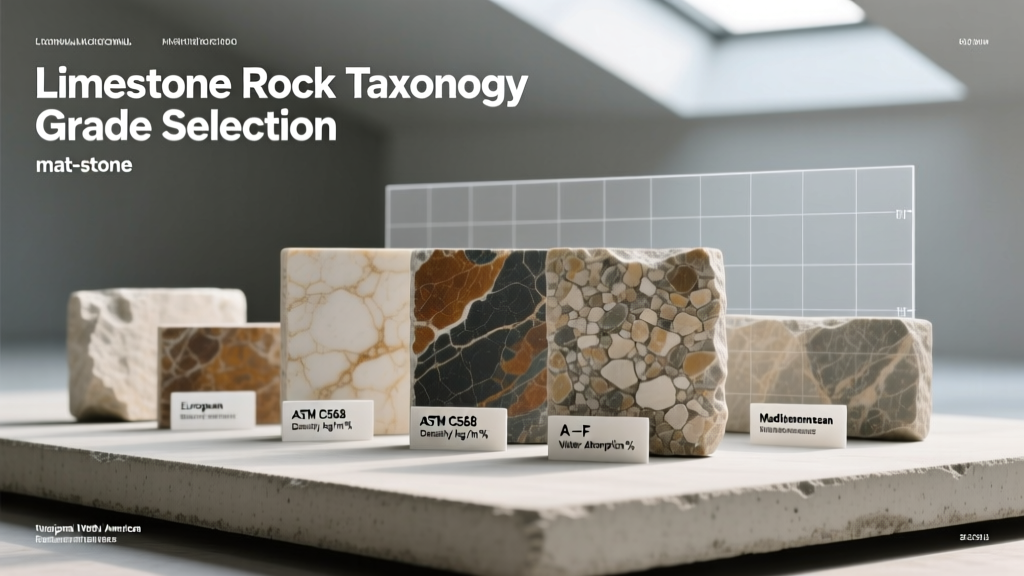
The ASTM C568 Classification Matrix
Selecting the correct limestone rock for construction requires moving beyond aesthetic preferences to evaluate structural and chemical properties. The foundational framework for this taxonomy is ASTM C568 (Standard Specification for Limestone Dimension Stone), which categorizes limestone into three distinct density grades. These grades dictate the stone's viability for exterior cladding, load-bearing masonry, and high-traffic paving.
| Property | Low Density | Medium Density | High Density |
|---|---|---|---|
| Minimum Density (lbs/ft³) | 110 | 135 | 160 |
| Maximum Water Absorption (%) | 12.0% | 7.5% | 3.0% |
| Min. Compressive Strength (psi) | 1,800 | 4,500 | 8,000 |
| Min. Modulus of Rupture (psi) | 400 | 700 | 1,000 |
| Primary Applications | Interior veneer, non-load partitions | Exterior cladding, standard veneer | Paving, heavy load-bearing, sills |
For exterior applications in climates subject to freeze-thaw cycles, specifying Medium or High Density limestone rock is non-negotiable. Low-density variants with absorption rates exceeding 7.5% will rapidly spall when trapped moisture freezes and expands within the pore structure.
Geological Variants and Regional Sourcing
The physical characteristics of limestone rock are directly tied to their geological formation. Understanding regional sourcing helps architects and contractors anticipate color consistency, grain structure, and fabrication behavior.
Indiana Salem Formation (Oolitic Limestone)
Quarried primarily in south-central Indiana, this medium-density stone is the industry benchmark for uniform exterior cladding. Composed of spherical ooids (calcium carbonate grains), it lacks the pronounced bedding planes found in other variants, allowing it to be cut in any direction without delamination risks. According to the Indiana Limestone Institute Technical Manual, it typically yields a compressive strength of 6,000 psi and an absorption rate of around 8%, placing it firmly in the upper tier of the Medium Density classification.
Texas Cordova and Shell Limestone
Sourced from the Cretaceous period formations in Central Texas, this fossiliferous limestone contains high concentrations of shell fragments and marine fossils. It exhibits greater color variability (ranging from creamy whites to deep golds) and higher porosity. Because of its variable density, Texas limestone requires selective quarrying and is best utilized as rubble veneer or in non-structural landscape masonry rather than precision ashlar cladding.
European Jura (Dolomitic Limestone)
Imported primarily from Germany, Jura limestone contains significant magnesium carbonate, classifying it as a dolomitic limestone. This chemical alteration results in a High Density stone with exceptional abrasion resistance. It is the premier choice for exterior paving, heavy-duty commercial thresholds, and exterior window sills where water shedding and physical wear are critical.
Selection Framework: Matching Grade to Application
Load-Bearing Masonry and Structural Piers
For structural applications, High Density limestone rock must be specified. The stone must be laid on its natural bed (the orientation it held in the quarry) to maximize compressive load distribution. Setting limestone on its edge (rift or grain) reduces its load-bearing capacity by up to 40% and increases the risk of vertical splitting under dead loads.
Interior Feature Walls and Wet Areas
Low Density limestone is perfectly viable for interior feature walls, fireplace surrounds, and powder rooms. However, because low-density stone is highly porous, it must be treated with a penetrating silane/siloxane sealer if used in wet areas to prevent soap scum and hard water staining. Do not use topical acrylic sealers, which trap moisture vapor and cause subsurface spalling.
Fabrication Tolerances and Finishing Profiles
The selected finish drastically alters the dimensional tolerances and installation requirements of limestone rock.
- Sawn (Machine Cut): Tolerances of ±1/16 inch. Requires tight, buttered mortar joints (3/8 inch maximum). Best for modern, monolithic aesthetics.
- Rock-Faced (Split): Tolerances of ±1/4 inch or more. Requires wider, raked joints (1/2 to 3/4 inch) to accommodate the uneven facial projections. The protruding rock face must not extend more than 1 inch beyond the nominal bed depth to prevent water damming.
- Honed/Thermal: Primarily reserved for High Density paving. Thermal finishing (flaming) is only effective on dolomitic or highly siliceous limestone; standard oolitic limestone will simply crumble under the intense heat of a thermal lance.
2026 Cost Analysis and Yield Factors
Pricing for limestone rock varies significantly based on the cut profile, bed depth, and waste factors inherent to the masonry pattern. As of early 2026, material costs at the distributor level (excluding freight) are structured as follows:
| Material Profile | Bed Depth | Material Cost (per sq. ft.) | Estimated Waste Factor |
|---|---|---|---|
| Standard Ashlar Veneer | 4 inches | $16.00 - $24.00 | 5% - 8% |
| Thin Veneer (Sawn Back) | 1 to 1.5 inches | $12.00 - $18.00 | 8% - 12% |
| Uncoursed Rubble | Variable (4-8 in) | $9.00 - $14.00 | 15% - 20% |
| Heavy Dimensional Sills/Caps | 6+ inches | $35.00 - $55.00 (linear ft) | 2% - 5% |
Note: Thin veneer yields a higher waste factor because the sawing process to reduce the bed depth often exposes hidden fissures or fossil voids that render the piece structurally unsound for adhered installation.
Common Failure Modes and Chemical Mitigation
Limestone rock is highly reactive to specific environmental and chemical stressors. Proper specification and installation protocols must address these failure modes proactively.
1. Sulfation and Gypsum Crusting
In urban environments with high sulfur dioxide (SO2) pollution, calcium carbonate reacts to form calcium sulfate (gypsum). This creates a hard, black crust on the stone surface that traps moisture behind it, leading to subsurface contour scaling. Mitigation: Specify High Density stone with absorption rates below 3% for urban exteriors, and design deep overhangs to minimize direct rainwater washing.
2. Mortar Incompatibility and Spalling
Using high-strength mortar (Type M or Type S) with medium or low-density limestone is a primary cause of masonry failure. The rigid mortar prevents the natural thermal expansion and moisture movement of the stone, forcing the stress into the softer limestone and causing the faces to spall off. Mitigation: Strictly specify Type N mortar (1 part Portland cement, 1 part hydrated lime, 6 parts masonry sand) or Type O mortar for all limestone rock masonry. The lime content provides the necessary flexibility and autogenous healing properties for micro-cracks.
3. Iron Oxidation (Rust Staining)
Certain beds of limestone, particularly in regional Texas and Kansas quarries, contain trace amounts of pyrite or siderite. When exposed to moisture, these iron sulfides oxidize, creating unsightly brown rust stains that bleed through the stone face. Mitigation: Require the supplier to provide a petrographic analysis (ASTM C1721) for exterior projects to identify and exclude iron-bearing beds from the quarry run.
For comprehensive data on national quarry outputs and historical pricing trends, the USGS Dimension Stone Statistics and Information database remains the definitive resource for tracking macro-level supply chain shifts in the natural stone sector.