Eldorado Veneer Stone Guide: Profiles, Costs & Installation
Explore our complete guide to Eldorado veneer stone. Compare popular profiles, analyze 2026 installation costs, and learn expert application tips.

Understanding Eldorado Manufactured Stone Veneer
Eldorado Stone operates as a premier brand within the architectural manufactured stone veneer (AMSV) market. Unlike natural stone, which is quarried and cut, Eldorado veneer stone is cast from molds of actual natural stone and poured with a lightweight concrete mixture blended with iron oxide pigments. This manufacturing process yields a product that replicates the exact textural nuances and color variations of natural stone while reducing the weight to approximately 10 to 12 pounds per square foot. This weight reduction eliminates the need for structural wall reinforcements, masonry ties, or specialized foundation footings in most residential and light commercial applications.
From a material science perspective, the concrete matrix is engineered to meet rigorous freeze-thaw durability standards. The pigments are not merely surface-painted; they are integrated throughout the concrete mix, ensuring that minor chips or weathering do not reveal a stark concrete core. For architects and builders in 2026, Eldorado remains a baseline specification for projects requiring high-end masonry aesthetics without the logistical burden of natural stone supply chains.
Top Eldorado Stone Profiles & Design Applications
Eldorado categorizes its product lines by profile shape and architectural style. Selecting the correct profile dictates both the visual rhythm of the facade and the installation speed.
Fieldledge & Stackstone (Modern & Craftsman)
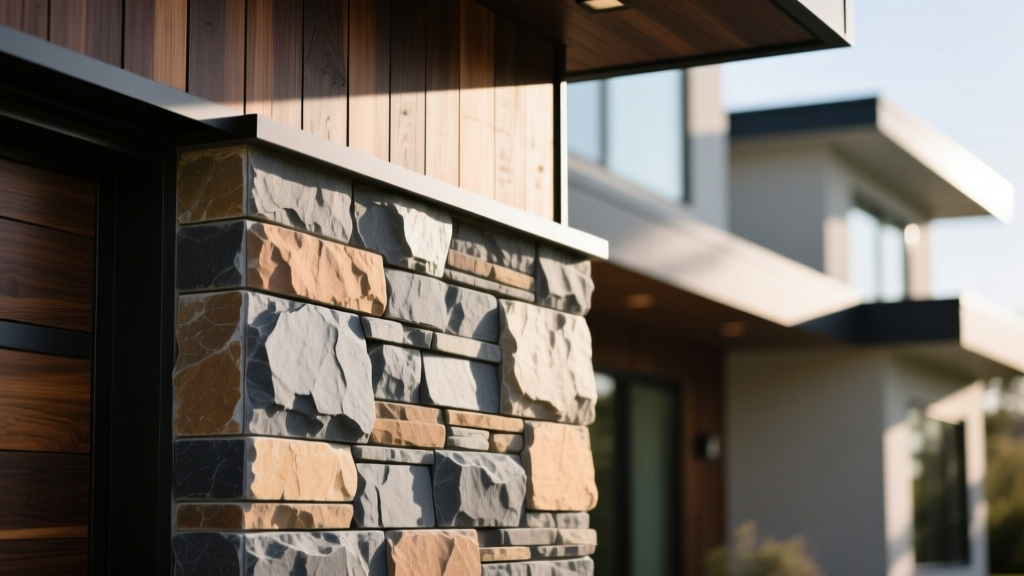
The Fieldledge profile features long, linear stones with dry-stacked edges, designed to be installed without visible mortar joints. This profile is heavily specified for contemporary exteriors, mid-century modern renovations, and interior fireplace surrounds. Because it requires tight, flush fitting, installers must spend additional time sorting and trimming stones to maintain continuous horizontal lines.
RoughCut & Mountain Valley (Rustic & Traditional)
RoughCut mimics hand-chiseled, ashlar-cut stone with distinct, rectangular shapes that require a standard mortar joint (typically 1/2 inch). Mountain Valley offers a more irregular, fieldstone appearance with rounded edges. These profiles are ideal for Tudor, French Country, and traditional American farmhouse architectures. The visible mortar joints allow for faster installation, as precise stone-to-stone contact is not required.
Material & Installation Cost Breakdown
Budgeting for Eldorado veneer stone requires separating the raw material costs from the extensive prep and labor required for proper adhesion. The pricing below reflects national averages for 2026, though regional labor rates will cause significant variance.
| Cost Category | Low-End (per sq. ft.) | High-End (per sq. ft.) | Notes |
|---|---|---|---|
| Eldorado Stone Material | $9.50 | $14.00 | Varies by profile; Stackstone is typically at the higher end. |
| Accessories (Lath, Mortar, Screed) | $3.50 | $5.50 | Includes 2.5 lb galvanized lath, Type S mortar, and weep screed. |
| Professional Installation Labor | $14.00 | $24.00 | Highly dependent on scaffolding needs and profile complexity. |
| Total Installed Cost | $27.00 | $43.50 | Excludes wall prep, demolition, or structural reinforcement. |
Technical Specifications & Building Code Compliance
When submitting plans for municipal permitting, building officials will look for compliance with specific ASTM standards. According to the Eldorado Stone Technical Data Sheets, the material is tested and certified across several critical performance metrics:
- Weight: 10 to 12 lbs/sq. ft. (Well below the 40 lbs/sq. ft. threshold that triggers structural engineering reviews for wall loads).
- Freeze-Thaw Durability: Tested per ASTM C666, demonstrating less than 1% weight loss after 50 cycles, making it suitable for all North American climate zones.
- Fire Rating: Non-combustible. When installed over a code-approved weather-resistant barrier and metal lath, the assembly contributes to a 1-hour or 2-hour fire-resistance rating depending on the underlying wall assembly.
- Compressive Strength: Exceeds 2,800 PSI (ASTM C1670 standard for manufactured stone masonry veneer).
Step-by-Step Installation Framework
Proper installation is critical to preventing moisture intrusion and delamination. The Masonry Veneer Manufacturers Association (MVMA) Installation Guide provides the industry-standard protocol that must be followed for warranty validation.
- Weather-Resistant Barrier (WRB): Apply two layers of Grade D building paper or a code-approved house wrap over the exterior sheathing. The dual-layer approach creates a drainage plane, allowing any moisture that penetrates the stone to drain downward.
- Weep Screed Application: Install a corrosion-resistant weep screed at the base of the wall. Critical clearance: Maintain a minimum 4-inch gap above soil grade and a 2-inch gap above paved surfaces like concrete driveways to prevent capillary moisture wicking.
- Metal Lath Attachment: Fasten 2.5 lb self-furring galvanized woven wire lath using corrosion-resistant nails or staples. Penetrate the wall studs (not just the sheathing) every 6 inches vertically and 16 inches horizontally. Overlap horizontal seams by 1 inch and vertical seams by 2 inches.
- Scratch Coat: Apply a 1/2-inch thick layer of Type S Portland cement mortar over the lath. Scarify (scratch) the surface horizontally with a raking tool while the mortar is thumbprint-hard to create a mechanical key for the stone.
- Stone Setting: Butter the back of each Eldorado stone with a 1/2-inch layer of mortar. Press the stone firmly into the scratch coat, ensuring mortar squeezes out the sides to eliminate air pockets. For dry-stack profiles, maintain tight, mortar-free joints on the face while ensuring the back is fully adhered.
Never use acrylic-based or mastic adhesives to install exterior manufactured stone. These products trap moisture within the concrete matrix. As moisture attempts to escape, it pushes soluble salts to the surface, resulting in severe, permanent white efflorescence staining. Always use Portland cement-based Type S or Type N mortar.
Eldorado Stone vs. Natural Stone Veneer
While natural stone offers unmatched geological authenticity, Eldorado manufactured veneer provides distinct advantages in logistics, consistency, and structural requirements. The following matrix highlights the operational differences for contractors and homeowners.
| Feature | Eldorado Manufactured Veneer | Natural Thin Stone Veneer |
|---|---|---|
| Weight per Sq. Ft. | 10 - 12 lbs | 15 - 25 lbs |
| Corner Pieces | Pre-cast 90-degree returns available | Difficult to source; requires skilled miter cutting |
| Color Consistency | Highly consistent across production runs | Varies wildly by quarry and pallet |
| Lead Times | 2 - 4 weeks (stocked at local suppliers) | 6 - 12 weeks (often shipped cross-country) |
| Waste Factor | 5% (stones can be easily cut and hidden) | 10% - 15% (brittle, prone to shattering when cut) |
Common Installation Mistakes to Avoid
Manufactured stone veneer is a drainable cladding system, not a waterproof barrier. The most common cause of system failure is treating it like a sealed surface. According to building science research on exterior wall moisture management, improper detailing leads to trapped water and structural rot.
Omitting the Weep Screed
Some installers run the lath and stone all the way to the concrete foundation slab to create a "clean" look. This bridges the drainage plane, allowing ground moisture to wick up into the stone and mortar. Over time, freeze-thaw cycles will cause the bottom course of stone to spall and pop off the wall. Always terminate the system at a weep screed.
Over-Washing the Joints
When cleaning excess mortar off the stone face during installation, using a high-pressure water hose or acid-based masonry cleaners will erode the fresh mortar joints and strip the iron oxide pigments from the stone surface. Use a soft bristle brush and clean water while the mortar is still semi-pliable to tool and clean the joints.
Ignoring Expansion and Control Joints
While Eldorado stone itself does not require control joints, the underlying framing and sheathing do. If the building design includes structural control joints in the framing or sheathing, those joints must be carried continuously through the metal lath, scratch coat, and stone veneer. Failing to honor underlying structural joints will result in vertical cracking through the masonry facade as the building settles and shifts.
Written by
Sarah WhitfieldSarah Whitfield is a chartered quantity surveyor (MRICS) and construction cost analyst with 15 years of experience in material pricing, procurement strategy, and project budgeting. She earned her degree in Construction Management from the University of Reading (UK) and has worked on projects ranging from $2M custom homes to $180M mixed-use developments across North America and Europe. Sarah currently leads cost estimating for BuildMat Insight, maintaining a proprietary database of 4,000+ material price points updated quarterly. She is a frequent contributor to RSMeans cost data panels and has presented at the International Cost Engineering Council (ICEC) congress. Based in Denver, CO, Sarah is an avid trail runner and volunteer mentor for Women in Construction.
More from Sarah Whitfield
View all
Wood & Lumber
What Are the Different Types of Wood? A Builder's Guide
Compare structural softwoods, finish hardwoods, and engineered lumber. Analyze Janka ratings, MOE values, and 2026 pricing for construction.
Aug 4, 2026

Walls & Panels
Steel Framing vs Wood Framing: Corrosion and Moisture Defense
Compare steel framing vs wood framing for moisture resistance. Learn about galvanized coatings, condensation risks, and corrosion protection strategies.
Jul 21, 2026

Stone & Masonry
How to Cut Stone Veneer: Wet Saw vs Grinder Comparison
Compare the best tools for cutting stone veneer. We review wet saws, angle grinders, and chop saws to help you achieve clean, chip-free cuts.
Jul 21, 2026