How to Clean and Maintain a Stack Stone Veneer Exterior
Learn expert techniques to clean, seal, and repair your stack stone veneer exterior. Discover PSI limits, sealer types, and efflorescence fixes.

The Hidden Vulnerabilities of Exterior Stack Stone
A stack stone veneer exterior provides exceptional curb appeal and mimics the mass of full-bed masonry at a fraction of the weight and cost. However, because it is a cladding system rather than a structural wall, its longevity relies entirely on the integrity of the mortar bonds, the weep screed drainage plane, and the surface sealant. Unlike solid masonry, manufactured and natural stone veneers are highly susceptible to moisture intrusion from the backside if the weather-resistive barrier (WRB) fails, and they are easily damaged by aggressive cleaning methods.
Proper maintenance of a stack stone veneer exterior requires abandoning common homeowner cleaning habits. The goal is to remove biological growth, mineral deposits, and atmospheric soiling without compromising the mortar joints or the stone's porous face. According to the National Park Service Preservation Brief on masonry cleaning, improper cleaning is the leading cause of accelerated masonry deterioration, often causing irreversible spalling and joint erosion.
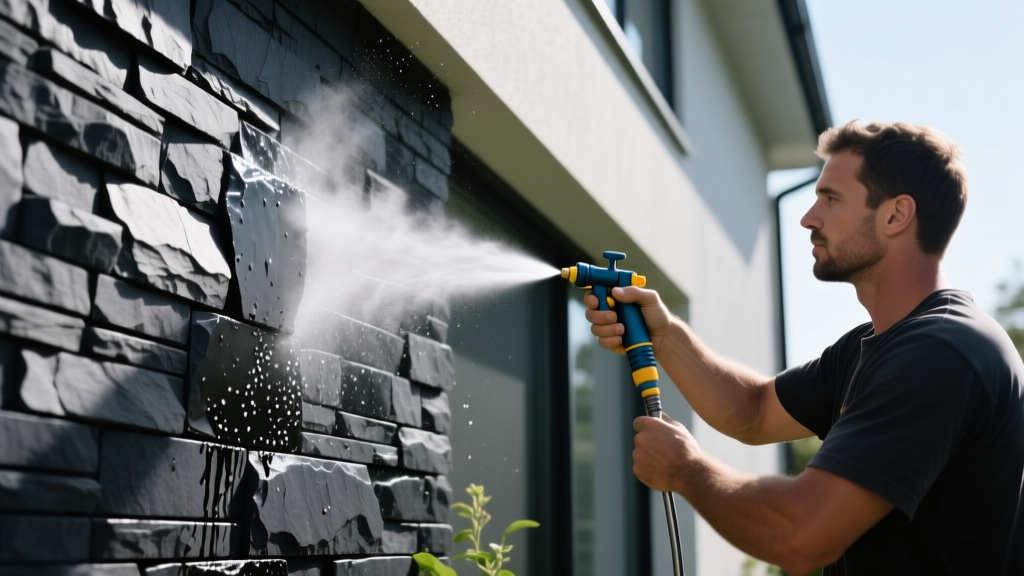
Never use a high-pressure power washer on a stack stone veneer exterior. Pressures exceeding 400 PSI will erode the lime in the mortar joints and force water behind the veneer, bypassing the weep screed and saturating the WRB. If you must use a pressure washer for rinsing, equip a 40-degree white fan nozzle, keep the wand at least 12 inches from the surface, and strictly limit the pressure to 300–400 PSI.
Annual Cleaning Protocol: Chemicals and Techniques
Routine maintenance should begin with a dry brushing using a stiff natural-bristle brush to remove loose dirt, cobwebs, and oxidized mortar dust. For deeper cleaning, chemical agents must be matched to the specific stain type. Using an acidic cleaner on an alkaline stain (or vice versa) will set the stain permanently into the stone's pores.
| Stain Type | Visual Identification | Recommended Active Ingredient | Application Method |
|---|---|---|---|
| Algae & Mildew | Green, black, or gray fuzzy patches on north-facing walls | Sodium hypochlorite (diluted 1:10) or Quaternary ammonium | Spray, dwell 10 mins, low-pressure rinse |
| Rust & Iron Oxide | Orange/brown streaking below metal flashing or fasteners | Oxalic acid or proprietary rust remover (e.g., Prosoco Sure Klean Rust Remover) | Poultice application, cover with plastic, remove after 24 hrs |
| Atmospheric Soot | Uniform gray/black film near driveways or exhaust vents | Alkaline cleaner (pH 10-12) with non-ionic surfactants | Agitate with nylon brush, dwell 5 mins, rinse thoroughly |
| Mortar Smears | White/gray crusty residue left from initial installation | Buffered hydrofluoric acid (masonry-specific dilution only) | Pre-wet wall, apply, agitate, neutralize with baking soda rinse |
Efflorescence and Moisture Management
Efflorescence appears as a white, powdery crystalline deposit on the surface of the stack stone veneer exterior. It occurs when water-soluble salts within the mortar or stone are carried to the surface by migrating moisture, which then evaporates and leaves the salts behind. While primarily an aesthetic issue, heavy efflorescence indicates excessive moisture movement through the wall assembly.
Step-by-Step Efflorescence Removal
- Dry Brushing: Always attempt to remove efflorescence with a stiff, non-metallic brush first. Water applied to fresh efflorescence can drive the salts back into the stone pores, making them harder to remove later.
- Vacuuming: Use a shop vac with a brush attachment to pull the dislodged crystalline powder away from the wall.
- Chemical Treatment: If dry brushing fails, apply a specialized efflorescence cleaner. Avoid raw muriatic acid, which can react with iron compounds in manufactured stone and create secondary rust stains.
- Source Correction: Inspect the roofline, gutters, and grade. If the weep screed at the base of the veneer is buried under mulch or soil, capillary action will continuously wick ground moisture into the stone.
According to the Whole Building Design Guide (WBDG), if efflorescence crystallizes just below the surface of the stone rather than on it (subflorescence), the expanding crystals can generate enough tensile stress to spall the face of the stone. If you notice the stone surface flaking off in thin sheets, stop all chemical cleaning and consult a masonry restoration specialist to evaluate the wall's vapor permeability.
Penetrating Sealers: What to Buy and What to Avoid
Sealing a stack stone veneer exterior is highly debated in the masonry community. The consensus among restoration experts is that sealers should only be applied if the stone is highly porous, subjected to severe freeze-thaw cycles, or exposed to heavy driving rain. If you choose to seal, the chemical composition of the sealer is critical.
Silane/Siloxane vs. Film-Forming Acrylics
Never use film-forming sealers (acrylics, urethanes, or epoxies) on exterior veneer. These create a plastic-like membrane on the surface that traps moisture inside the wall assembly. When temperatures drop, the trapped water freezes, expands, and blows the face off the stone.
Instead, use a silane/siloxane penetrating sealer. These chemicals react with the silica in the stone and mortar to form a hydrophobic resin within the pores, repelling liquid water while allowing water vapor to escape (breathability). Look for products with a 5% to 10% active solids content for vertical applications. Apply using a low-pressure pump sprayer in two wet-on-wet coats, ensuring the wall is completely dry and has not seen rain for 48 hours prior to application.
Mortar Joint Deterioration and Repointing
The mortar joints in a stack stone veneer exterior are the first line of defense against water intrusion. Over time, thermal expansion, settlement, and freeze-thaw cycles can cause hairline cracks or voids in the mortar. Repointing (tuckpointing) these joints is a necessary maintenance task that should be addressed immediately upon discovery.
Selecting the Correct Mortar Type
A common and costly mistake is using a mortar that is harder than the original installation mortar. Most modern stone veneers are installed with Type N mortar (1 part Portland cement, 1 part hydrated lime, 6 parts masonry sand). Type N has a compressive strength of roughly 750 PSI, which is soft enough to absorb thermal movement without cracking the stone. If you use a high-strength Type S or Type M mortar for repairs, the rigid joint will force the expanding stone to crack during temperature fluctuations.
- Preparation: Use a carbide-tipped grout saw or a masonry chisel to rake out the deteriorated mortar to a depth of at least 1/2 inch or until sound mortar is reached.
- Wetting: Mist the joints with water before applying new mortar. If the joint is dry, it will suck the moisture out of the new mortar too quickly, preventing proper hydration and resulting in a weak, crumbly repair.
- Tooling: Once the mortar is thumbprint hard, tool the joint with a convex jointer to compress the mortar against the stone edges, creating a tight weather seal.
Maintenance Cost Breakdown (2026 Estimates)
Budgeting for the long-term care of your exterior cladding ensures you can address minor issues before they require full veneer replacement. The following costs reflect national averages for professional masonry restoration services and high-end DIY materials.
| Maintenance Task | DIY Material Cost (Per Sq Ft) | Professional Service Cost (Per Sq Ft) | Recommended Frequency |
|---|---|---|---|
| Chemical Cleaning & Biocide | $0.15 - $0.30 | $1.25 - $2.50 | Every 2-3 Years |
| Silane/Siloxane Sealing | $0.40 - $0.85 | $1.50 - $3.00 | Every 5-7 Years |
| Mortar Repointing (Minor) | $0.50 - $1.00 | $4.00 - $8.00 | As Needed (Annual Inspection) |
| Efflorescence Treatment | $0.20 - $0.45 | $2.00 - $4.50 | As Needed |
By adhering to strict PSI limits during washing, utilizing breathable siloxane sealers, and matching the compressive strength of repair mortars, a stack stone veneer exterior will easily exceed its 50-year expected lifespan without suffering from moisture-induced spalling or structural detachment.
Written by
James ThorntonJames Thornton is a construction industry veteran with 25 years of hands-on experience in wood framing, lumber grading, and residential building codes. He started as a framing carpenter in rural Oregon, earned his ICC Residential Building Inspector certification, and eventually became a senior plan reviewer for the City of Portland Bureau of Development Services. James holds a B.S. in Wood Science & Technology from Oregon State University and is a certified lumber grader through the West Coast Lumber Inspection Bureau (WCLIB). He has inspected over 3,000 residential construction sites and authored the city's internal guide on advanced framing techniques (2x6 at 24" O.C.). James lives in Bend, OR, where he builds custom timber-frame cabins and competes in lumberjack sports.
More from James Thornton
View all
Insulation
Best Home Insulation Materials: Complete 2026 Guide
Compare top home insulation materials for 2026. Find R-values, installed costs per square foot, and best uses for fiberglass, spray foam, and mineral wool.
Aug 4, 2026

Sustainable Building
Certify Your Green Building Material for LEED and WELL
Step-by-step guide to certifying a green building material for LEED v5 and WELL v2. Master EPDs, HPDs, and VOC limits for 2026 project specifications.
Aug 4, 2026

Stone & Masonry
Veneer Stacked Stone Panels: Interior Design & Style Showcase
Discover how veneer stacked stone panels transform interiors. Explore modern design profiles, material pairings, and technical installation specs.
Aug 4, 2026