Granite Veneer Stone: Natural vs Manufactured Cost Review
Compare natural and manufactured granite veneer stone. Discover 2026 costs, weight loads, freeze-thaw durability, and installation specs for your project.

The Core Dilemma: Quarried vs. Cast
Selecting the right granite veneer stone for an exterior facade or interior accent wall requires navigating a fundamental split in the masonry market: natural thin-sawn granite versus manufactured (cast) granite profiles. Natural granite veneer is sliced from solid quarried blocks using diamond-tipped gang saws, yielding a product with the exact mineral composition, compressive strength, and geological permanence of full-bed dimension stone. Manufactured granite veneer, conversely, is a composite of Portland cement, lightweight pumice aggregates, and iron oxide pigments poured into polyurethane molds taken from real stone.
While both achieve the visual aesthetic of a traditional granite masonry wall, their structural demands, lifecycle costs, and failure modes diverge significantly. This review dissects the technical specifications and real-world installation economics of both materials to help architects, contractors, and homeowners make an evidence-based decision.
Quick Decision Matrix
- Choose Natural Granite Veneer if: The project demands absolute UV stability, zero water absorption, and a lifecycle exceeding 75 years with zero maintenance, and the budget accommodates structural steel supports for heavier cladding.
- Choose Manufactured Granite Veneer if: The substrate is standard wood-frame construction without engineered load-bearing reinforcements, the budget is strictly capped below $12 per square foot (material), and the design requires consistent corner returns and specialized trim pieces.
Material Specifications & Structural Weight Loads
The most critical differentiator between natural and manufactured granite veneer is mass. Building codes and structural engineering parameters dictate how much dead load a wall assembly can support. Natural granite, composed primarily of quartz and feldspar, is exceptionally dense. Even when sawn to a thin veneer profile, it imposes substantial gravitational loads on the substrate.
| Specification | Natural Thin Granite | Manufactured Granite |
|---|---|---|
| Average Thickness | 0.5" to 1.25" | 1.0" to 2.5" |
| Installed Weight | 12.0 - 15.5 lbs / sq. ft. | 8.0 - 11.0 lbs / sq. ft. |
| Water Absorption (ASTM C97) | < 0.40% | 5.0% - 8.5% |
| Compressive Strength | 15,000 - 25,000 psi | 2,500 - 4,500 psi |
| Corner Pieces Available | Rare (requires mitering) | Standard (L-shaped casts) |
Because natural granite veneer routinely exceeds 12 pounds per square foot, the National Concrete Masonry Association and standard building codes require that exterior applications on wood-frame structures incorporate continuous steel angle iron (shelf angles) anchored to the foundation or structural framing at every floor level to bear the dead load. Manufactured veneer, falling comfortably under the 15 lbs/sq. ft. threshold, can be adhered directly to properly prepared cementitious backer boards or lath-and-scratch assemblies on standard stud walls.
True Cost Breakdown: Material, Prep, and Labor
Evaluating the cost of granite veneer stone requires looking past the per-square-foot material price tag. The total installed cost encompasses substrate preparation, weather barriers, metal lath, mortar, and mason labor rates, which in 2026 average between $65 and $95 per hour for skilled veneer specialists.
Natural Granite: The Premium Investment
High-quality natural thin granite (such as profiles sourced from North American quarries like Cold Spring Granite or international equivalents) typically ranges from $14.00 to $24.00 per square foot for the material alone. However, the hidden costs lie in the preparation. Installing steel shelf angles, heavy-duty fasteners, and the additional labor required to cut and miter dense quartz-heavy stone with diamond wet saws pushes the total installed cost to $38.00 - $55.00 per square foot.
Manufactured Granite: The Budget-Conscious Alternative
Cast granite profiles from major manufacturers like Eldorado Stone or Coronado Stone generally cost between $6.50 and $11.00 per square foot. Because the material is softer, masons can cut it rapidly with standard abrasive masonry blades, and the inclusion of pre-cast corner pieces eliminates time-consuming mitering. Total installed costs typically land between $22.00 and $32.00 per square foot.
Durability, Weathering, and Freeze-Thaw Cycles
Exterior cladding must withstand severe environmental stress, particularly in climates with frequent freeze-thaw cycles. The performance gap between natural and manufactured granite veneer stone is most pronounced here.
"Natural granite's near-zero porosity makes it virtually immune to freeze-thaw spalling. Water simply cannot penetrate the stone matrix to expand upon freezing. Manufactured stone, being a cementitious product, is inherently porous. If the moisture management system behind the veneer fails, trapped water will freeze and cause the face of the cast stone to delaminate or pop off."
According to the Natural Stone Institute, dimension granite easily passes ASTM C67 freeze-thaw testing with negligible weight loss. Manufactured stone must rely heavily on proper installation—specifically the integration of a high-quality Weather Resistive Barrier (WRB), a drainage mat, and weep holes—to ensure that any moisture penetrating the veneer is immediately evacuated before temperatures drop below freezing.
Installation Nuances: Mortar, Lath, and Flashing
Both materials demand rigorous adherence to masonry best practices, but the specific chemical and physical requirements differ.
Mortar Selection and Mixing
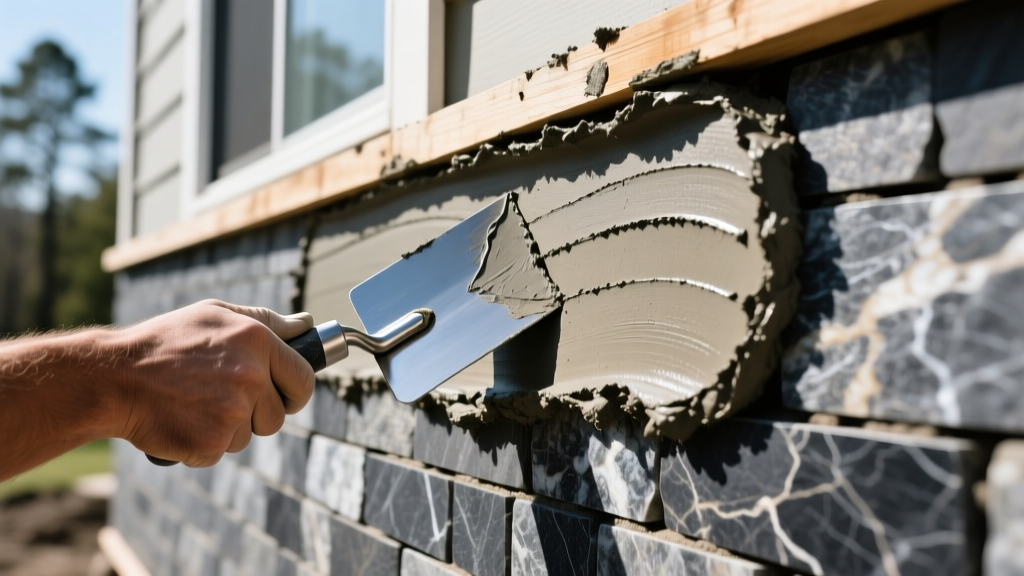
- Manufactured Veneer: Requires ASTM C270 Type S mortar. Type S offers high tensile bond strength, which is critical for adhering the relatively flat back of cast stone to the scratch coat. A standard mix ratio is 1 part Portland cement, 1/2 part hydrated lime, and 4.5 parts damp sand.
- Natural Veneer: Can utilize Type N or Type S mortar. Because natural thin stone often has an irregular, riven back, mechanical interlock plays a larger role than pure chemical adhesion. Many installers prefer a polymer-modified thin-set mortar (ANSI A118.4) for interior natural granite applications to maximize bond strength without the thickness of a traditional mud bed.
The Critical Weep Screed and Flashing Detail
The most common cause of veneer failure—regardless of whether it is natural or manufactured—is moisture wicking from the ground. Building codes mandate the installation of a corrosion-resistant weep screed at the base of all exterior veneer walls.
Exact Placement Specs: The weep screed must be installed a minimum of 4 inches above finished earth grade, or 2 inches above paved surfaces like concrete walkways. The WRB (such as Grade D building paper or a fluid-applied membrane) must lap over the weep screed's attachment flange, ensuring that water draining down the back of the veneer exits through the weep holes rather than migrating into the bottom plate of the wall framing.
Edge Case Troubleshooting: Efflorescence and Staining
A frequent aesthetic complaint with masonry veneers is efflorescence—the white, powdery deposit of water-soluble salts on the surface of the stone.
Natural Granite: True efflorescence on the granite itself is exceptionally rare due to its low absorption rate. However, if a high-alkali Portland cement mortar is used and the joints are not properly tooled and sealed, salts from the mortar can migrate to the surface of the granite. Using a low-alkali mortar or a specialized latex-portland cement mortar mitigates this risk.
Manufactured Granite: Because cast stone contains Portland cement and is highly porous, it is inherently prone to efflorescence if exposed to chronic moisture. To prevent this, never use acid-based cleaners (like muriatic acid) to wash manufactured granite veneer, as the acid reacts with the cement and accelerates salt leaching. Instead, use a stiff bristle brush and a neutral-pH masonry cleaner. Furthermore, ensure that roof runoff is directed away from the veneer via adequately sized gutters and downspouts; chronic saturation will guarantee efflorescence on cast products.
Final Verdict: Aligning Material with Project Scope
The choice between natural and manufactured granite veneer stone is not a matter of one being universally superior, but rather matching the material's physical properties to the project's structural realities and financial parameters. For high-end commercial facades, luxury residential exteriors in severe freeze-thaw climates, or projects where a 100-year maintenance-free lifecycle is required, the premium paid for natural thin-sawn granite and its requisite steel structural supports is a justifiable capital expenditure.
For residential remodels, interior feature walls, wood-frame exteriors with standard load-bearing capacities, and projects where budget constraints dictate a sub-$30/sq. ft. installed cost, manufactured granite veneer provides an exceptional visual approximation with highly manageable structural demands, provided the moisture management details are executed flawlessly.
Written by
Sarah WhitfieldSarah Whitfield is a chartered quantity surveyor (MRICS) and construction cost analyst with 15 years of experience in material pricing, procurement strategy, and project budgeting. She earned her degree in Construction Management from the University of Reading (UK) and has worked on projects ranging from $2M custom homes to $180M mixed-use developments across North America and Europe. Sarah currently leads cost estimating for BuildMat Insight, maintaining a proprietary database of 4,000+ material price points updated quarterly. She is a frequent contributor to RSMeans cost data panels and has presented at the International Cost Engineering Council (ICEC) congress. Based in Denver, CO, Sarah is an avid trail runner and volunteer mentor for Women in Construction.
More from Sarah Whitfield
View all
Wood & Lumber
What Are the Different Types of Wood? A Builder's Guide
Compare structural softwoods, finish hardwoods, and engineered lumber. Analyze Janka ratings, MOE values, and 2026 pricing for construction.
Aug 4, 2026

Walls & Panels
Steel Framing vs Wood Framing: Corrosion and Moisture Defense
Compare steel framing vs wood framing for moisture resistance. Learn about galvanized coatings, condensation risks, and corrosion protection strategies.
Jul 21, 2026

Stone & Masonry
How to Cut Stone Veneer: Wet Saw vs Grinder Comparison
Compare the best tools for cutting stone veneer. We review wet saws, angle grinders, and chop saws to help you achieve clean, chip-free cuts.
Jul 21, 2026