Maintaining Limestone as a Building Material: Expert Care Guide
Master the maintenance of limestone as a building material. Learn expert cleaning protocols, sealer selection, and stain removal to prevent spalling.

The Chemistry of Limestone Degradation
Understanding how to maintain limestone as a building material requires a foundational grasp of its mineralogy. Limestone is a sedimentary rock composed primarily of calcium carbonate (CaCO3). This alkaline composition makes it exceptionally vulnerable to acidic environments. When exposed to acid rain (which contains sulfuric and nitric acids) or improper acidic cleaning agents, the calcium carbonate dissolves, leading to surface etching, loss of architectural detail, and structural weakening.
Furthermore, limestone's inherent porosity—typically ranging from 5% to 15% by volume—allows it to absorb water and dissolved salts. When this moisture migrates to the surface and evaporates, it leaves behind crystalline salts. If the stone is sealed with a non-breathable coating, trapped moisture expands during freeze-thaw cycles, generating internal hydrostatic pressure that exceeds the stone's tensile strength, resulting in catastrophic spalling.
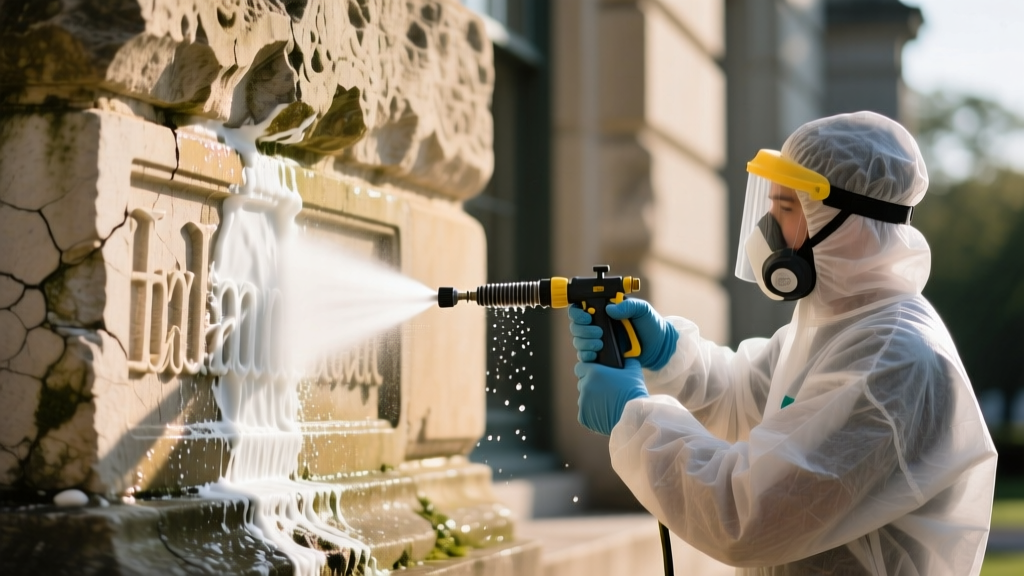
Diagnostic Matrix: Identifying Limestone Pathologies
Before applying any maintenance treatment, accurately diagnose the specific failure mode. Misidentifying a pathology often leads to treatments that exacerbate the underlying issue. Use the following matrix to identify common limestone defects and determine the immediate corrective action.
| Symptom | Primary Cause | Immediate Corrective Action |
|---|---|---|
| White, powdery deposits (Efflorescence) | Soluble salts migrating to the surface via capillary action. | Dry brush with stiff natural bristles. Identify and eliminate the moisture ingress source. Do not wash with water. |
| Flaking or peeling surface (Spalling) | Freeze-thaw cycles exacerbated by trapped moisture behind a film-forming sealer. | Strip existing acrylic/urethane sealers using a specialized alkaline stripper. Allow to dry completely before applying a breathable siloxane. |
| Hard, black gypsum crusts | Atmospheric sulfur dioxide reacting with calcium carbonate to form calcium sulfate. | Apply an ammonium carbonate poultice to draw out the sulfate, followed by gentle micro-abrasion if necessary. |
| Green or black biological staining | Algae, lichen, or moss thriving in persistently damp, shaded microclimates. | Apply a quaternary ammonium biocide. Allow 48 hours of dwell time, then low-pressure rinse. |
Routine Cleaning Protocols and Product Specifications
Routine maintenance of limestone as a building material should prioritize gentleness and chemical compatibility. The goal is to remove atmospheric soiling without altering the stone's surface profile.
Chemical Cleaning Specifications
For general atmospheric dirt and light carbon soiling, utilize an alkaline or pH-neutral cleaner specifically formulated for calcareous stones. A highly effective industry standard is Prosoco SureKlean Limestone & Masonry Cleaner. This product is engineered to break down dirt and grime without reacting with the calcium carbonate matrix.
- Dilution: Mix 1 part cleaner to 1-4 parts clean, cold water depending on soiling severity.
- Application: Pre-wet the wall thoroughly with clean water to prevent the stone from absorbing the cleaning solution too rapidly.
- Dwell Time: Allow the solution to dwell for 5 to 10 minutes. Keep the surface wet during this period; do not let the cleaner dry on the stone.
- Agitation: Scrub with a soft-bristled nylon brush. Avoid wire brushes, which can leave iron particles that will later rust and stain the stone.
Pressure Washing Parameters
High-pressure water can easily erode the softer matrix of limestone, exposing the harder fossil inclusions and creating an uneven, pitted texture. According to guidelines from the National Park Service Technical Preservation Briefs, water pressure must be strictly controlled.
- PSI: Never exceed 800 PSI for standard cleaning; drop to 300 PSI for heavily weathered or historic stone.
- Nozzle: Use a wide 12-inch fan tip to disperse pressure.
- Distance: Maintain a minimum standoff distance of 18 inches from the masonry surface.
- Angle: Spray at a 45-degree downward angle to avoid driving water deep into the mortar joints.
Sealing Strategies: Breathability vs. Protection
The most common maintenance error made by contractors is applying a film-forming sealer (such as acrylics, epoxies, or polyurethanes) to exterior limestone. These coatings create a vapor barrier that traps moisture inside the masonry. When the sun heats the facade, the trapped moisture turns to vapor, creating immense outward pressure that blows the face off the stone.
Instead, specify penetrating silane or siloxane water repellents. These compounds react chemically with the silica in the stone's matrix to form a hydrophobic resin within the pores, rather than on the surface. This allows liquid water to be repelled while permitting water vapor to escape.
Recommended Penetrating Sealers
| Product | Chemistry | Coverage Rate | Service Life |
|---|---|---|---|
| Prosoco Siloxane PD | Siloxane | 100 - 150 sq ft/gal | 5 - 8 Years |
| W. R. Meadows INTRAQUARD | Silane/Siloxane Blend | 100 - 200 sq ft/gal | 7 - 10 Years |
| EcoChem Systems DRY-TREAT 40SK | Silane | 75 - 150 sq ft/gal | 10 - 15 Years |
Always conduct a test patch in an inconspicuous area before full-scale application to ensure the sealer does not induce unwanted darkening or color shifts in the specific limestone quarry run.
Stain Removal Decision Tree
When routine cleaning fails to remove localized stains, a chemical poultice is required. A poultice consists of an absorbent powder (such as diatomaceous earth, kaolin clay, or talc) mixed with a specific chemical solvent to draw the stain out of the stone's pores via capillary action. According to the Natural Stone Institute, matching the solvent to the stain type is critical for success.
1. Organic Stains (Leaves, Berries, Tobacco, Bird Droppings)
- Poultice Liquid: 12% to 20% hydrogen peroxide (hair bleaching strength) or acetone.
- Application: Mix to a thick paste (peanut butter consistency). Apply 1/4 inch thick over the stain, extending 1 inch beyond the stain's edge.
- Cure Time: Cover with plastic wrap and tape the edges. Allow to dry completely (24 to 48 hours). As it dries, it pulls the organic pigments into the powder.
2. Metallic Stains (Rust, Copper)
- Poultice Liquid: Sodium citrate solution or a commercial rust remover specifically buffered for calcareous stone (e.g., Prosoco SureKlean Rust Stain Remover).
- Warning: Standard rust removers contain hydrofluoric or oxalic acid, which will severely etch limestone. Ensure the product is explicitly labeled safe for marble and limestone.
- Cure Time: 24 hours. Multiple applications may be necessary for deep iron oxidation.
3. Oil and Grease Stains
- Poultice Liquid: Acetone or mineral spirits.
- Application: Apply the poultice and cover with plastic. Unlike organic stains, oil poultices should remain damp. Check after 24 hours, re-wet with solvent if dry, and leave for another 24 hours before uncovering to allow the final drying phase.
Cost Analysis: Preventative Maintenance vs. Restoration
Building owners often defer limestone maintenance due to perceived costs, unaware that reactive restoration expenses are exponentially higher. The following cost breakdown illustrates the financial imperative of a proactive maintenance schedule for limestone as a building material.
| Service Type | Average Cost (per sq. ft.) | Frequency |
|---|---|---|
| Routine Low-Pressure Washing | $0.50 - $1.25 | Annually or Bi-Annually |
| Penetrating Siloxane Sealing | $1.50 - $3.50 | Every 7 - 10 Years |
| Chemical Poultice Stain Removal | $15.00 - $30.00 (per sq. ft. of stain) | As Needed |
| Dutchman Repair (Spall Patching) | $150.00 - $350.00 (per linear foot) | Reactive / As Needed |
| Full Block Replacement & Repointing | $800.00 - $2,500.00+ (per block) | Reactive / Severe Failure |
By allocating a marginal annual budget for gentle cleaning and periodic breathable sealing, facility managers can entirely avoid the five-figure invoices associated with masonry Dutchman repairs and scaffolding mobilization for block replacements. Proper maintenance ensures that limestone as a building material retains its structural integrity and aesthetic dignity for centuries.
Written by
James ThorntonJames Thornton is a construction industry veteran with 25 years of hands-on experience in wood framing, lumber grading, and residential building codes. He started as a framing carpenter in rural Oregon, earned his ICC Residential Building Inspector certification, and eventually became a senior plan reviewer for the City of Portland Bureau of Development Services. James holds a B.S. in Wood Science & Technology from Oregon State University and is a certified lumber grader through the West Coast Lumber Inspection Bureau (WCLIB). He has inspected over 3,000 residential construction sites and authored the city's internal guide on advanced framing techniques (2x6 at 24" O.C.). James lives in Bend, OR, where he builds custom timber-frame cabins and competes in lumberjack sports.
More from James Thornton
View all
Insulation
Best Home Insulation Materials: Complete 2026 Guide
Compare top home insulation materials for 2026. Find R-values, installed costs per square foot, and best uses for fiberglass, spray foam, and mineral wool.
Aug 4, 2026

Sustainable Building
Certify Your Green Building Material for LEED and WELL
Step-by-step guide to certifying a green building material for LEED v5 and WELL v2. Master EPDs, HPDs, and VOC limits for 2026 project specifications.
Aug 4, 2026

Stone & Masonry
Veneer Stacked Stone Panels: Interior Design & Style Showcase
Discover how veneer stacked stone panels transform interiors. Explore modern design profiles, material pairings, and technical installation specs.
Aug 4, 2026