Stone Veneer Outside: Manufactured vs. Natural Stone Exterior Comparison
Compare manufactured vs. natural stone veneer outside. Expert analysis on 2026 costs, freeze-thaw durability, ASTM standards, and installation methods.

Material Composition and Industry Standards
When specifying stone veneer outside, the primary decision hinges on the choice between Manufactured Stone Veneer (MSV) and Natural Stone Veneer (NSV). While both deliver the aesthetic of solid masonry, their chemical makeup, structural behavior, and regulatory standards differ significantly.
Manufactured stone veneer is an engineered architectural concrete product. It is cast from molds taken from real stone and colored with iron oxide pigments. The core mixture typically consists of Portland cement, lightweight aggregates (like pumice or expanded shale), and water. High-quality MSV must comply with ASTM C1670, which dictates maximum water absorption limits, compressive strength, and freeze-thaw durability. Brands like Cultured Stone and Eldorado Stone engineer their mixes to achieve a density of roughly 10 to 12 pounds per square foot.
Natural stone veneer, conversely, is quarried directly from the earth. Materials such as limestone, granite, slate, and sandstone are sliced to a uniform thickness (typically 0.75 to 1.5 inches) using diamond-tipped gang saws. Natural stone is governed by specific ASTM standards depending on the rock type, such as ASTM C568 for limestone or ASTM C616 for sandstone. Because it is solid rock, NSV is denser, often weighing between 15 and 25 pounds per square foot, requiring more robust substrate preparation.
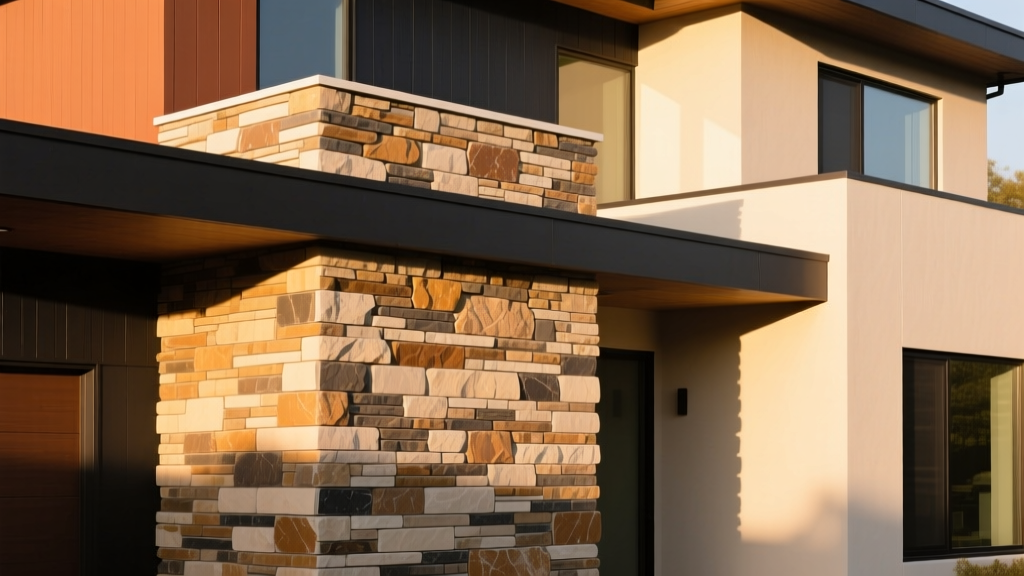
2026 Exterior Installation Cost Matrix
Pricing for exterior stone veneer has stabilized following the supply chain fluctuations of the early 2020s, but labor and specialized moisture-management materials remain significant cost drivers. The following matrix breaks down the expected costs per square foot for a standard 1,500-square-foot exterior facade project.
| Cost Component | Manufactured Stone Veneer (MSV) | Natural Stone Veneer (NSV) |
|---|---|---|
| Material Cost (Stone Only) | $6.50 - $13.00 / sq ft | $14.00 - $28.00 / sq ft |
| Substrate & Moisture Prep | $3.50 - $5.00 / sq ft | $3.50 - $5.00 / sq ft |
| Mortar & Accessories | $1.50 - $2.50 / sq ft | $1.50 - $2.50 / sq ft |
| Professional Labor | $14.00 - $22.00 / sq ft | $18.00 - $28.00 / sq ft |
| Total Installed Cost | $25.50 - $42.50 / sq ft | $37.00 - $63.50 / sq ft |
Labor costs for natural stone are inherently higher because the material requires more cutting, shaping, and physical handling. MSV often features interlocking edges or specialized corner pieces that accelerate installation speed by 15% to 20% compared to natural fieldstone.
Moisture Management and Freeze-Thaw Durability
The most common cause of exterior stone veneer failure is not the stone itself, but trapped moisture. When installing stone veneer outside over wood or steel framing, a continuous drainage plane is non-negotiable.
According to technical guidelines published by the Masonry Veneer Manufacturers Association (MVMA), exterior installations require a minimum 1-inch air space (drainage cavity) behind the metal lath and scratch coat when applied over wood sheathing. This is achieved using corrugated drainage mats or furring strips.
Water Absorption Rates
- Manufactured Stone: ASTM C1670 limits water absorption to a maximum of 8% to 12% by weight. Premium manufacturers achieve rates closer to 6% by using specialized admixtures and denser aggregate blends.
- Natural Granite/Slate: Extremely low absorption, often less than 0.5%, making them virtually impervious to freeze-thaw damage.
- Natural Sandstone/Limestone: Can exhibit absorption rates between 3% and 8%, requiring the application of breathable, silane-siloxane penetrating sealers in northern climates.
Structural Load and Substrate Preparation
While both materials are classified as 'veneers' and do not bear structural loads from the building, their dead weight dictates the required fastening schedules and substrate rigidity.
For MSV (approx. 12 lbs/sq ft), standard 2.5 lb self-furring galvanized steel lath attached with 1-inch roofing nails or staples at 6-inch intervals into the studs is sufficient. The scratch coat must be a polymer-modified Type S mortar, applied to a thickness of 3/8 inch and scored horizontally to provide a mechanical key for the setting bed.
For NSV (approx. 20+ lbs/sq ft), the Brick Industry Association (BIA) recommends upgrading to 3.4 lb galvanized steel lath. Fasteners must penetrate the structural framing by a minimum of 1 inch. In seismic zones or high-wind coastal regions, structural engineers often require supplemental mechanical ties (such as corrugated stainless steel wall ties) anchored directly to the studs every 16 inches vertically and horizontally to prevent delamination during lateral loading events.
Aesthetic Longevity and UV Fading
A frequent concern with manufactured stone is color degradation. In budget-tier MSV, color is applied as a topical slurry during the casting process. When exposed to direct UV radiation and acidic rain, this surface layer can fade or wash away within 7 to 10 years, revealing the gray concrete core.
To mitigate this, specify MSV products that utilize integral coloring. In this manufacturing process, iron oxide pigments are mixed directly into the concrete batch. Even if the surface is chipped or acid-washed, the color remains consistent throughout the entire thickness of the unit. Natural stone, being a geological product, is entirely UV-stable and will only develop a natural patina or lichen growth over decades, which many architects consider a desirable weathering characteristic.
Project Selection Decision Framework
Use the following conditional logic to determine the optimal material for your specific exterior application:
- Choose Manufactured Stone Veneer If:
- Your project budget is strictly capped below $40 per square foot installed.
- The substrate is an existing, non-reinforced masonry wall where reducing dead load is a priority.
- You require exact color matching across multiple phases of a multi-year commercial development.
- The design calls for highly uniform, repetitive patterns like stacked ledgestone or smooth river rock.
- Choose Natural Stone Veneer If:
- The project is a historic restoration or located in a strict architectural review district requiring authentic materials.
- The stone will be installed in high-impact zones (e.g., exterior wainscoting near driveways) where concrete chipping would reveal an artificial core.
- You are utilizing local, regionally quarried stone to achieve LEED credits for regional materials and reduced transportation emissions.
- The design requires large, irregular, multi-dimensional ashlar patterns that are difficult to replicate in concrete molds.
Frequently Asked Questions
Can I install stone veneer outside directly over existing wood siding?
No. Wood siding (whether cedar, vinyl, or engineered wood) is not a structurally sound substrate for masonry fasteners, and it traps moisture. All existing siding must be stripped down to the OSB or plywood sheathing. A weather-resistive barrier (WRB) like Tyvek HomeWrap or a fluid-applied membrane must be applied, followed by the metal lath and scratch coat.
Does exterior stone veneer require weep holes?
Yes. When stone veneer outside is installed over a framed wall with a drainage cavity, weep holes must be integrated into the head flashing at the base of the wall, above windows, and above doors. Standard practice dictates open-head joint weeps or corrugated plastic weep vents placed every 16 to 24 inches along the bottom course to allow trapped hydrostatic pressure to escape.
Written by
Priya KapoorPriya Kapoor is a real estate market analyst and construction economics researcher with expertise in housing affordability, development feasibility, and infrastructure investment. She holds a Master of Regional Planning from Cornell University and previously worked as a senior analyst at CBRE's Investment Properties group, where she modeled returns for $4B in mixed-use development pipelines. Priya now runs an independent research practice advising developers, municipalities, and REITs on construction cost forecasting and market timing. She publishes the quarterly "BuildMat Market Pulse" report tracking material price indices across 12 commodity categories. Based in Austin, TX, Priya serves on the board of Habitat for Humanity Austin and is a marathon runner.
More from Priya Kapoor
View all
Construction Cost
Cost to Build a 1600 Sq Ft Home in 2026: Full Breakdown
Accurate 2026 cost to build a 1600 sq ft home—material, labor, and regional pricing breakdowns included. Plan your budget with real-time estimates.
Aug 11, 2026

Wood & Lumber
Name the Types of Wood for Pressure Treatment and Preservation
Learn how to name the types of wood best suited for pressure treatment. Compare species treatability, chemical retention levels, and 2026 preservation costs.
Aug 4, 2026

Stone & Masonry
Stone Veneer Suppliers Lindenhurst: 2026 Cost Analysis
Analyze 2026 stone veneer costs in Lindenhurst, NY. Compare local supplier pricing, delivery fees, and Suffolk County installation labor rates.
Aug 4, 2026