Homes With Stone Veneer: 2026 Cost Breakdown & ROI
Discover the true cost of adding stone veneer to your home. We break down 2026 material, labor, and ROI data to help you budget your exterior upgrade.

The Financial Case for Upgrading to Stone Veneer
When evaluating exterior renovations, homeowners and real estate investors alike are increasingly drawn to the aesthetic and financial benefits of homes with stone veneer. Unlike full-thickness natural masonry, adhered stone veneer provides the high-end visual weight of quarried rock at a fraction of the structural and material cost. However, accurately budgeting for this upgrade requires moving beyond basic square-footage estimates. In 2026, fluctuating material supply chains, specialized labor shortages, and updated building code requirements for water management have significantly shifted the cost landscape.
This comprehensive cost analysis dissects the exact expenses associated with manufactured and natural stone veneer installations. We will examine material pricing, specialized labor rates, hidden structural prep costs, and the ultimate return on investment (ROI) to help you determine if this premium cladding makes financial sense for your specific property.
Material Costs: Manufactured vs. Natural Stone Veneer
The most significant variable in your budget will be the choice between Manufactured Stone Veneer (MSV) and natural thin stone veneer. MSV is a Portland cement-based product cast in molds taken from real stone, while natural thin veneer is actual quarried stone sliced to a 1-inch thickness.
| Material Type | Cost Per Sq. Ft. (Materials Only) | Weight Per Sq. Ft. | Best Application |
|---|---|---|---|
| Manufactured Stone Veneer (MSV) | $7.50 - $13.00 | 10 - 12 lbs | Full facade overhauls, interior accent walls, budget-conscious luxury |
| Natural Thin Stone Veneer | $16.00 - $28.00 | 12 - 15 lbs | High-end custom builds, historical restorations, premium resale markets |
| Interlocking Panel Systems | $9.00 - $15.00 | 8 - 11 lbs | DIY installations, tight timelines, flat exterior surfaces |
While MSV dominates the market due to its lower price point and consistent coloring, natural thin veneer offers unmatched authenticity. According to the Natural Stone Institute, natural stone will not fade under UV exposure and possesses a geological lifespan that outlasts the structure itself. However, the premium for natural stone extends beyond the material; its irregular shapes often require 15% to 20% more waste factor during cutting and fitting compared to the modular edges of MSV.
Labor, Prep, and Hidden Installation Expenses
Labor for stone veneer installation is highly specialized. Unlike vinyl or fiber cement siding, stone veneer requires a masonry skill set. In 2026, expect to pay between $11.00 and $18.00 per square foot for professional installation of MSV, and up to $25.00 per square foot for natural stone, which requires more meticulous piecing and mortar joint tooling.
The Mandatory Prep Work
You cannot simply adhere stone veneer to existing painted wood or vinyl siding. The substrate must be stripped to the sheathing, or a specialized furring strip framework must be built out. The standard installation sequence involves:
- Weather-Resistive Barrier (WRB): Two layers of Grade D building paper or a high-performance fluid-applied membrane.
- Corrosion-Resistant Lath: Minimum 2.5 lb self-furring galvanized steel lath, fastened directly to the studs (not just the sheathing) every 6 inches.
- Scratch Coat: A 1/2-inch layer of Type S mortar, scored horizontally to provide a mechanical key for the setting bed.
- Setting and Pointing: Applying the stones with a 1/2-inch mortar bed and filling the joints with a grout bag to prevent surface staining.
⚠️ Hidden Cost Alert: Water Management & Scaffolding
Many contractor bids omit critical water management components. The Masonry Veneer Manufacturers Association (MVMA) strictly mandates the use of a weep screed at the base of all exterior stone veneer walls to allow trapped moisture to escape. Omitting a weep screed or failing to integrate it with the WRB will lead to catastrophic wood rot and void your material warranty. Additionally, for two-story homes, scaffolding erection and teardown can add $1,500 to $3,500 to the total project cost, a line item frequently excluded from initial per-square-foot estimates.
ROI Analysis: Do Homes With Stone Veneer Appraise Higher?
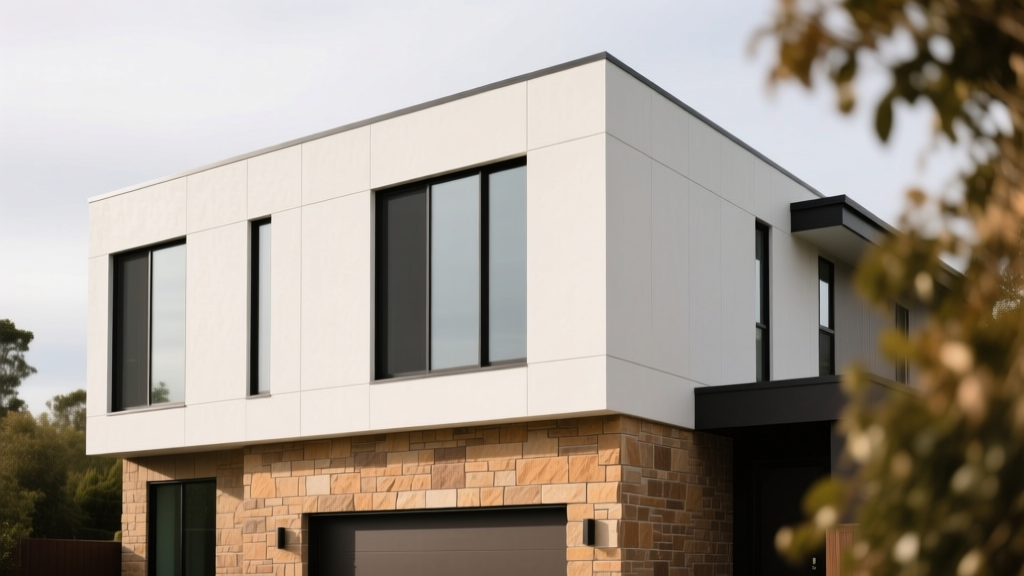
The financial justification for homes with stone veneer extends far beyond curb appeal; it is deeply embedded in appraisal metrics and buyer psychology. Stone conveys permanence, structural integrity, and luxury. When analyzing the return on investment, exterior stone veneer consistently ranks among the top tier of remodeling projects.
'Homes featuring exterior masonry or high-quality stone veneer accents typically appraise 5% to 8% higher than identical counterparts with purely vinyl or aluminum siding, primarily due to the perceived durability and reduced maintenance lifecycle expected by modern buyers.'
— 2026 Residential Appraisal Trends Report, Appraisal Institute
For a standard 1,500-square-foot facade upgrade costing roughly $28,000 (MSV installed), homeowners can expect to recoup between 85% and 102% of the project cost at resale, depending on the local market. In premium suburban neighborhoods where masonry is the architectural norm, failing to have stone accents can actually result in functional obsolescence, making the veneer a mandatory expense to remain competitive.
Regional Labor Rate Variations
Masonry labor is not uniformly distributed. The availability of skilled masons drastically alters the final invoice. Below is a 2026 snapshot of regional labor premiums for adhered stone veneer installation:
- Northeast & Mid-Atlantic (e.g., NY, MA, PA): $16.00 - $22.00 / sq. ft. (High union presence, strict municipal building codes, premium labor rates).
- West Coast (e.g., CA, WA, OR): $15.00 - $20.00 / sq. ft. (Seismic bracing requirements and high cost of living drive up masonry wages).
- Midwest (e.g., IL, OH, MI): $11.00 - $15.00 / sq. ft. (Strong historical masonry workforce, moderate labor costs).
- Southeast (e.g., FL, GA, TX): $10.00 - $14.00 / sq. ft. (Lower labor overhead, though high humidity requires specialized efflorescence-preventing mortar additives).
Technical Specs That Protect Your Investment
To ensure your investment does not fail prematurely, you must hold your contractor to specific industry standards. The most common failure mode for stone veneer is efflorescence (white, powdery salt deposits) and water intrusion leading to delamination.
Crucial ASTM Standards to Demand in Your Contract
Do not accept vague language like 'installed to manufacturer specifications.' Your contract should explicitly state compliance with the following standards:
- ASTM C1670: Standard Specification for Adhered Manufactured Stone Masonry Veneer. This ensures the material itself meets rigorous freeze-thaw and compressive strength testing.
- ASTM C1063: Standard Specification for Installation of Lathing and Furring. This dictates the exact fastener spacing and lath overlap required to prevent the scratch coat from cracking under thermal expansion.
- ASTM C270: Standard Specification for Mortar for Unit Masonry. Your installer must use Type S mortar for the scratch coat and setting bed, which provides higher tensile bond strength than Type N, crucial for vertical adhered applications.
Budgeting Framework: Estimating Your Specific Project
To generate a highly accurate budget for your home, follow this step-by-step calculation framework:
The 2026 Stone Veneer Budget Calculator
Step 1: Calculate Net Square Footage. Measure the total wall area, then subtract the square footage of all windows, doors, and garage openings. (e.g., 1,200 sq ft total - 200 sq ft openings = 1,000 net sq ft).
Step 2: Add Waste Factor. Multiply net sq ft by 1.10 for MSV, or 1.15 for natural stone to account for cuts and breakage.
Step 3: Material Multiplier. Multiply adjusted sq ft by $10.00 (average MSV cost).
Step 4: Labor & Prep Multiplier. Multiply adjusted sq ft by $14.00 (average regional labor + lath + mortar).
Step 5: Add Fixed Ancillary Costs. Add $2,500 for scaffolding, demo of existing siding, and weep screed/flashing integration.
Example: 1,100 adjusted sq ft x $24.00 (Mat + Labor) = $26,400 + $2,500 Ancillary = $28,900 Total Project Cost.
Ultimately, homes with stone veneer represent a premium capital improvement that bridges the gap between cosmetic siding upgrades and structural masonry. By understanding the nuanced costs of materials, the non-negotiable labor requirements for water management, and the strong appraisal premiums associated with masonry facades, you can confidently execute a project that enhances both the architectural character and the long-term equity of your property.
Written by
David NakamuraDavid Nakamura is a licensed architect (AIA) and construction technology writer focused on sustainable building methods, mass timber engineering, and high-performance building envelopes. He holds a Master of Architecture from the University of Washington and is a certified Passive House Consultant (CPHC). David spent eight years at the Seattle firm Mithun, where he led the design of three LEED Platinum projects, before founding his own practice specializing in net-zero residential design. He serves on the editorial advisory board of GreenBuilder Magazine and has authored peer-reviewed papers on cross-laminated timber (CLT) connections for the Journal of Structural Engineering. In his spare time, David teaches woodworking at Pratt Fine Arts Center and kayaks the Puget Sound.
More from David Nakamura
View all
Construction Cost
Labor Cost to Build a Deck Per Sq Ft: 2026 Installation Guide
Discover the exact labor cost to build a deck per sq ft in 2026. This installation guide breaks down contractor rates, complexity factors, and hidden fees.
Aug 4, 2026

Construction Cost
How Much Does It Cost to Build a 3 Bedroom House? Financing Guide
Learn exactly how much it costs to build a 3 bedroom house and explore 2026 financing options, construction loan types, and budget frameworks for your build.
Aug 4, 2026

Construction Cost
Cost to Build a Tennis Court: 2026 Guide
How much does it cost to build a tennis court in 2026? Breakdowns for asphalt, concrete, and synthetic surfaces plus fencing and lighting.
Jul 30, 2026