Modern Design Ideas Using Stack Stone Veneer Panels
Explore architectural applications, material comparisons, and lighting frameworks for stack stone veneer panels in contemporary interior and exterior design.

The Defining Characteristics of Stack Stone Veneer
Stack stone veneer panels represent a definitive shift from rustic, irregular masonry to precise, linear aesthetics. Characterized by tight, groutless joints and uniform horizontal coursing, this profile creates a continuous, monolithic visual flow. Unlike traditional fieldstone or ledgestone, which rely on varying depths and wide mortar joints to create shadow lines, stack stone relies on the natural micro-fissures and tight horizontal seams of the material itself. Standard dimensions for individual stack stone pieces typically range from 2 to 6 inches in height and 12 to 24 inches in length, while modern manufactured panels often come in 48-inch by 24-inch interlocking sheets designed to mimic this dry-stack appearance without the individual piece placement.
The absence of grout is the defining architectural feature. This "dry-stack" look aligns perfectly with contemporary, minimalist, and transitional design languages, where clean lines and unbroken geometric planes are paramount. According to the Masonry Veneer Manufacturers Association, the tight-stack profile has become the fastest-growing category in architectural stone veneer, driven by demand for modern farmhouse and contemporary commercial facades.
Material Matrix: Natural vs. Manufactured vs. Polyurethane
Selecting the right stack stone veneer panels requires balancing structural load, budget, and environmental exposure. The market is currently divided into three primary material categories, each with distinct physical properties and installation requirements.
| Material Type | Weight (lbs/sq ft) | Avg Material Cost | Best Design Application | Fastening / Installation |
|---|---|---|---|---|
| Natural Quartzite / Slate | 12.0 - 15.0 | $12 - $18 / sq ft | High-end interior feature walls, luxury spa bathrooms | Metal lath, scratch coat, Type S Mortar |
| Cementitious Manufactured | 8.0 - 10.5 | $8 - $12 / sq ft | Exterior facade accents, commercial lobbies, fireplace surrounds | WRB, metal lath, mortar (or mortarless systems) |
| HDPU (Polyurethane) | 1.0 - 1.5 | $10 - $14 / sq ft | Exterior retrofits, ceiling applications, DIY interior accents | Direct-to-sheathing structural screws, PVC caulk |
Interior Showcase: High-Impact Design Applications
The Monolithic Fireplace Surround
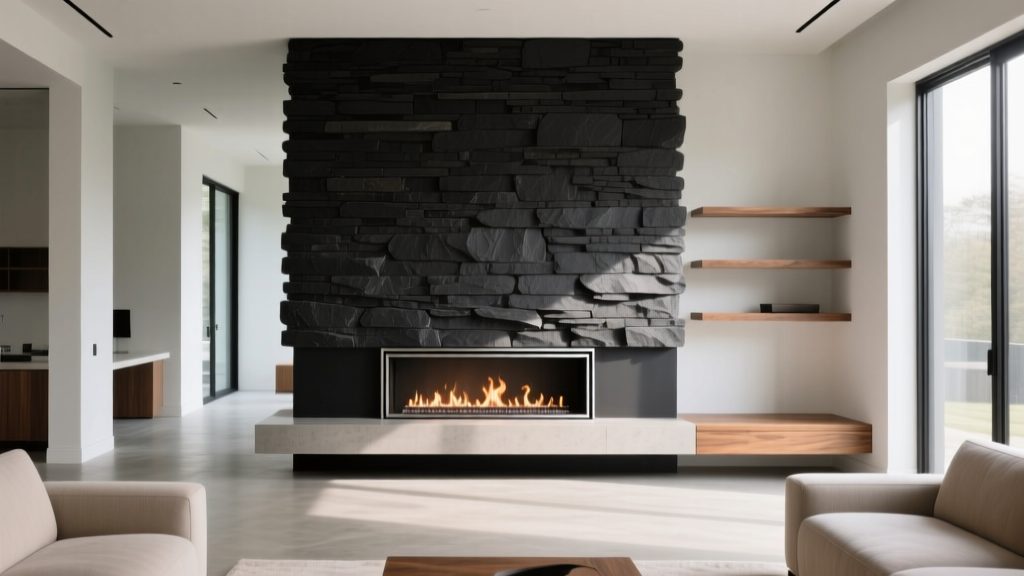
The most prominent interior application for stack stone veneer panels is the floor-to-ceiling fireplace surround. To achieve a truly monolithic look, designers are eliminating the traditional raised hearth and mantel, running the linear stone directly from the finished floor to the ceiling plane. When using natural stone or cementitious veneer, maintain the manufacturer's specified clearance to combustibles (typically 12 inches for natural stone, though always verify local building codes). For linear gas fireplaces, the horizontal lines of the stack stone echo the elongated flame bed, creating a cohesive, grounded aesthetic.
Biophilic Bathroom & Spa Accents
Stack stone introduces necessary tactile contrast in modern bathrooms dominated by large-format porcelain and glass. However, moisture management is critical. Natural stack stone is highly porous. If installed in a wet zone or high-humidity environment, it must be treated with an impregnating silane/siloxane sealer, such as Prosoco Siloxa-Tek 8510, which penetrates the micro-fissures without altering the stone's natural matte finish. Avoid topical film-forming sealers, which will trap moisture behind the stone and cause spalling or efflorescence over time.
Never install unsealed porous natural stack stone on a kitchen island base. Grease aerosolization from nearby cooking surfaces will permanently stain the micro-fissures and tight horizontal seams. If wrapping a 36-inch high island base, specify a high-density polyurethane (HDPU) alternative, or apply a penetrating fluoropolymer sealer rated specifically for interior grease resistance. Always cap the top edge of the veneer with a metal Schluter profile or a solid surface capstone to prevent liquid spills from migrating into the top joint.
Exterior Architecture: Facade Integration
On exterior elevations, stack stone veneer panels are rarely used to cover an entire structure. Instead, they serve as anchoring elements in mixed-material facades. The prevailing 2026 architectural trend pairs the linear geometry of stack stone with contrasting organic or industrial materials:
- Shou Sugi Ban & Stack Stone: The deep, charred texture of burned cedar siding provides a striking visual counterpoint to the clean, light-colored horizontal lines of limestone or manufactured stack stone.
- Corten Steel & Dark Slate: The rusted, organic patina of weathering steel fascia bands beautifully against the rigid, dark grey tones of natural slate stack stone.
- Black Aluminum Window Mullions: Using a bright white or light grey quartzite stack stone around dark, matte-black window frames creates a high-contrast, contemporary commercial aesthetic.
For exterior installations, the National Association of Home Builders emphasizes the necessity of a proper Weather-Resistive Barrier (WRB) and weep screed at the base of the wall to allow trapped moisture to escape, preventing structural rot behind the veneer.
Mastering the Corners: Mitering vs. Interlocking
The hallmark of a premium stack stone installation is how the outside corners are handled. Visible mortar or caulk lines on a 90-degree corner immediately break the illusion of solid masonry.
For natural stone, fabricators must miter two flat pieces at a precise 45-degree angle. This requires a 10-inch bridge saw with a continuous rim diamond blade, cutting from the back face to prevent micro-chipping on the visible arris. The seam is then bonded using a two-part epoxy color-matched to the stone's internal matrix (e.g., Tenax Akeemi). Natural corner pieces with 90-degree returns are available but are rare, expensive ($25-$40 per linear foot), and often disrupt the horizontal coursing pattern.
For manufactured and HDPU panels, manufacturers provide pre-cast interlocking corner pieces. These feature alternating长短 (long-short) return lengths that weave into the horizontal field panels, completely hiding the vertical seam and reducing corner labor costs by up to 40%.
Lighting Framework: Grazing vs. Washing Textured Veneer
Stack stone relies heavily on directional lighting to reveal its texture. Because the joints are tight and groutless, the depth of the stone face (the relief) is the only element that casts shadows. According to guidelines from the Illuminating Engineering Society, the technique of "wall grazing" is vastly superior to "wall washing" for this specific material.
Wall Washing places light fixtures far from the wall to eliminate shadows, creating a flat, uniform illumination. This completely destroys the visual depth of stack stone, making it look like printed wallpaper.
Wall Grazing places the light source extremely close to the wall plane (typically 6 to 12 inches away), aiming the beam sharply up or down. This exaggerates the micro-texture and horizontal seams, creating dramatic, high-contrast shadow lines that emphasize the linear geometry of the panels.
Specification Directive: For interior stack stone walls, specify 3000K LED linear grazers with a narrow 15-degree beam angle. Mount the fixture 8 inches from the wall plane. For exterior soffits, use adjustable, wet-rated architectural spotlights with snoots to prevent light spill, aiming down at a steep angle to rake the stone facade.
2026 Cost & Sourcing Analysis
When budgeting for stack stone veneer panels, material costs are only half the equation. The labor variance between natural stone and modern alternatives is massive.
| Cost Component | Natural Stone (Quartzite/Slate) | Manufactured Cementitious | HDPU Polyurethane Panels |
|---|---|---|---|
| Material Cost (per sq ft) | $12.00 - $18.00 | $8.00 - $12.00 | $10.00 - $14.00 |
| Prep & Substrate Materials | $2.50 - $4.00 | $2.50 - $4.00 | $0.50 - $1.00 |
| Professional Installation Labor | $18.00 - $28.00 | $14.00 - $22.00 | $4.00 - $8.00 |
| Total Installed Cost (per sq ft) | $32.50 - $50.00 | $24.50 - $38.00 | $14.50 - $23.00 |
High-Density Polyurethane (HDPU) panels have captured significant market share in the renovation sector. Because they weigh roughly 1.2 lbs per square foot, they bypass the need for structural reinforcement, metal lath, scratch coats, and mortar. Installation requires structural wood screws driven directly into OSB or plywood sheathing, with color-matched PVC caulk at the seams. This makes them the dominant choice for exterior retrofits, ceiling applications, and projects where structural load limits or tight labor budgets prohibit cementitious or natural stone.
Final Design Directives
Stack stone veneer panels are a powerful architectural tool when applied with restraint and technical precision. Prioritize tight, groutless profiles to maintain contemporary aesthetics. Always match the material weight to the structural capacity of the substrate, specify miters or interlocking corners to preserve the monolithic illusion, and utilize narrow-beam grazing lighting to activate the horizontal shadow lines. By treating the material as a precise geometric cladding rather than traditional rustic masonry, designers can achieve high-impact, timeless environments.
Written by
Priya KapoorPriya Kapoor is a real estate market analyst and construction economics researcher with expertise in housing affordability, development feasibility, and infrastructure investment. She holds a Master of Regional Planning from Cornell University and previously worked as a senior analyst at CBRE's Investment Properties group, where she modeled returns for $4B in mixed-use development pipelines. Priya now runs an independent research practice advising developers, municipalities, and REITs on construction cost forecasting and market timing. She publishes the quarterly "BuildMat Market Pulse" report tracking material price indices across 12 commodity categories. Based in Austin, TX, Priya serves on the board of Habitat for Humanity Austin and is a marathon runner.
More from Priya Kapoor
View all
Construction Cost
Cost to Build a 1600 Sq Ft Home in 2026: Full Breakdown
Accurate 2026 cost to build a 1600 sq ft home—material, labor, and regional pricing breakdowns included. Plan your budget with real-time estimates.
Aug 11, 2026

Wood & Lumber
Name the Types of Wood for Pressure Treatment and Preservation
Learn how to name the types of wood best suited for pressure treatment. Compare species treatability, chemical retention levels, and 2026 preservation costs.
Aug 4, 2026

Stone & Masonry
Stone Veneer Suppliers Lindenhurst: 2026 Cost Analysis
Analyze 2026 stone veneer costs in Lindenhurst, NY. Compare local supplier pricing, delivery fees, and Suffolk County installation labor rates.
Aug 4, 2026