Natural Stone Veneer Dealers Near Me: Local Cost Analysis & Quote Comparison
Compare quotes from natural stone veneer dealers near you. Learn local pricing, hidden delivery fees, and how to evaluate regional stone yards in 2026.

The True Cost of Buying Local: Natural Stone Veneer Dealers Near Me
When homeowners and contractors search for "natural stone veneer dealers near me," the immediate assumption is that buying locally saves money on freight. While regional stone yards eliminate the cross-country LTL (Less Than Truckload) shipping fees associated with national distributors, local pricing structures introduce a different set of variables. Evaluating the actual cost of procuring natural stone veneer from a local dealer requires looking past the per-square-foot material tag and analyzing pallet minimums, waste factors, and accessory markups.
This cost analysis breaks down exactly what to expect when sourcing natural stone veneer from regional suppliers, providing a framework to compare local quotes against big-box retail and direct-quarry purchasing.
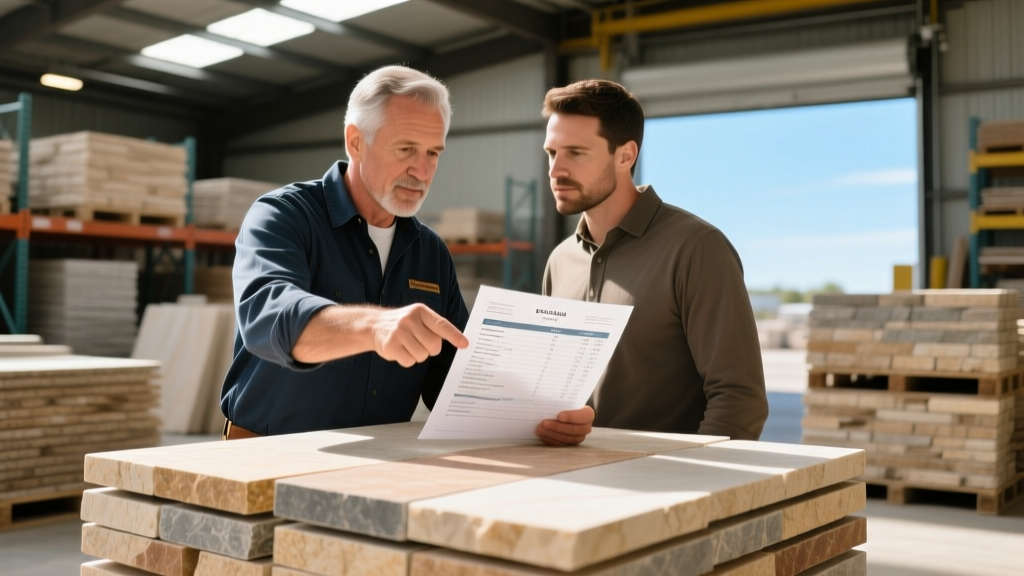
Base Material Pricing: Local Yards vs. Big Box Retailers
The most significant advantage of a specialized local stone dealer is inventory depth and quality control. Big-box stores typically stock manufactured stone veneer (MSV) or lower-grade, pre-packaged natural stone in limited color palettes. Local dealers source directly from regional quarries or specialized importers, offering premium natural options like Oklahoma ledger stone, Wisconsin limestone, or Pennsylvania fieldstone.
2026 Average Pricing Matrix by Stone Type
Below is a comparative cost matrix for natural stone veneer materials sourced from regional dealers versus national home improvement centers. Prices reflect material only, excluding mortar, lath, and labor.
| Stone Veneer Type | Local Dealer Price (Per Sq. Ft.) | Big Box Retail Price (Per Sq. Ft.) | Typical Pallet Size (Sq. Ft.) |
|---|---|---|---|
| Limestone Thin Veneer (Sawn) | $9.50 - $13.00 | Rarely Stocked | 250 - 300 |
| Granite Fieldstone (Split Face) | $11.00 - $15.50 | $12.00 - $14.00 (Limited Colors) | 200 - 250 |
| Slate Ledger Panels (Pre-assembled) | $14.00 - $19.00 | $16.00 - $22.00 | 150 - 200 |
| Sandstone Mosaic (Irregular) | $8.00 - $11.50 | Rarely Stocked | 300 - 350 |
| Quartzite Thin Veneer (Stacked) | $12.50 - $17.00 | $14.00 - $18.00 | 200 - 250 |
Decoding the Local Dealer Quote: Hidden Costs to Anticipate
When you request a quote from natural stone veneer dealers near you, the per-square-foot material cost is only the baseline. Specialized masonry yards structure their invoices differently than standard retail environments. Failing to account for these line items is the primary reason residential stone projects exceed their initial budgets.
1. The Corner Piece Premium
Natural stone veneer requires specialized corner units to wrap around exterior edges, window returns, and fireplaces seamlessly. While flat veneer is priced by the square foot, corners are priced by the linear foot.
- Flat Veneer Cost: $10.00 / sq. ft.
- Corner Veneer Cost: $16.00 to $24.00 / linear ft.
2. Pallet Minimums and Breakage Allowances
Local dealers rarely break pallets for natural stone due to the risk of color lot mismatches. If your project requires 180 square feet of flat veneer, and the dealer's pallets are packaged in 250-square-foot increments, you must purchase the full 250 sq. ft. pallet.
Furthermore, the Masonry Magazine industry standards suggest ordering a 10% to 15% waste factor for natural stone due to cutting waste and transit breakage. Local dealers will automatically build this into their quotes, meaning a 200 sq. ft. wall will be quoted for 230 sq. ft. of material.
3. Local Delivery and Equipment Fees
Unlike manufactured stone, which is relatively lightweight, natural stone veneer pallets weigh between 2,500 and 3,500 lbs.
- Standard Curbside Delivery (50-mile radius): $150 - $250
- Boom Truck / Moffett Forklift Delivery: $350 - $600
How to Evaluate and Compare Local Stone Yards
Not all "dealers near me" operate with the same level of expertise or inventory transparency. Use this decision framework to vet local suppliers before committing to a purchase.
Many local landscape supply yards do not actually stock natural thin veneer. They act as brokers, ordering from regional wholesalers and adding a 20% to 35% handling markup. Always ask the dealer: "Is this specific stone color and profile currently on your lot, or is it a special order from a distributor?" If it is a special order, ask for the direct wholesaler contact or seek a dedicated masonry supply house instead.
The 4-Point Dealer Vetting Checklist
- Lot Consistency Guarantees: Natural stone varies wildly by quarry seam. Ask the dealer if they can guarantee that all flat and corner pieces come from the exact same production lot. Reputable yards will pull from the same bales to ensure color continuity.
- ASTM Testing Documentation: For exterior applications in freeze-thaw climates, request the ASTM C67 (absorption) and ASTM C99 (flexural strength) test reports for the stone. If the dealer cannot provide these, the stone may spall or delaminate after two winters.
- Sample Availability: Never buy natural stone from a digital brochure. A quality local dealer will provide a physical 12"x12" sample board or allow you to view an open pallet in the yard to inspect the thickness and backing consistency.
- Return Policies on Unopened Pallets: Because of pallet minimums, you will likely over-order. Negotiate a restocking agreement upfront. Many local yards will accept returns of unopened, undamaged pallets for a 15% to 20% restocking fee, which is vastly cheaper than absorbing the cost of 50 unused square feet.
Regional Price Variations Across the United States
The cost of natural stone veneer is heavily dictated by your proximity to active quarries. Freight is the great equalizer in masonry materials. According to data from the U.S. Geological Survey (USGS), the localized availability of specific stone types drastically shifts regional pricing.
- Northeast & Mid-Atlantic: Abundant access to Pennsylvania Bluestone, New York limestone, and granite. Expect local dealer pricing for these regional stones to be at the lower end of the spectrum ($8 - $12/sq. ft.), while imported western quartzite will carry heavy freight surcharges.
- Midwest: Wisconsin and Indiana limestone dominate. Local yards will have deep inventories of sawn limestone thin veneer. However, slate and quartzite must be shipped from the East or West coasts, inflating local dealer quotes by 30% or more.
- Southwest & West Coast: Rich in sandstone, flagstone, and slate. Local dealers in Arizona and Colorado offer highly competitive pricing on desert mosaic and sandstone ledger panels. Sourcing traditional eastern fieldstone here will result in prohibitive LTL freight costs.
Finalizing Your Local Procurement Strategy
Finding the right natural stone veneer dealer in your area is about balancing material authenticity with logistical reality. While big-box stores offer convenience, they lack the specialized corner profiles, lot-matching capabilities, and masonry-grade accessories required for a professional natural stone installation. When gathering quotes from local dealers, insist on a line-item breakdown that separates flat veneer, linear corner footage, delivery equipment requirements, and applicable waste factors. By controlling these variables and verifying the quarry source of the stone, you secure a premium natural material that will outlast manufactured alternatives by decades, while keeping your procurement costs firmly anchored to local market realities.
Written by
David NakamuraDavid Nakamura is a licensed architect (AIA) and construction technology writer focused on sustainable building methods, mass timber engineering, and high-performance building envelopes. He holds a Master of Architecture from the University of Washington and is a certified Passive House Consultant (CPHC). David spent eight years at the Seattle firm Mithun, where he led the design of three LEED Platinum projects, before founding his own practice specializing in net-zero residential design. He serves on the editorial advisory board of GreenBuilder Magazine and has authored peer-reviewed papers on cross-laminated timber (CLT) connections for the Journal of Structural Engineering. In his spare time, David teaches woodworking at Pratt Fine Arts Center and kayaks the Puget Sound.
More from David Nakamura
View all
Construction Cost
Labor Cost to Build a Deck Per Sq Ft: 2026 Installation Guide
Discover the exact labor cost to build a deck per sq ft in 2026. This installation guide breaks down contractor rates, complexity factors, and hidden fees.
Aug 4, 2026

Construction Cost
How Much Does It Cost to Build a 3 Bedroom House? Financing Guide
Learn exactly how much it costs to build a 3 bedroom house and explore 2026 financing options, construction loan types, and budget frameworks for your build.
Aug 4, 2026

Construction Cost
Cost to Build a Tennis Court: 2026 Guide
How much does it cost to build a tennis court in 2026? Breakdowns for asphalt, concrete, and synthetic surfaces plus fencing and lighting.
Jul 30, 2026