How to Select Stone Veneer for Fireplace Surrounds and Hearths
Compare natural and manufactured stone veneer for fireplace surrounds. Explore weight limits, heat clearances, top brands, and installation costs.

The Core Decision: Natural vs. Manufactured Stone Veneer
When specifying stone veneer for fireplace applications, the primary fork in the road is choosing between natural stone and manufactured stone veneer (MSV). Natural stone is quarried and sliced, offering unparalleled authenticity and thermal mass. However, it is heavy, expensive, and requires significant structural support. Manufactured stone veneer, governed by the ASTM C1670 standard, is a Portland cement-based product cast in molds from real stone. Modern MSV replicates the exact mineral veining and texture of natural rock while weighing roughly half as much.
- Choose Natural Stone if: You are building a new masonry fireplace from scratch, require high thermal mass to retain and radiate heat, and have the budget for structural reinforcement.
- Choose Manufactured Stone if: You are retrofitting an existing drywall-framed fireplace, want to minimize structural load, or need specific color consistency across a large surface area.
Weight Limits and Substrate Preparation
The most common failure point in fireplace veneer projects is substrate collapse due to uncalculated dead loads. You cannot adhere stone veneer directly to standard drywall or painted surfaces. The weight of the stone, combined with the mortar and metal lath, will eventually pull the paper face off the drywall.
| Material Type | Weight per Sq. Ft. | Required Substrate | Structural Reinforcement |
|---|---|---|---|
| Natural Stone Veneer | 10 - 15 lbs | Cement backer board + Lath | Often requires blocking or steel studs |
| Manufactured Stone (MSV) | 6 - 9 lbs | Cement backer board + Lath | Standard wood framing (16" O.C.) |
| High-Density Polyurethane | 1 - 2 lbs | Direct to drywall or plywood | None required |
For a standard interior fireplace remodel, strip the existing drywall down to the studs. Install a weather-resistive barrier (even indoors, to prevent mortar moisture from warping wood studs), followed by 2.5 lb self-furring galvanized metal lath, and a 1/2-inch scratch coat of Type S mortar. Once the scratch coat cures for 24 to 48 hours, the wall is ready to bear the veneer load.
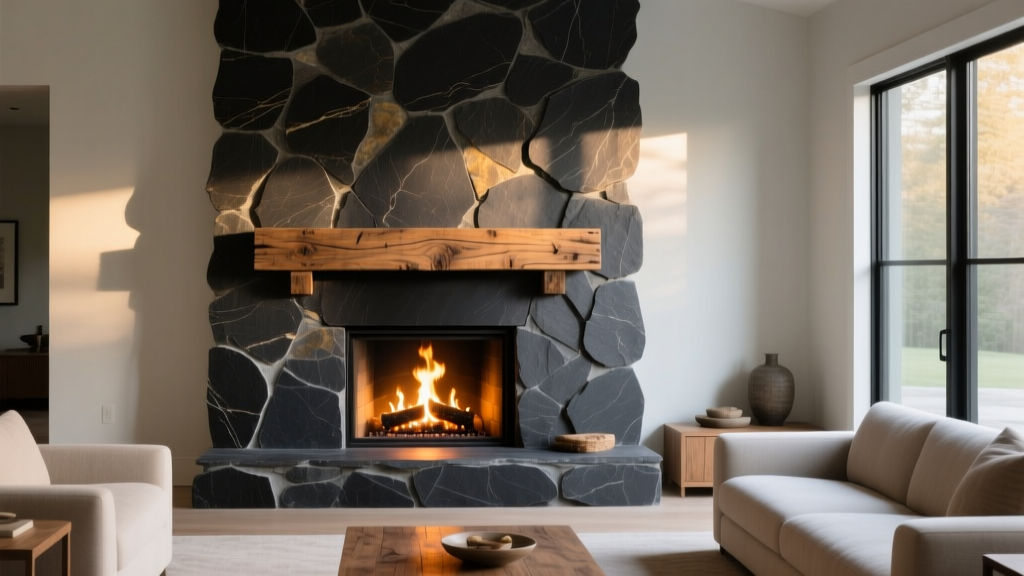
Heat Tolerance and Clearance to Combustibles
While the stone veneer itself is entirely non-combustible, the fireplace system as a whole is governed by strict safety codes. According to NFPA 211 (Standard for Chimneys, Fireplaces, Vents, and Solid Fuel-Burning Appliances), you must maintain specific clearances between the firebox opening and any combustible materials, such as a wooden mantel or exposed wood framing.
Typically, a combustible mantel must be placed at least 12 inches above the top of the firebox opening. If the mantel projects more than 1.5 inches from the face, an additional inch of clearance is required for every 1/8 inch of projection. The stone veneer can be installed directly up to the metal firebox flange, but you must use a high-temperature silicone sealant or a non-combustible expansion joint where the stone meets the metal firebox to accommodate thermal expansion without cracking the mortar.
Profile Selection and the 'Corner Piece' Trap
Stone veneer is categorized by its profile, which dictates the architectural tone of the room. When buying, understand that flats (the main wall pieces) are sold by the square foot (SF), while corner pieces are sold by the linear foot (LF). A common buyer mistake is calculating the total surface area and ordering that exact amount in flats, forgetting to deduct the corners or realizing too late that corners are priced at a premium.
Popular Fireplace Profiles
- Ledge Stone / Stack Stone: Horizontal, rectangular cuts. Creates a modern, linear, or mid-century aesthetic. Best for wide, low-profile fireplaces.
- Fieldstone / River Rock: Rounded, organic shapes. Ideal for rustic, cabin, or traditional craftsman homes. Requires more mortar and skill to fit together tightly.
- Ashlar / Cut Stone: Squared, masonry-style blocks with tight joints. Fits transitional, colonial, or formal living spaces.
Always measure the linear footage of your outside corners first. One linear foot of corner pieces typically covers 0.75 to 1.0 square feet of wall space. Deduct this coverage from your total square footage before ordering flat pieces to avoid overbuying heavy, non-returnable materials.
Top Manufactured Brands for Fireplace Applications
The MSV market is dominated by a few key manufacturers that offer superior color-fastness and interlocking modular systems specifically designed for fireplaces.
- Eldorado Stone: Known for their 'Pro-Fit' modular ledge stone systems. These panels interlock and hide mortar joints, reducing installation time by up to 40% compared to hand-setting individual stones.
- Cultured Stone (by Boral/IBP): Offers the 'Country Rubble' and 'Dressed Fieldstone' lines, which feature deep, varied textures that cast excellent shadows under directional fireplace lighting.
- Coronado Stone: Provides excellent value and a wide array of color blends. Their 'Thin Veneer' natural stone line offers real quarried stone sliced to 1-inch thicknesses, bridging the gap between natural weight and MSV installation methods.
Installation Realities: Mortar Selection
Do not use standard brick mortar or thinset tile adhesive for stone veneer. Thinset lacks the compressive strength and sag resistance required for heavy, uneven stones. You must use a polymer-modified veneer stone mortar, such as SAKRETE Veneer Stone Mortar or a custom-blended Type S masonry mortar with a latex bonding admixture. These mortars offer high initial tack (preventing the stone from sliding down the wall while curing) and retain enough flexibility to handle the thermal cycling of a fireplace without cracking.
For the hearth extension (the floor area in front of the firebox), the veneer must be installed over a non-combustible base, such as a concrete slab or a properly supported cement board substrate. The hearth extension must extend at least 16 inches in front of the firebox opening and 8 inches beyond each side for fireboxes under 6 square feet, per standard building codes.
Cost Breakdown: Material vs. Labor
Budgeting for a stone veneer fireplace requires separating material costs from the highly variable labor rates. The Masonry Veneer Manufacturers Association (MVMA) notes that proper prep work accounts for a significant portion of the labor timeline.
| Cost Category | Estimated Range (2026) | Notes |
|---|---|---|
| MSV Material (Flats) | $5.00 - $12.00 / sq. ft. | Modular panels are at the higher end |
| Natural Thin Veneer | $8.00 - $18.00 / sq. ft. | Highly dependent on quarry origin |
| Corner Pieces | $10.00 - $22.00 / lin. ft. | Typically 2x the cost of flats |
| Substrate Prep Materials | $2.50 - $4.00 / sq. ft. | Backer board, lath, scratch coat |
| Professional Labor | $15.00 - $35.00 / sq. ft. | Varies by regional mason rates |
For a standard 50-square-foot fireplace surround, expect a total turnkey cost (materials and labor) between $1,200 and $2,500 for manufactured stone, and $2,000 to $4,000 for natural thin veneer. Investing in a high-quality polymer-modified mortar and rigorous substrate preparation ensures the veneer will withstand decades of thermal expansion without delaminating from the hearth.
Written by
David NakamuraDavid Nakamura is a licensed architect (AIA) and construction technology writer focused on sustainable building methods, mass timber engineering, and high-performance building envelopes. He holds a Master of Architecture from the University of Washington and is a certified Passive House Consultant (CPHC). David spent eight years at the Seattle firm Mithun, where he led the design of three LEED Platinum projects, before founding his own practice specializing in net-zero residential design. He serves on the editorial advisory board of GreenBuilder Magazine and has authored peer-reviewed papers on cross-laminated timber (CLT) connections for the Journal of Structural Engineering. In his spare time, David teaches woodworking at Pratt Fine Arts Center and kayaks the Puget Sound.
More from David Nakamura
View all
Construction Cost
Labor Cost to Build a Deck Per Sq Ft: 2026 Installation Guide
Discover the exact labor cost to build a deck per sq ft in 2026. This installation guide breaks down contractor rates, complexity factors, and hidden fees.
Aug 4, 2026

Construction Cost
How Much Does It Cost to Build a 3 Bedroom House? Financing Guide
Learn exactly how much it costs to build a 3 bedroom house and explore 2026 financing options, construction loan types, and budget frameworks for your build.
Aug 4, 2026

Construction Cost
Cost to Build a Tennis Court: 2026 Guide
How much does it cost to build a tennis court in 2026? Breakdowns for asphalt, concrete, and synthetic surfaces plus fencing and lighting.
Jul 30, 2026