Natural vs Manufactured Stone Veneer Siding Panels: 2026 Comparison
Compare natural and manufactured stone veneer siding panels for your 2026 exterior project. We break down costs, weight, durability, and installation.

The Shift in Exterior Cladding: Natural vs. Panel Systems
The market for exterior cladding has evolved significantly, with stone veneer siding panels emerging as a dominant alternative to traditional full-bed masonry. In 2026, architects and builders are primarily choosing between three distinct categories: Natural Thin Veneer (NTV), cementitious manufactured stone panels, and high-density polyurethane (HDPU) faux stone panels. Each system offers a vastly different profile regarding structural load, moisture management, labor requirements, and lifecycle cost. Selecting the correct system requires moving beyond aesthetic preferences and evaluating the physical mechanics of your specific wall assembly.
Material Composition and Manufacturing
Natural thin stone veneer is quarried from sedimentary, igneous, or metamorphic rock deposits and sawn to a thickness of 0.75 to 1.5 inches. Because it is a geological product, NTV exhibits natural variations in mineral composition, porosity, and compressive strength. ASTM C616 governs the selection of natural sandstone, while ASTM C568 covers limestone, dictating minimum density and absorption rates for exterior use.
Cementitious manufactured stone panels are cast in molds taken from natural stone using a blend of Portland cement, lightweight aggregates (like expanded shale or pumice), and iron oxide pigments. The resulting product replicates the texture of natural stone but reduces the weight. High-quality manufacturers bake the pigment into the concrete matrix rather than surface-painting it, ensuring the color remains consistent even if the panel is chipped during installation.
HDPU faux stone panels represent a departure from masonry entirely. These panels are injection-molded from high-density polyurethane or polyisocyanurate foam. Modern 2026 formulations incorporate UV-inhibitor topcoats and mineral-oxide acoustic flecks to eliminate the hollow sound and plastic sheen that plagued early-generation synthetic stones. While they do not offer the thermal mass of real stone, they provide an R-value of roughly R-3.5 to R-4.5 per inch of thickness, contributing marginally to the wall's continuous insulation.
Weight and Structural Load Limits
Structural engineers evaluate cladding based on dead load. When specifying stone veneer siding panels for second-story applications, cantilevered overhangs, or retrofits over aging foundations, weight becomes the primary limiting factor.
- Natural Thin Veneer: Weighs between 10 and 15 lbs per square foot. Requires robust structural headers and often necessitates masonry support ledgers bolted to the foundation when installed on the first story.
- Cementitious Manufactured Panels: Weighs 8 to 12 lbs per square foot. Slightly lighter than NTV but still requires standard adhered veneer structural supports.
- HDPU Faux Stone Panels: Weighs 1.5 to 2.5 lbs per square foot. Because the dead load is negligible, these panels can be installed on virtually any structurally sound wall assembly, including direct-to-stud applications on interior accent walls or over existing vinyl siding (provided the underlying sheathing is sound).
Cost Matrix: Material, Labor, and Lifecycle
The true cost of stone cladding is rarely found in the material price alone. Labor and wall-preparation costs frequently invert the expected budget hierarchy. The following table outlines the 2026 national average costs for residential applications.
| System Type | Material Cost (per sq. ft.) | Labor & Prep Cost (per sq. ft.) | Total Installed Cost | Expected Lifespan |
|---|---|---|---|---|
| Natural Thin Veneer | $11.00 - $18.00 | $16.00 - $25.00 | $27.00 - $43.00 | 75+ Years |
| Cementitious Panels | $8.50 - $13.00 | $14.00 - $22.00 | $22.50 - $35.00 | 50 Years |
| HDPU Faux Panels | $10.00 - $15.00 | $3.50 - $8.00 | $13.50 - $23.00 | 25 - 40 Years |
While HDPU faux panels carry a higher material cost than basic cementitious options, the elimination of metal lath, scratch coats, and specialized masons results in a drastically lower total installed cost. Furthermore, interlocking HDPU panels can be installed by general carpenters or advanced DIYers at a rate of 15 to 25 square feet per hour, compared to the 3 to 5 square feet per hour typical for mortared natural stone.
Moisture Management and Drainage Planes
The most common cause of stone veneer failure is not material degradation, but trapped moisture leading to wood rot and mold. According to Building Science Corporation's digest on rain control, adhered masonry veneers act as a face-sealed or mass-wall system, meaning they absorb and hold significant quantities of water during wind-driven rain events.
When installing NTV or cementitious stone veneer siding panels, a continuous water-resistive barrier (WRB) is mandatory. In 2026, best practice dictates the use of a vented rainscreen mat (a three-dimensional mesh) installed between the WRB and the metal lath. This creates a capillary break and a drainage gap, allowing incidental moisture to weep out through flashing at the base of the wall. Omitting this drainage plane in high-rainfall climates like the Pacific Northwest or the coastal Southeast is a critical liability.
'Adhered stone veneer must be treated as a reservoir cladding. When the sun hits a wet stone wall, vapor drive pushes moisture inward. Without a vented drainage plane and interior vapor control, you are engineering a rot trap.' — Building Science Best Practices for Reservoir Claddings.
Conversely, HDPU panels are inherently impervious to water absorption. They are typically installed over standard housewrap using furring strips or direct-to-sheathing with integrated spacer tabs, naturally creating a slight drainage channel. Because the foam does not hold water, the vapor-drive risks associated with cementitious and natural stone are virtually eliminated.
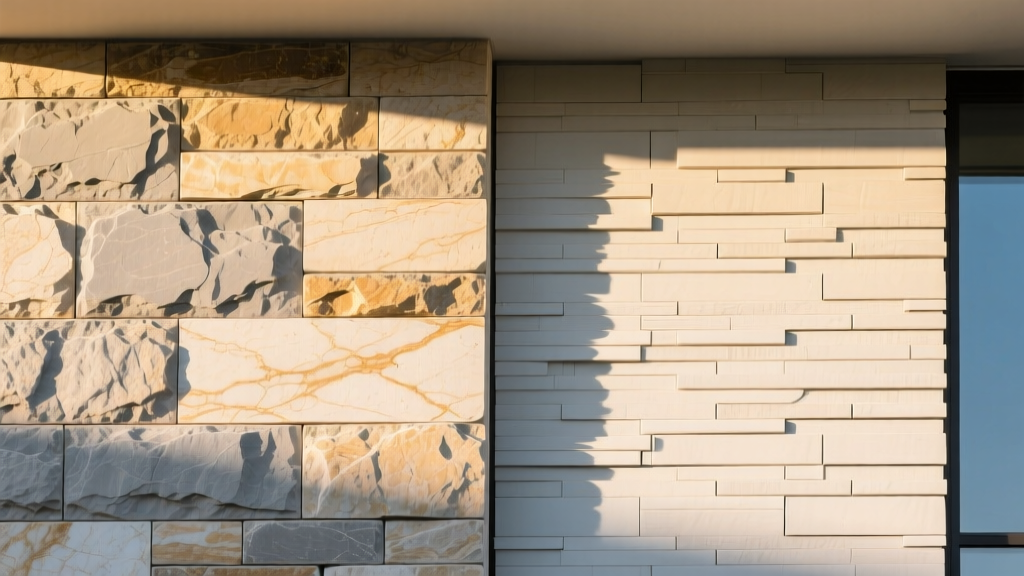
Installation Realities: Mortared vs. Interlocking
The installation methodology dictates the project timeline and the required skill level of the crew.
Adhered Masonry (NTV and Cementitious)
Installing traditional thin veneer requires a multi-day, multi-step process. The wall must first be prepped with two layers of Grade D building paper or a modern fluid-applied WRB. Next, self-furring galvanized metal lath is stapled to the studs. A scratch coat of Type S mortar is applied and cured for 24 to 48 hours. Finally, the stones are buttered with mortar and pressed into a setting bed. Joints must be tooled, and the entire wall requires acid washing and sealing after curing. This process is highly weather-dependent; temperatures must remain above 40°F (4°C) during mortar application and curing.
Mortarless Interlocking Panels (HDPU)
Interlocking stone veneer siding panels utilize a tongue-and-groove or shiplap edge profile. Installation begins by snapping a level chalk line at the base of the wall and securing a metal or composite starter strip. Panels are then applied from the bottom up, interlocking to hide the fastener flange of the previous row.
Fastening Specifications: Panels must be secured using 1.5-inch to 2-inch exterior-grade wood screws or ring-shank nails, driven directly into the structural studs (16 or 24 inches on center). If the wall features continuous exterior rigid foam insulation, fasteners must be long enough to penetrate through the foam, the sheathing, and embed at least 1 inch into the solid wood framing. Relying solely on the OSB or plywood sheathing for pull-out resistance violates most manufacturer engineering reports and local building codes.
Durability and UV Degradation
Natural stone is geologically permanent. It will not fade under UV exposure, though porous stones like sandstone may require a penetrating silane/siloxane sealer every 7 to 10 years to prevent freeze-thaw spalling in northern climates. Cementitious panels are similarly resilient to UV light, though they can suffer from efflorescence (white salt deposits) if moisture constantly migrates through the concrete matrix.
HDPU faux panels face the harshest scrutiny regarding UV stability. Early synthetic stones suffered from chalking and pigment fading within five years. However, premium 2026 HDPU panels utilize multi-stage molding processes where a UV-stabilized, mineral-flecked acrylic topcoat is chemically bonded to the polyurethane core. When selecting faux stone veneer siding panels, verify that the manufacturer offers a minimum 25-year fade warranty and explicitly lists the ASTM G154 accelerated UV testing results in their technical data sheets.
Decision Framework: Which System Fits Your Project?
To finalize your material selection, map your project constraints to the following decision matrix:
- Choose Natural Thin Veneer if: You are building a custom, high-end legacy home where geological authenticity, thermal mass, and a 75+ year lifespan are paramount, and the budget accommodates specialized masonry labor and structural reinforcement.
- Choose Cementitious Manufactured Panels if: You require the fire-resistance and mass of real masonry for wildfire-prone zones (WUI compliance) or commercial fire-ratings, but need to reduce the dead load and material costs compared to natural stone.
- Choose HDPU Faux Panels if: You are executing a rapid exterior remodel, retrofitting over existing cladding, working with strict structural weight limits, or managing a project where general carpenters must execute the installation without specialized masonry subcontractors.
For comprehensive installation details and flashing integrations specific to your regional climate zone, always cross-reference the manufacturer's installation instructions with the Fine Homebuilding siding project guides and your local municipal building codes.
Written by
Elena RodriguezElena Rodriguez is a civil engineer and technical writer specializing in concrete technology, masonry systems, and ASTM/ACI compliance. She earned her B.S. in Civil Engineering from Texas A&M University and spent a decade at a materials testing laboratory, performing over 2,000 concrete compressive strength tests and masonry prism evaluations. Elena is an ACI-certified Field Testing Technician (Grade I) and a member of ASTM Committee C12 on Natural Building Stone. She currently consults on forensic engineering cases involving concrete failures and moisture intrusion. Based in San Antonio, TX, Elena is a proud member of the Society of Women Engineers (SWE) and coaches her daughter's FIRST Robotics team.
More from Elena Rodriguez
View all
Walls & Panels
Cost Analysis: Light Gauge Steel Framing Advantages and Disadvantages
Evaluate light gauge steel framing advantages and disadvantages through a strict cost analysis lens, comparing material, labor, and lifecycle expenses.
Aug 4, 2026

Walls & Panels
Gypsum Board Types: Exact Specifications, Thickness & Dimensions
Compare standard, Type X, and moisture-resistant gypsum board types. Get exact specifications, thicknesses, dimensions, and ASTM standards for your project.
Aug 4, 2026

Fire Resistance
Best Fire-Resistant Outdoor Decking Materials: 2026 Buyer Guide
Discover the best fire-resistant outdoor decking materials for 2026. Compare Class A PVC, aluminum, and hardwood options for WUI compliance and safety.
Aug 4, 2026