2026 Old World Stone Veneer Buyer's Guide: Styles & Costs
Compare manufactured vs. natural old world stone veneer. Explore 2026 pricing, European profile styles, mortar techniques, and structural requirements.

Defining the Old World Aesthetic in Modern Masonry
Old world stone veneer replicates the heavy, textured, and time-worn masonry of historic European architecture. Unlike contemporary ledger panels or smooth river rock, old world profiles feature irregular edges, deep mortar joints, and varied stone dimensions that mimic centuries-old chateaus, English cottages, and Tuscan villas. For buyers navigating the 2026 cladding market, selecting the right old world stone veneer requires balancing authentic visual weight with modern structural limitations and budget constraints. This guide breaks down material compositions, specific profile styles, critical mortar techniques, and exact pricing to help you specify the right product for your build.
Material Showdown: Manufactured vs. Natural Old World Stone
The first major decision is choosing between architectural manufactured stone veneer (AMSV) and natural thin stone veneer. While both achieve the old world look, their physical properties dictate where and how they can be installed.
| Feature | Manufactured Stone Veneer (AMSV) | Natural Thin Stone Veneer |
|---|---|---|
| Weight | 10 – 13 lbs per sq. ft. | 22 – 35 lbs per sq. ft. |
| Material Cost (2026) | $9.50 – $16.00 per sq. ft. | $22.00 – $45.00 per sq. ft. |
| Structural Footing | Not required (can tie into wall studs) | Required for heights over 10 ft or heavy profiles |
| Color Consistency | High (batch-controlled oxides) | Low (natural mineral variations) |
| Porosity & Sealing | Moderate (requires siloxane sealer in freeze-thaw) | Variable (limestone needs sealing; quartzite does not) |
Manufactured stone, produced by brands like Eldorado Stone and Cultured Stone, uses Portland cement, lightweight aggregates, and iron oxide pigments poured into molds taken from real historic stone. It is the default choice for retrofitting existing homes where adding a structural masonry footing is cost-prohibitive. Natural thin stone, cut from real quarried limestone or fieldstone, offers unmatched authenticity and UV permanence but demands rigorous structural prep due to its sheer weight.
Top Profile Styles for Authentic European & Rustic Facades
The term "old world" encompasses several distinct regional styles. Specifying the exact profile name ensures your supplier delivers the correct aesthetic.
Chateau & Ashlar Cut
Inspired by French and German estates, Chateau profiles feature large, rectangular, and slightly squared stones with heavily chiseled faces and broken edges. The stones are typically laid in a random ashlar pattern. Look for sizes ranging from 4x8 inches up to 12x18 inches. This style requires wide, recessed mortar joints (typically 1/2 to 3/4 inch) to emphasize the massive scale of the individual blocks.
Rough-Cut Fieldstone & Rubble
Common in English and Irish countryside architecture, fieldstone profiles are entirely irregular, round, and uncut. They mimic stones gathered from local fields and stacked by early masons. This profile is highly textured and casts deep shadows. It is best applied with a "dry-stack" look or a heavily overgrouted (smeared) joint to replicate the mud-and-lime mortars of the 18th century.
Tuscan & Mediterranean Limestone
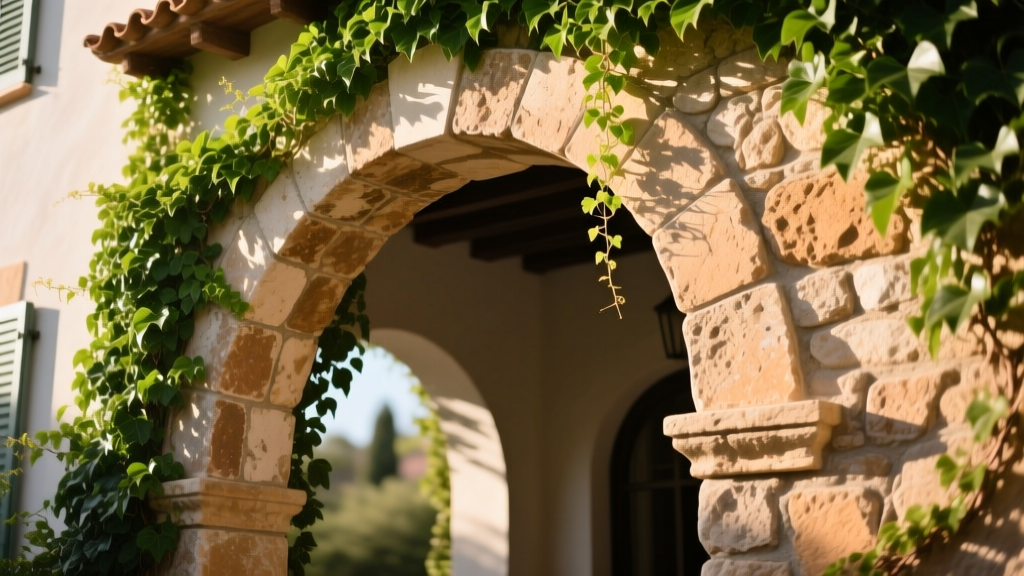
This style relies on softer, more porous-looking stones with tumbled edges and warm, sun-baked color palettes (creams, tans, and pale ochres). The stones are generally flatter and more uniform than fieldstone, designed to be laid in a tight, ledger-style pattern with minimal mortar visibility, reflecting the refined masonry of Italian villas.
Mortar Joint Techniques That Make or Break the Look
In old world masonry, the mortar is as visually important as the stone. A standard 1/2-inch raked joint (common in modern brickwork) will instantly ruin the historic illusion. You must specify the joint profile to your mason.
For authentic fieldstone and rubble profiles, specify an "overgrout" or "smeared" joint. The mason applies excess mortar and intentionally smears it over the edges of the stone, then wipes the center of the stone face with a damp sponge. This mimics the messy, lime-heavy mortars used before the invention of modern Portland cement. Use a buff or cream-colored Type N mortar rather than standard gray to complete the historic illusion.
For Chateau and Ashlar profiles, specify a flush joint or a slightly weathered (sloped) joint. The mortar should be packed tightly and struck flush with the stone face, then lightly brushed with a stiff bristle brush to expose the aggregate in the mortar, giving it a weathered, aged texture.
2026 Pricing Breakdown & Installation Variables
Budgeting for old world stone veneer requires looking beyond the per-square-foot material cost. The intricate nature of old world profiles increases labor time compared to modern stacked stone panels.
- Material Costs: Manufactured old world profiles average $11.50 to $14.00 per sq. ft. Natural thin limestone or fieldstone ranges from $24.00 to $38.00 per sq. ft.
- Labor Costs: Because old world stones are individually placed and require custom mortar jointing, expect masonry labor to run $18.00 to $28.00 per sq. ft. (compared to $12.00 for standard ledger panels).
- Substrate & Prep: Budget $3.50 to $5.50 per sq. ft. for weather-resistant barriers (WRB), corrosion-resistant metal lath, and the scratch coat.
- Mortar & Accessories: Type N mortar mix, weep screeds, and casing beads will add approximately $1.50 to $2.50 per sq. ft.
Total Installed Cost Expectation: For a high-quality manufactured old world veneer, expect total project costs between $34.00 and $48.00 per square foot in 2026. Natural stone installations will push this range to $55.00 to $85.00 per square foot.
Structural Prep & Common Buyer Mistakes
According to the Eldorado Stone installation guidelines, proper substrate preparation is non-negotiable for veneer longevity. The most common failure mode in old world stone installations is moisture entrapment leading to efflorescence or freeze-thaw spalling.
The Mandatory Substrate Stack (Exterior)
- Sheathing: OSB or plywood, properly gapped at seams.
- WRB: Two layers of Grade D building paper, or a fluid-applied membrane (e.g., Prosoco R-Guard FastFlash).
- Weep Screed: A corrosion-resistant weep screed (ASTM C1063) must be installed at the base of the wall, minimum 4 inches above grade or 2 inches above paved surfaces, to allow trapped moisture to escape.
- Metal Lath: Self-furring, corrosion-resistant woven wire lath (minimum 2.5 lbs/sq yd, ASTM C847), fastened every 6 inches into studs.
- Scratch Coat: A 3/8 to 1/2 inch layer of Type S or Type N mortar, scored horizontally, and cured for 24 to 48 hours before stone application.
Edge Cases and Mistakes to Avoid
Mistake 1: Using Type S Mortar for the Setting Bed on Manufactured Stone.
Type S mortar has a high compressive strength (1800+ psi) and high Portland cement content. When used to set lightweight manufactured stone, it is too rigid and can cause the stones to pop off during thermal expansion. Always use Type N mortar (750 psi) for the setting bed on AMSV, as recommended by the National Concrete Masonry Association (NCMA), unless local seismic codes dictate otherwise.
Mistake 2: Ignoring Efflorescence Mitigation.
Old world styles often utilize heavy mortar joints, which increases the volume of Portland cement on the wall face. As moisture moves through the wall, it carries soluble alkali salts to the surface, leaving white, powdery stains (efflorescence). To prevent this, ensure your mason uses an integral water repellent in the mortar mix, and apply a breathable silane/siloxane penetrating sealer (never a film-forming acrylic) 30 days after installation once the masonry has fully cured and dried.
Mistake 3: Failing to Blend Pallets.
Old world profiles rely on subtle color variations to look authentic. If your mason installs stones directly from a single box or pallet, you will end up with distinct "blocks" of identical color on the wall. Mandate in your contract that the installer must pull stones from at least three to four different pallets simultaneously to ensure a natural, randomized blend across the facade.
Written by
Sarah WhitfieldSarah Whitfield is a chartered quantity surveyor (MRICS) and construction cost analyst with 15 years of experience in material pricing, procurement strategy, and project budgeting. She earned her degree in Construction Management from the University of Reading (UK) and has worked on projects ranging from $2M custom homes to $180M mixed-use developments across North America and Europe. Sarah currently leads cost estimating for BuildMat Insight, maintaining a proprietary database of 4,000+ material price points updated quarterly. She is a frequent contributor to RSMeans cost data panels and has presented at the International Cost Engineering Council (ICEC) congress. Based in Denver, CO, Sarah is an avid trail runner and volunteer mentor for Women in Construction.
More from Sarah Whitfield
View all
Wood & Lumber
What Are the Different Types of Wood? A Builder's Guide
Compare structural softwoods, finish hardwoods, and engineered lumber. Analyze Janka ratings, MOE values, and 2026 pricing for construction.
Aug 4, 2026

Walls & Panels
Steel Framing vs Wood Framing: Corrosion and Moisture Defense
Compare steel framing vs wood framing for moisture resistance. Learn about galvanized coatings, condensation risks, and corrosion protection strategies.
Jul 21, 2026

Stone & Masonry
How to Cut Stone Veneer: Wet Saw vs Grinder Comparison
Compare the best tools for cutting stone veneer. We review wet saws, angle grinders, and chop saws to help you achieve clean, chip-free cuts.
Jul 21, 2026