Veneer Stone Mortar QUIKRETE Selection Guide: Which Mix to Buy
Compare QUIKRETE veneer stone mortar options, including Veneer Stone Mortar and Scratch/Brown Base Coat, with coverage rates, costs, and mixing tips.

The Critical Role of Mortar in Stone Veneer Systems
Adhesion failure, efflorescence, and cracked joints in manufactured or natural stone veneer installations are rarely caused by the stone itself. In the vast majority of cases, the root cause is incorrect mortar selection or improper substrate preparation. When specifying materials for a veneer system, contractors and DIYers must navigate the difference between standard masonry mixes and specialized polymer-modified products. QUIKRETE dominates the retail and commercial masonry space, but their extensive catalog can lead to misapplication if the specific product nuances are not understood.
This guide breaks down the exact QUIKRETE products required for a code-compliant, durable stone veneer installation, detailing item numbers, coverage yields, and 2026 market pricing to help you estimate accurately and avoid structural callbacks.
QUIKRETE Veneer Mortar Lineup: Comparison Matrix
Not all bags labeled 'mortar' are interchangeable. A standard Type N mix lacks the flexural bond strength required to hold heavy stone profiles on vertical surfaces without mechanical assistance. Below is the definitive comparison of the three primary QUIKRETE products used in veneer stone applications.
| Product Name | Item # | Formulation / Type | Primary Application | 80-lb Bag Yield (Setting) | Est. Cost (2026) |
|---|---|---|---|---|---|
| QUIKRETE® Veneer Stone Mortar | 1136-80 | Polymer-Modified (Exceeds Type S) | Setting bed / Jointing | 25 - 30 sq ft | $23.00 - $27.00 |
| QUIKRETE® Scratch and Brown Base Coat | 1139-80 | Standard Portland / Lime | Scratch coat over metal lath | N/A (Used for base) | $15.00 - $18.00 |
| QUIKRETE® Mortar Mix (Type S) | 1102-80 | Standard Type S | General masonry / Parging | Not recommended for veneer | $9.00 - $11.00 |
Deep Dive: QUIKRETE® Veneer Stone Mortar (No. 1136-80)
For the actual setting of the stone and the subsequent pointing of the joints, QUIKRETE® Veneer Stone Mortar (No. 1136-80) is the mandatory choice. This is a proprietary, polymer-modified blend specifically engineered for high-shear vertical applications.
Why Polymer Modification Matters
Standard mortar relies on mechanical interlocking and basic hydration for adhesion. Polymer-modified mortars incorporate redispersible polymer powders that activate upon mixing with water. As the mortar cures, these polymers form a microscopic film that bridges the cement matrix and the stone substrate. This results in:
- Increased Flexural Bond Strength: Critical for withstanding thermal expansion and contraction cycles without cracking.
- Reduced Water Absorption: Minimizes the risk of freeze-thaw spalling in exterior climates.
- Enhanced Workability: The mix remains cohesive on the trowel and resists sagging when heavy stones are pressed into the vertical bed.
The Scratch Coat: QUIKRETE® Scratch and Brown Base Coat (No. 1139-80)
A common and costly error is using the premium Veneer Stone Mortar (1136-80) to apply the initial scratch coat over the metal lath. While it will technically adhere, it is economically inefficient and cures with a different shrinkage profile than what is ideal for a base layer.
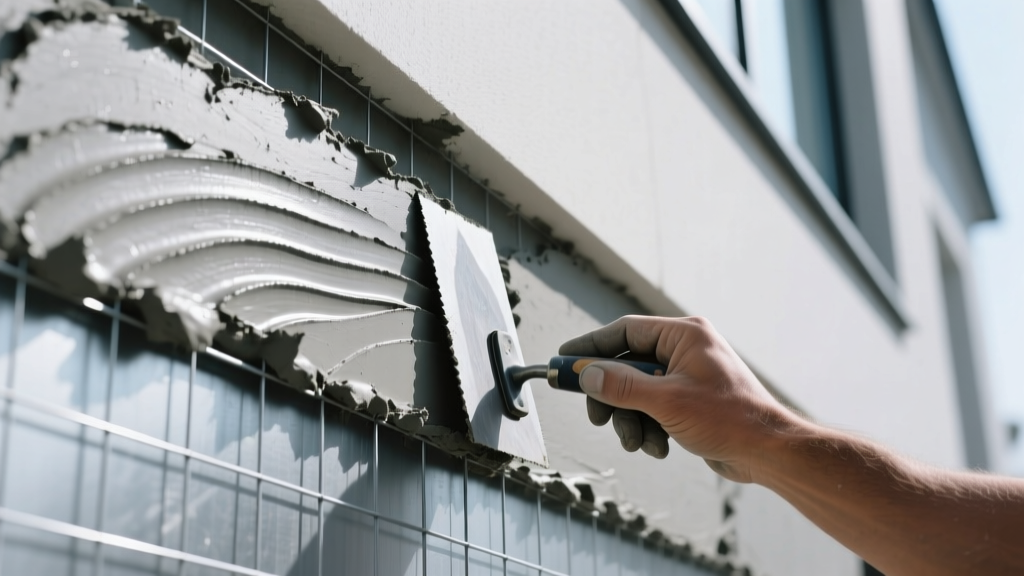
According to guidelines published by the National Concrete Masonry Association (NCMA), a proper veneer system requires a corrosion-resistant metal lath embedded in a 1/2-inch to 3/4-inch scratch coat. QUIKRETE® Scratch and Brown Base Coat (No. 1139-80) is formulated specifically for this step. It provides a rough, porous, and structurally sound base that the polymer-modified setting bed can mechanically grip.
Substrate Preparation Requirements
Before applying the 1139-80 scratch coat, ensure your weather-resistive barrier (WRB) and lath are correctly installed:
- Apply two layers of Grade D asphalt felt or a code-approved house wrap over OSB/plywood sheathing.
- Fasten self-furring, 2.5 lb galvanized diamond mesh lath using corrosion-resistant nails or staples, penetrating the studs by a minimum of 1 inch.
- Ensure the lath overlaps at horizontal and vertical seams by a minimum of 1 inch.
Project Estimation: Coverage and Cost Calculator
Accurate material estimation prevents mid-project delays and ensures color consistency across batches. Below is a real-world calculation for a standard 150 square foot exterior facade.
150 Sq Ft Veneer Project Breakdown
1. Scratch Coat (Using No. 1139-80)
- Coverage per 80-lb bag: ~12 to 15 sq ft at 1/2-inch thickness.
- Bags required: 150 / 12.5 = 12 bags.
- Estimated Cost: 12 x $16.50 = $198.00.
2. Setting Bed & Joints (Using No. 1136-80)
- Coverage per 80-lb bag: ~25 sq ft (assuming 1/2-inch back-butter and standard joint profile).
- Bags required: 150 / 25 = 6 bags.
- Estimated Cost: 6 x $25.00 = $150.00.
Total Mortar Material Cost: ~$348.00 (excluding stone, lath, and fasteners).
Mixing Protocols and Application Nuances
Even the best polymer-modified mortar will fail if mixed incorrectly. The QUIKRETE official mortar mixing guidelines emphasize strict water control. Follow this protocol for the 1136-80 setting bed:
The 'Slump' Test for Veneer Mortar
Veneer stone mortar should not be mixed to the soupy consistency of bricklaying mortar. It requires a 'stiff' or 'dry' mix.
- Add approximately 1.5 to 1.75 quarts of clean, potable water per 80-lb bag into the mixer first.
- Gradually add the dry mix while the paddle is turning.
- Mix for a full 3 to 5 minutes after all material is added to ensure the polymer powders are fully hydrated.
- The Test: Grab a handful of the mixed mortar (wearing gloves) and squeeze it. It should hold its shape perfectly without dripping water or slumping. If it crumbles immediately, add water in 2-ounce increments. If it sags, discard the batch or use it for a non-critical fill; do not add dry powder to a wet batch.
Polymer-modified mortars have a shorter pot life than standard cementitious mixes, especially in high heat or low humidity. Once mixed, No. 1136-80 must be used within 60 minutes. If the mortar begins to stiffen in the wheelbarrow or hawk, do not retemper it with water. Retempering breaks the polymer bonds and destroys the adhesive strength. Discard stiffened mortar immediately.
Troubleshooting Common Veneer Mortar Failures
Understanding how mortar interacts with the environment allows you to preemptively avoid the most common failures documented by The Masonry Society and field inspectors.
Efflorescence (White, Powdery Staining)
Cause: Using too much water in the mix, applying mortar in freezing conditions, or failing to install a proper weep screed at the base of the wall, allowing ground moisture to wick up into the mortar bed.
Prevention: Stick strictly to the low-water mixing ratio. Ensure a minimum 4-inch clearance from grade to the bottom of the veneer, and install a corrosion-resistant weep screed to allow incidental moisture to drain out of the wall cavity.
Delamination (Stone Pulling Away from Scratch Coat)
Cause: Failing to back-butter the stones, or applying the setting bed to a scratch coat that has been left exposed to the sun and wind for weeks, causing it to become dusty and absorb water from the new mortar too rapidly.
Prevention: Always 100% back-butter the back of every stone with a 1/2-inch layer of 1136-80 mortar. If the scratch coat has cured for more than 48 hours, lightly mist it with water immediately before applying the setting bed to prevent it from sucking the moisture out of the polymer-modified mortar.
Final Selection Verdict
For any manufactured or natural stone veneer project, the selection strategy is binary and non-negotiable: Use QUIKRETE® Scratch and Brown Base Coat (1139-80) exclusively for embedding the metal lath and creating the structural base. Use QUIKRETE® Veneer Stone Mortar (1136-80) exclusively for setting the stone and pointing the joints. Bypassing the polymer-modified setting mortar to save $15 per bag introduces catastrophic adhesion risks that far outweigh the initial material savings.
Written by
Sarah WhitfieldSarah Whitfield is a chartered quantity surveyor (MRICS) and construction cost analyst with 15 years of experience in material pricing, procurement strategy, and project budgeting. She earned her degree in Construction Management from the University of Reading (UK) and has worked on projects ranging from $2M custom homes to $180M mixed-use developments across North America and Europe. Sarah currently leads cost estimating for BuildMat Insight, maintaining a proprietary database of 4,000+ material price points updated quarterly. She is a frequent contributor to RSMeans cost data panels and has presented at the International Cost Engineering Council (ICEC) congress. Based in Denver, CO, Sarah is an avid trail runner and volunteer mentor for Women in Construction.
More from Sarah Whitfield
View all
Wood & Lumber
What Are the Different Types of Wood? A Builder's Guide
Compare structural softwoods, finish hardwoods, and engineered lumber. Analyze Janka ratings, MOE values, and 2026 pricing for construction.
Aug 4, 2026

Walls & Panels
Steel Framing vs Wood Framing: Corrosion and Moisture Defense
Compare steel framing vs wood framing for moisture resistance. Learn about galvanized coatings, condensation risks, and corrosion protection strategies.
Jul 21, 2026

Stone & Masonry
How to Cut Stone Veneer: Wet Saw vs Grinder Comparison
Compare the best tools for cutting stone veneer. We review wet saws, angle grinders, and chop saws to help you achieve clean, chip-free cuts.
Jul 21, 2026