Best Stone Veneer for Sale: 2026 Design Showcase
Discover the best stone veneer for sale in 2026. Explore design pairings, cost matrices, and expert sourcing tips for modern, rustic, and transitional homes.

Architectural Alchemy: Matching Veneer Profiles to Design Styles
Evaluating stone veneer for sale requires looking past basic texture and color to understand how specific profiles interact with light, shadow, and surrounding architectural elements. In 2026, the market has moved far beyond the hyper-artificial, high-gloss faux rocks of the early 2000s. Today’s premium architectural veneers utilize advanced iron-oxide pigment layering and real-stone casting molds to achieve indistinguishable parity with quarried masonry. For designers and homeowners, the challenge is no longer finding realistic materials, but rather selecting the exact profile and mortar joint technique that aligns with a specific design vernacular.
The Modern Minimalist: Ashlar and Geometric Paneling
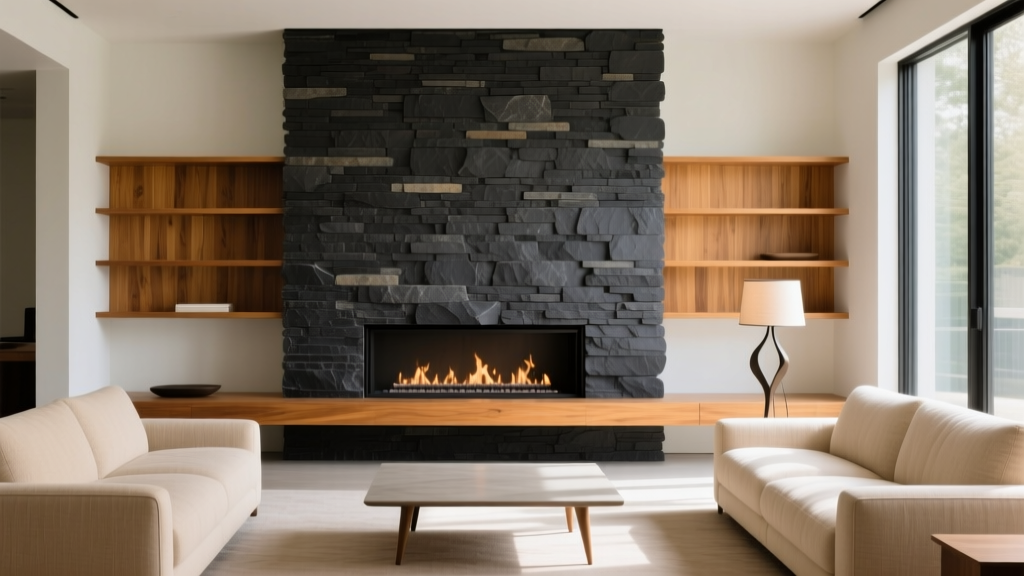
Modern and contemporary architectures demand clean sightlines and restrained material palettes. For these spaces, avoid rounded fieldstones or chaotic rubble profiles. Instead, seek out Ashlar patterns or panelized geometric systems. Eldorado Stone’s Shadowstone or Creek Bed profiles offer elongated, linear cuts that emphasize horizontal continuity. When installed using a dry-stack method (zero visible mortar joint), the resulting shadow lines create a sharp, monolithic appearance that pairs flawlessly with matte black steel windows, large-format porcelain tile, and white oak millwork. Material costs for premium panelized systems typically range from $9.50 to $14.00 per square foot.
Modern Farmhouse & Organic Contemporary: Ledgestone
The modern farmhouse aesthetic relies on tactile contrast—pairing rough, organic materials with crisp, painted surfaces. Ledgestone profiles, characterized by their long, narrow, rectangular cuts, are the undisputed standard here. Westlake Royal Building Products manufactures the highly sought-after Cultured Stone Country Ledgestone, which provides a rugged, stacked appearance. To maintain a contemporary edge rather than slipping into a purely rustic cabin vibe, specify a tight 1/4-inch raked mortar joint in a contrasting light gray or buff color. This profile integrates beautifully with white shiplap, reclaimed timber mantels, and unlacquered brass hardware. Expect to budget between $7.50 and $11.00 per square foot for the material.
Transitional & Old-World: Fieldstone and Cobble
Transitional homes, Mediterranean villas, and Tudor revivals require the rounded, varied geometry of Fieldstone or Cobble profiles. These shapes mimic naturally weathered river rocks and quarried boulders. Coronado Stone’s Vintage Farmstone or Dutch Quality Stone’s Tuscan Villa lines excel in this category. The visual weight of these profiles demands a wider mortar joint (3/4-inch to 1-inch) with an overgrout or flush finish to unify the disparate shapes. Pair these heavy textures with limewashed walls, wrought iron light fixtures, and terracotta flooring. Material pricing generally sits between $8.00 and $12.50 per square foot.
2026 Design Matrix: Profile, Joint, and Cost Breakdown
Use the following matrix to align your architectural style with the correct veneer profile, mortar application, and budgetary expectations.
| Design Style | Recommended Profile | Mortar Joint Technique | Avg. Material Cost (per sq. ft.) | Complementary Materials |
|---|---|---|---|---|
| Modern Minimalist | Ashlar / Panelized | Dry-Stack (No Mortar) | $9.50 - $14.00 | Steel, Porcelain, Walnut |
| Modern Farmhouse | Ledgestone | 1/4" Raked Joint | $7.50 - $11.00 | Shiplap, Reclaimed Wood, Brass |
| Transitional / Tudor | Fieldstone / Cobble | 3/4" Overgrout / Flush | $8.00 - $12.50 | Limewash, Wrought Iron, Terracotta |
| Industrial / Loft | Weathered Brick | 1/2" Flush with Smear | $6.50 - $9.50 | Exposed Ductwork, Concrete, Glass |
The Mathematics of Procurement: Calculating Overage and Corners
One of the most frequent errors when purchasing stone veneer for sale is miscalculating the ratio of flat pieces to corner pieces, leading to severe project delays. Veneer is sold in two distinct units: flats (measured in square feet) and corners (measured in linear feet).
- Corner Coverage: One linear foot of corner pieces typically covers 0.75 to 1.0 square feet of wall area, depending on the profile’s depth. Always subtract the linear footage of your corners from your total square footage before ordering flats.
- The Overage Rule: Never order exact measurements. Stone veneer requires cutting, fitting, and occasional discarding of broken pieces. Order a minimum of 10% overage for flat planes and 15% overage for complex areas with multiple window cutouts or electrical boxes.
- Dye-Lot Tracking: If you must order additional material mid-project, you risk receiving a different dye-lot. Manufacturers blend pigments in batches, and slight color shifts between batches are common. Always buy your total calculated overage upfront and store it in a dry, climate-controlled space.
Sourcing Strategy: Where to Find Premium Stone Veneer for Sale
The point of purchase drastically impacts the quality of material and the expertise available to you during the selection process.
Specialized Masonry Supply Yards vs. Big Box Retailers
While large home improvement centers carry entry-level veneer lines, they rarely stock the high-fidelity, architecturally specified profiles required for luxury builds. Specialized masonry supply yards and dedicated stone distributors offer distinct advantages:
- Physical Sample Walls: Reputable yards build 4x4 foot sample walls using actual mortar, allowing you to see how the stone looks at scale and under different lighting conditions, rather than relying on a 2x2 inch showroom chip.
- Mortar Matching Services: Masonry yards can custom-tint Type N or Type S mortar to match your exact design specifications, a service big box stores do not provide.
- Accessory Integration: They stock the necessary hidden components—corrosion-resistant metal lath, weep screeds, and specific masonry anchors—that are often overlooked until the day of installation.
Installation Nuances That Dictate Visual Success
The most expensive stone veneer for sale will look entirely unconvincing if the installation lacks artisanal nuance. According to guidelines published by the Masonry Veneer Manufacturers Association (MVMA), the structural integrity and visual authenticity of the installation rely heavily on the scratch coat and mortar consistency.
"The mortar joint is not merely an adhesive; it is a primary design element. The color, depth, and tooling of the mortar joint account for up to 30% of the visible surface area on a standard fieldstone application and dictates the overall contrast and shadow profile of the wall."
For dry-stack applications, the substrate must be perfectly plumb, as there is no mortar to hide gaps or uneven framing. Installers must use a diamond-blade wet saw to cut the high-density concrete aggregates cleanly; using a masonry chisel or angle grinder will result in chipped, artificial-looking edges that instantly betray the material as manufactured. Finally, always specify a masonry sealer with a matte or natural finish. High-gloss sealers create a plastic-like sheen that ruins the light-diffusing properties of the stone’s porous surface, immediately signaling to the eye that the material is faux.
Written by
David NakamuraDavid Nakamura is a licensed architect (AIA) and construction technology writer focused on sustainable building methods, mass timber engineering, and high-performance building envelopes. He holds a Master of Architecture from the University of Washington and is a certified Passive House Consultant (CPHC). David spent eight years at the Seattle firm Mithun, where he led the design of three LEED Platinum projects, before founding his own practice specializing in net-zero residential design. He serves on the editorial advisory board of GreenBuilder Magazine and has authored peer-reviewed papers on cross-laminated timber (CLT) connections for the Journal of Structural Engineering. In his spare time, David teaches woodworking at Pratt Fine Arts Center and kayaks the Puget Sound.
More from David Nakamura
View all
Construction Cost
Labor Cost to Build a Deck Per Sq Ft: 2026 Installation Guide
Discover the exact labor cost to build a deck per sq ft in 2026. This installation guide breaks down contractor rates, complexity factors, and hidden fees.
Aug 4, 2026

Construction Cost
How Much Does It Cost to Build a 3 Bedroom House? Financing Guide
Learn exactly how much it costs to build a 3 bedroom house and explore 2026 financing options, construction loan types, and budget frameworks for your build.
Aug 4, 2026

Construction Cost
Cost to Build a Tennis Court: 2026 Guide
How much does it cost to build a tennis court in 2026? Breakdowns for asphalt, concrete, and synthetic surfaces plus fencing and lighting.
Jul 30, 2026