Stone Veneer Retaining Wall Cost: 2026 Pricing & Materials Guide
Analyze the true stone veneer retaining wall cost in 2026. Get exact pricing for natural and manufactured veneers, structural cores, drainage, and labor.

The Structural Reality: Veneer is Not Load-Bearing
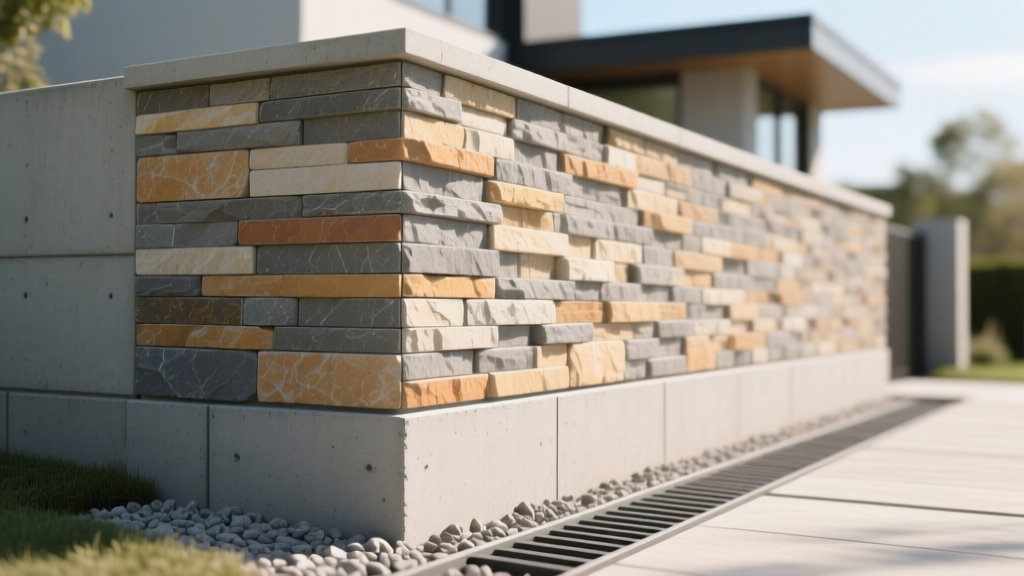
When calculating the stone veneer retaining wall cost, the most critical concept to understand is that stone veneer—whether natural thin-cut or manufactured concrete—has zero structural earth-retaining capacity. Veneer is strictly an aesthetic cladding. The actual work of holding back thousands of pounds of lateral soil pressure and managing hydrostatic loads is performed by a hidden structural core, typically constructed from reinforced Concrete Masonry Units (CMU) or poured concrete.
Therefore, your total project budget is actually the sum of two distinct construction systems: the structural retaining wall and the exterior veneer application. Failing to budget for both systems, or attempting to use veneer products as structural facing without a reinforced core, will inevitably lead to catastrophic wall failure, bulging, or total collapse under lateral earth pressure.
2026 Comprehensive Cost Matrix
The following matrix breaks down the average national costs for a standard 4-foot-high retaining wall in 2026. Costs are calculated per square foot of wall face or per linear foot of wall length, encompassing both materials and professional installation labor.
| Project Component | Unit of Measure | Material Cost (2026) | Labor Cost | Total Installed |
|---|---|---|---|---|
| Excavation & Concrete Footing | Per Linear Ft | $18.00 - $25.00 | $22.00 - $35.00 | $40.00 - $60.00 |
| Structural Core (8x8x16 CMU Block) | Per Sq Ft (Face) | $6.50 - $9.00 | $14.00 - $22.00 | $20.50 - $31.00 |
| Rebar & Grout Fill (Core Reinforcement) | Per Sq Ft (Face) | $3.00 - $5.00 | $4.00 - $7.00 | $7.00 - $12.00 |
| Manufactured Stone Veneer | Per Sq Ft (Face) | $9.00 - $16.00 | $12.00 - $18.00 | $21.00 - $34.00 |
| Natural Thin Stone Veneer | Per Sq Ft (Face) | $15.00 - $28.00 | $16.00 - $25.00 | $31.00 - $53.00 |
| Drainage Aggregate & Weep System | Per Linear Ft | $12.00 - $18.00 | $8.00 - $12.00 | $20.00 - $30.00 |
| Precast or Natural Stone Wall Cap | Per Linear Ft | $14.00 - $35.00 | $10.00 - $18.00 | $24.00 - $53.00 |
For a complete 4-foot high by 20-foot long wall (80 square feet of face), the total installed cost typically ranges from $9,500 to $16,800 using manufactured veneer, and $12,500 to $22,000+ using premium natural stone.
Choosing the Structural Core System
The structural core dictates the longevity of the wall. For walls retaining more than 3 feet of soil, engineering specifications usually require a reinforced CMU (Concrete Masonry Unit) core or poured concrete.
Reinforced CMU (Concrete Block)
Standard 8x8x16-inch CMU blocks are the industry standard for veneer-faced retaining walls. The blocks are laid on a poured concrete footing that extends below the local frost line. Every other cell (or every cell in high-load scenarios) is filled with steel rebar (typically #4 or #5 grade 60) and high-slump grout. This creates a monolithic concrete beam capable of resisting lateral shear forces. According to the National Concrete Masonry Association (NCMA), proper reinforcement and footing depth are non-negotiable for preventing overturning and sliding failures.
Poured Concrete
For curved walls or sites with extreme surcharge loads (e.g., a driveway or pool located immediately behind the wall), poured concrete cores are preferred. While the forming and pouring labor increases the core cost by 20% to 35% compared to CMU, it provides superior tensile strength and eliminates the mortar joints where water can infiltrate the core structure.
Veneer Material Breakdown: Natural vs. Manufactured
Once the structural core is cured and prepped, the veneer is applied. The choice between natural and manufactured stone heavily influences both the material budget and the installation timeline.
Manufactured Stone Veneer (MSV)
Brands like Eldorado Stone and Cultured Stone cast concrete mixes in molds taken from real stone. MSV weighs roughly 10 to 12 pounds per square foot, making it lighter and easier to handle. The color is integrated throughout the mix using iron-oxide pigments.
- Cost: $9 to $16 per sq. ft.
- Installation: Requires a metal lath and a 1/2-inch scratch coat of Type S mortar applied to the CMU core before the veneer is set. Follow the Eldorado Stone Exterior Installation Specifications for exact mortar mix ratios and curing times.
- Best For: Budget-conscious projects, DIYers (due to lighter weight), and designs requiring highly specific, uniform color palettes.
Natural Thin Stone Veneer
Natural veneer is quarried stone (limestone, slate, fieldstone, granite) sliced to a 1-inch to 1.5-inch thickness. It weighs between 13 and 18 pounds per square foot.
- Cost: $15 to $28+ per sq. ft.
- Installation: Heavier weights require a highly skilled mason. Natural stone often requires more time to sort, shape, and fit due to irregular edges, increasing labor costs by up to 40% compared to MSV.
- Best For: High-end luxury properties, historic restorations, and environments where the natural patina and geological variation of real stone are paramount.
The Hidden Cost Drivers: Drainage and Caps
Amateur estimators frequently overlook the backend costs of water management and wall termination. These elements are not optional; they are critical to the wall's survival.
Water trapped in the soil behind a retaining wall generates hydrostatic pressure that can easily exceed the structural limits of a reinforced CMU core. A 4-foot wall holding saturated soil can experience lateral pressures exceeding 120 pounds per square foot at the base. Proper drainage is mandatory, not an upgrade.
- Drainage Aggregate: A minimum 12-inch layer of clean, washed 3/4-inch crushed stone must be placed directly behind the CMU core. Budget $45 to $65 per ton for washed drain rock.
- Perforated Drain Pipe: A 4-inch SDR 35 or Schedule 40 perforated PVC pipe must run along the base of the wall footing, sloped at 1/8 inch per foot to daylight or a dry well. Cost: $1.50 to $3.00 per linear foot.
- Wall Caps: Caps protect the top of the CMU core and the veneer from water intrusion. Precast concrete caps cost $14 to $22 per linear foot, while thermal-finished natural granite or limestone caps range from $25 to $45 per linear foot.
Critical Failure Modes and Prevention
Understanding how stone veneer retaining walls fail allows you to specify the right materials to prevent expensive callbacks or rebuilds.
1. Efflorescence Staining
The Problem: White, powdery salt deposits bloom on the face of the stone veneer. This occurs when water migrates through the porous CMU core, dissolving soluble salts (calcium hydroxide) in the concrete and mortar, and deposits them on the veneer surface as it evaporates.
The Fix: Before applying the metal lath and scratch coat, treat the exterior face of the cured CMU core with a silane/siloxane penetrating water repellent (such as PROSOCO Siloxane PD). This blocks water migration through the block while allowing the wall to breathe. Additionally, ensure weep holes are installed every 4 to 6 feet at the base of the veneer to allow water to exit before it reaches the veneer face.
2. Freeze-Thaw Delamination
The Problem: In northern climates, water gets trapped behind the veneer. When it freezes, it expands, popping the stone off the scratch coat.
The Fix: Do not use standard Type N or Type S masonry cement for the veneer setting bed in freeze-thaw zones. Instead, specify a polymer-modified mortar that meets ANSI A118.15 standards (Improved Modified Dry-Set Cement Mortar). These polymers increase flexural strength and bond adhesion, allowing the mortar to absorb micro-movements without cracking.
3. Insect Intrusion via Weep Holes
The Problem: Open weep holes at the base of the wall provide a direct highway for termites, ants, and rodents to enter the wall cavity or the adjacent structure.
The Fix: Install specialized weep hole inserts (like Advanced Building Products weep vents) featuring a cellular plastic matrix or stainless steel mesh. These allow water to drain freely while blocking pests. Budget an extra $2.50 to $4.00 per weep vent.
Step-by-Step Cost Estimation Framework
To generate an accurate budget for your specific site, follow this sequential calculation framework:
- Calculate Face Area: Multiply the exposed wall height by the total linear length. (e.g., 4 ft x 30 ft = 120 sq ft).
- Calculate Footing & Cap Lineage: Note the total linear feet for the concrete footing and the wall caps (e.g., 30 linear ft).
- Calculate Drainage Volume: Multiply the wall height by the length, then by the required drainage gravel depth (usually 1 ft) to get cubic feet. Divide by 27 to convert to cubic yards of gravel.
- Apply the Matrix: Multiply your measurements by the 2026 cost matrix provided above.
- Add Engineering & Permits: Any retaining wall over 3 or 4 feet (depending on local municipal codes) requires a stamped engineering drawing. Budget $800 to $1,500 for a licensed geotechnical or structural engineer, plus $150 to $400 for municipal building permits.
- Factor in Site Access: If excavators and pallets of CMU block cannot be driven directly to the wall site, add 15% to 25% to your labor costs for manual material handling and wheelbarrow transport.
By treating the stone veneer retaining wall cost as a dual-system investment—prioritizing the structural integrity of the hidden core equally with the aesthetic quality of the visible cladding—you ensure a landscape feature that remains structurally sound and visually flawless for decades.
Written by
Sarah WhitfieldSarah Whitfield is a chartered quantity surveyor (MRICS) and construction cost analyst with 15 years of experience in material pricing, procurement strategy, and project budgeting. She earned her degree in Construction Management from the University of Reading (UK) and has worked on projects ranging from $2M custom homes to $180M mixed-use developments across North America and Europe. Sarah currently leads cost estimating for BuildMat Insight, maintaining a proprietary database of 4,000+ material price points updated quarterly. She is a frequent contributor to RSMeans cost data panels and has presented at the International Cost Engineering Council (ICEC) congress. Based in Denver, CO, Sarah is an avid trail runner and volunteer mentor for Women in Construction.
More from Sarah Whitfield
View all
Wood & Lumber
What Are the Different Types of Wood? A Builder's Guide
Compare structural softwoods, finish hardwoods, and engineered lumber. Analyze Janka ratings, MOE values, and 2026 pricing for construction.
Aug 4, 2026

Walls & Panels
Steel Framing vs Wood Framing: Corrosion and Moisture Defense
Compare steel framing vs wood framing for moisture resistance. Learn about galvanized coatings, condensation risks, and corrosion protection strategies.
Jul 21, 2026

Stone & Masonry
How to Cut Stone Veneer: Wet Saw vs Grinder Comparison
Compare the best tools for cutting stone veneer. We review wet saws, angle grinders, and chop saws to help you achieve clean, chip-free cuts.
Jul 21, 2026