Stone Veneer Siding Contractors: 2026 Cost & Hiring Guide
Analyze costs for hiring stone veneer siding contractors. Compare natural vs. manufactured stone labor rates, material markups, and hidden structural fees.

The True Cost of Hiring Stone Veneer Siding Contractors
Upgrading your home’s exterior with stone veneer is one of the highest-ROI remodeling projects available, but the financial success of the project hinges entirely on the expertise of the installers. Hiring specialized stone veneer siding contractors involves navigating a complex pricing structure that extends far beyond the per-square-foot cost of the stone itself. In 2026, the national average cost to install manufactured stone veneer (MSV) ranges from $16.50 to $28.00 per square foot, while natural stone veneer installations command between $32.00 and $55.00 per square foot.
Unlike vinyl or fiber cement siding, stone veneer is a multi-layer masonry system. It requires precise moisture management, structural evaluation, and specialized mortar application. Contractors who bid significantly below market rates often cut corners on the critical preparatory layers—specifically the weather-resistant barrier (WRB), metal lath, and scratch coat—leading to catastrophic moisture intrusion and delamination within three to five years. According to the Masonry Veneer Manufacturers Association (MVMA), over 80% of stone veneer failures are attributed to improper installation of the underlying water-management system, not the stone itself.
• Manufactured Stone Veneer (MSV): $16.50 – $28.00 / sq. ft. installed
• Natural Stone Veneer: $32.00 – $55.00 / sq. ft. installed
• Average Project Size (Partial Facade): 300 – 500 sq. ft.
• Total Average Project Cost: $6,500 – $18,000
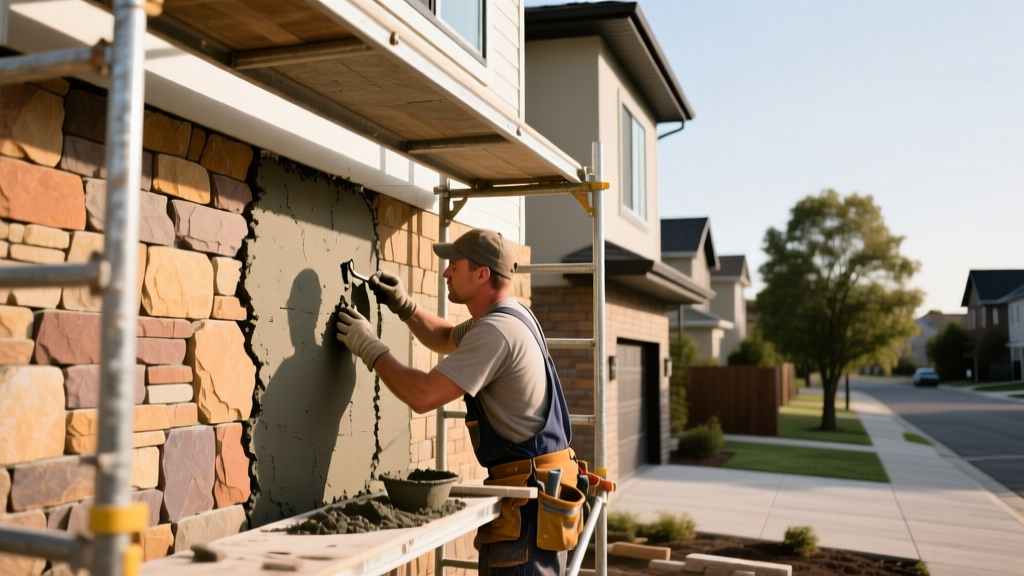
Labor vs. Material: Where Your Budget Actually Goes
When reviewing bids from stone veneer siding contractors, it is crucial to understand the ratio of labor to materials. Stone veneer is heavily labor-intensive. While the stone itself is the most visible expense, the preparatory labor and auxiliary materials (mortar, lath, fasteners, flashing) constitute the majority of the contractor’s overhead and profit margins.
| Cost Component | Manufactured Stone (MSV) | Natural Stone Veneer | Percentage of Total |
|---|---|---|---|
| Stone Material | $6.00 – $12.00 / sq. ft. | $15.00 – $30.00 / sq. ft. | 35% – 45% |
| Auxiliary Materials (Lath, Mortar, WRB) | $2.50 – $4.00 / sq. ft. | $3.00 – $5.00 / sq. ft. | 15% – 20% |
| Labor (Prep, Scratch Coat, Setting) | $8.00 – $12.00 / sq. ft. | $14.00 – $20.00 / sq. ft. | 40% – 50% |
| Waste Disposal & Scaffolding | $500 – $1,500 flat | $800 – $2,500 flat | 5% – 10% |
Natural vs. Manufactured Stone: Contractor Pricing Differences
Stone veneer siding contractors price natural and manufactured stone differently due to the distinct physical properties and handling requirements of each material. Understanding these differences will help you contextualize the bids you receive.
Manufactured Stone Veneer (MSV)
Brands like Eldorado Stone, Cultured Stone, and Coronado Stone produce MSV using Portland cement, lightweight aggregates, and iron oxide pigments. Because MSV is cast in molds, it features a flat back that adheres easily to a mortar bed. Contractors favor MSV because it is lighter (averaging 10-12 lbs per square foot) and requires less cutting and fitting. The installation speed is roughly 15 to 25 square feet per day per mason, keeping labor costs relatively contained.
Natural Stone Veneer
Natural stone (such as limestone, slate, or fieldstone) is quarried and sliced to a veneer thickness. It is significantly heavier (up to 40 lbs per square foot) and features irregular, uneven backs. Contractors must charge a premium for natural stone labor because each piece requires custom buttering, extensive chipping, and shaping to achieve tight joints. Furthermore, the sheer weight of natural stone often requires the contractor to install additional structural ties or heavy-duty metal lath, adding both material and labor hours to the estimate.
Hidden Fees and Edge Cases That Inflate Quotes
When comparing estimates, homeowners are frequently blindsided by change orders once the project begins. Reputable stone veneer siding contractors will include the following line items in their initial proposal. If they are missing, you are likely looking at an incomplete bid that will result in surprise invoices.
According to ASTM C1063 standards and the International Residential Code (IRC), a weep screed must be installed at the base of all exterior stone veneer walls. This metal flashing allows trapped moisture to escape the wall cavity. If a contractor’s bid does not explicitly mention ‘weep screed installation at minimum 4 inches above grade,’ they are likely planning to bury the stone into the soil or rest it directly on the concrete foundation, which guarantees moisture wicking and severe efflorescence.
- Structural Reinforcement: If your home’s existing framing was designed only for lightweight vinyl siding, the contractor may need to add blocking or reinforce the rim joists to support the dead load of the stone, particularly for natural stone or multi-story applications.
- Window and Door Jamb Extensions: Adding 1 to 3 inches of stone veneer to your exterior means your existing window and door frames will be recessed. Contractors must charge for building out the jambs, installing new flashing, and applying custom sill extensions to prevent water from pooling behind the new stone profile.
- Scaffolding and Equipment: For second-story installations, scaffolding erection and dismantling can add $1,500 to $3,500 to the project. Ensure this is listed as a fixed cost rather than an open-ended daily rental rate.
- Substrate Remediation: If the contractor removes existing siding and discovers rotted OSB sheathing or compromised housewrap, they will charge a time-and-materials rate (typically $85–$125 per hour) to replace the sheathing before installing the WRB and lath.
Vetting Quotes: A Framework for Comparing Bids
Do not simply select the contractor with the lowest bottom line. Use this technical checklist to evaluate the quality and completeness of the proposals you receive from stone veneer siding contractors.
- Verify the WRB Specification: The bid must specify a dual-layer moisture barrier. The first layer should be a Grade D asphalt-impregnated paper or a high-quality housewrap (like Tyvek DrainWrap), followed by a second layer of Grade D paper. This creates a drainage plane. Single-layer systems are a red flag.
- Check the Lath Weight: Ensure the quote specifies 2.5 lb per square yard, self-furring, galvanized metal lath. Contractors attempting to cut costs may use 1.75 lb lath or non-galvanized wire, which will rust and expand behind the stone, cracking the mortar.
- Scratch Coat Curing Time: The proposal should outline a multi-day schedule. The scratch coat (a 1/2-inch layer of Type S mortar scored horizontally) requires a minimum of 48 hours to cure before the stone can be set. Contractors who promise to prep and set stone in a single day are violating masonry best practices.
- Mortar Type Specification: Look for the explicit mention of Type S mortar or a proprietary polymer-modified veneer mortar (like ProSpec or QUIKRETE Veneer Stone Mortar). Standard Type N masonry cement lacks the bond strength required for vertical veneer applications.
Regional Labor Rate Variations
The cost to hire stone veneer siding contractors fluctuates significantly based on regional union densities, local building code strictness, and climate-driven installation requirements. Data aggregated from the Remodeling Cost vs. Value Report highlights distinct regional pricing tiers for masonry exterior projects.
- Northeast & Mid-Atlantic: Highest labor rates ($14–$22/sq. ft. for MSV labor). Strict freeze-thaw building codes require contractors to use premium polymer-modified mortars and enhanced flashing details to prevent winter spalling.
- Pacific West (California, Oregon, Washington): High material transport costs and stringent seismic structural requirements drive total project costs up by 15-20% above the national average. Lath must be tied directly into studs with specific seismic fasteners.
- South & Southeast: Most competitive labor rates ($8–$13/sq. ft. for MSV labor). However, contractors must account for high-humidity environments by integrating advanced drainage mats and maximizing weep screed placement to combat heavy wind-driven rain.
- Midwest: Aligns closely with the national average, though contractors must factor in strict temperature limitations. Mortar cannot be applied when ambient temperatures are below 40°F without specialized cold-weather admixtures and heated enclosures, which can add $1,000+ to winter projects.
Frequently Asked Questions
Do stone veneer siding contractors need a specific masonry license?
Requirements vary by state and municipality. While a general remodeling or exterior contractor license is often legally sufficient, you should prioritize contractors who hold certifications from the Masonry Society or manufacturer-specific certifications (such as the Eldorado Stone Certified Installer program). These certifications prove the crew has been tested on modern water-management and flashing techniques.
How long does a 500-square-foot stone veneer installation take?
A professional crew of two to three masons will typically complete a 500-square-foot MSV installation in 6 to 9 working days. This includes 1 day for demolition and substrate prep, 1 day for WRB and lath, 1 day for the scratch coat, 2 days of curing, 2 to 3 days for setting the stone, and 1 day for jointing and cleanup. Natural stone will add 2 to 4 additional days due to the custom cutting required.
Will stone veneer increase my property taxes?
According to the National Association of Home Builders (NAHB), exterior masonry upgrades significantly boost appraised home values, often recouping 90% to 102% of the project cost at resale. Because it permanently increases the assessed value and curb appeal of the property, your local tax assessor may increase your annual property tax burden slightly, though the equity gained far outweighs the marginal tax increase.
Written by
Sarah WhitfieldSarah Whitfield is a chartered quantity surveyor (MRICS) and construction cost analyst with 15 years of experience in material pricing, procurement strategy, and project budgeting. She earned her degree in Construction Management from the University of Reading (UK) and has worked on projects ranging from $2M custom homes to $180M mixed-use developments across North America and Europe. Sarah currently leads cost estimating for BuildMat Insight, maintaining a proprietary database of 4,000+ material price points updated quarterly. She is a frequent contributor to RSMeans cost data panels and has presented at the International Cost Engineering Council (ICEC) congress. Based in Denver, CO, Sarah is an avid trail runner and volunteer mentor for Women in Construction.
More from Sarah Whitfield
View all
Wood & Lumber
What Are the Different Types of Wood? A Builder's Guide
Compare structural softwoods, finish hardwoods, and engineered lumber. Analyze Janka ratings, MOE values, and 2026 pricing for construction.
Aug 4, 2026

Walls & Panels
Steel Framing vs Wood Framing: Corrosion and Moisture Defense
Compare steel framing vs wood framing for moisture resistance. Learn about galvanized coatings, condensation risks, and corrosion protection strategies.
Jul 21, 2026

Stone & Masonry
How to Cut Stone Veneer: Wet Saw vs Grinder Comparison
Compare the best tools for cutting stone veneer. We review wet saws, angle grinders, and chop saws to help you achieve clean, chip-free cuts.
Jul 21, 2026