How Stone Veneer Sizes Impact Total Installation Costs in 2026
Discover how stone veneer sizes impact your 2026 budget. Compare material and labor costs for loose stone, standard panels, and large-format veneers.

The Size-Cost Paradox in Stone Veneer Installation
When budgeting for a masonry or exterior cladding project, contractors and homeowners often assume that smaller, individual stones are cheaper because their per-square-foot material price is lower. This is a fundamental miscalculation. In stone veneer installation, the dimensions of the material dictate the labor methodology, mortar volume, waste factor, and structural requirements. Larger stone veneer sizes almost always carry a premium at the supply yard, but they drastically compress labor hours, frequently resulting in a lower total installed cost.
Understanding the financial mechanics of stone veneer sizes requires separating material acquisition from field installation. According to industry data tracked by Angi's masonry cost guides, labor accounts for 50% to 70% of total veneer expenses. By manipulating the size of the veneer units, you directly manipulate the most volatile variable in your budget.
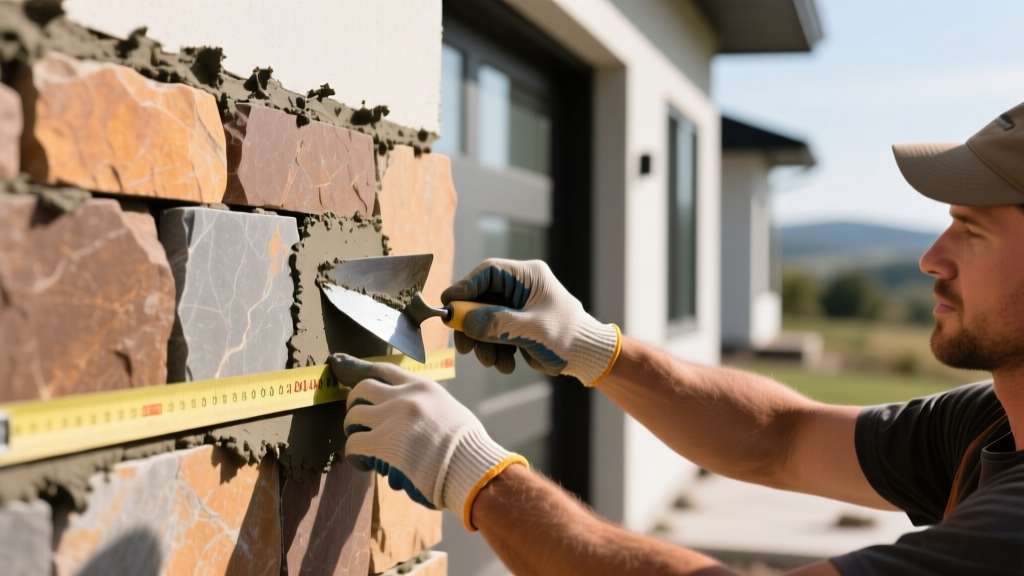
2026 Cost Matrix: Veneer Sizes vs. Installed Pricing
The following matrix breaks down the average national costs for three primary stone veneer size categories. These figures reflect 2026 market rates for both manufactured and natural stone products, incorporating standard prep work (weather-resistant barrier, metal lath, and scratch coat).
| Veneer Size Category | Typical Dimensions | Material Cost (per sq ft) | Labor Cost (per sq ft) | Total Installed Cost |
|---|---|---|---|---|
| Loose / Fieldstone | 3"x5" to 8"x12" | $5.50 - $9.00 | $14.00 - $22.00 | $19.50 - $31.00 |
| Standard Ledger Panels | 6"x24" or 12"x24" | $7.50 - $12.50 | $8.00 - $14.00 | $15.50 - $26.50 |
| Large-Format Natural | 24"x48" and up | $14.00 - $24.00 | $12.00 - $18.00* | $26.00 - $42.00 |
| Large-Format PU / Interlocking | 24"x48" (Foam/Resin) | $9.00 - $14.00 | $3.00 - $6.00 | $12.00 - $20.00 |
*Large-format natural stone requires mechanical wall ties, adding approximately $2.50 to $4.00 per square foot in hardware and specialized labor.
Category 1: Loose and Small-Cut Veneer (High Labor, Low Material)
Loose veneer, often sold as 'fieldstone', 'cobble', or 'rubble', consists of individual, irregularly shaped pieces. Because there is no standardized interlocking mechanism, masons must individually select, orient, and butter each stone. This requires a thick mortar bed (typically 1/2-inch to 3/4-inch of Type S mortar for exterior applications) and extensive jointing work.
The primary cost driver here is time. A skilled mason can typically install only 15 to 25 square feet of loose veneer per day. At standard masonry rates of $65 to $95 per hour, the labor quickly eclipses the material savings. Furthermore, loose stone carries a high waste factor. You must order a 15% to 20% overage to account for broken pieces, unusable shapes, and cutting waste, which inflates the baseline material cost.
Category 2: Standard Ledger and Interlocking Panels (The Cost Sweet Spot)
Standard panels, predominantly measuring 6 inches by 24 inches, represent the most cost-efficient balance for residential and light commercial projects. These units feature a Z-lip or shiplap interlocking edge that hides horizontal seams and automatically staggers vertical joints.
From a cost perspective, standard panels reduce mortar consumption by up to 40% compared to loose stone because the bed joint only requires a 1/4-inch to 3/8-inch thickness. Installation speed doubles; a two-person crew can lay 60 to 80 square feet per day. According to the Remodeling Magazine Cost vs. Value Report, manufactured stone veneer (which heavily utilizes these panel sizes) consistently yields one of the highest returns on investment in exterior remodeling, largely because the installation costs are kept tightly controlled.
Category 3: Large-Format Architectural Panels (Divergent Cost Paths)
When stone veneer sizes expand to 24x48 inches or larger, the cost analysis splits based on the material composition:
- Natural Large-Format Stone: Heavy and brittle. Units exceeding 10 pounds per square foot or 24 inches in any dimension require mechanical anchoring. Installers must embed stainless steel wall ties (such as those specified by The Masonry Society in TMS 402 standards) into the structural backing and wrap them into the mortar joints. This adds hardware costs and slows installation, making it the most expensive option overall.
- Manufactured / Polyurethane Large Panels: Brands producing high-density polyurethane or lightweight concrete panels in 24x48 sizes eliminate mortar entirely. These are screwed directly to OSB or plywood sheathing using structural exterior screws. Labor costs plummet to $3.00–$6.00 per square foot, and a DIYer can install them, removing professional labor costs entirely.
Hidden Dimension-Driven Costs to Budget For
When calculating your final estimate based on stone veneer sizes, factor in these secondary costs that scale with the dimensions of the product:
Larger, denser stone panels require specialized diamond-tipped masonry blades. Cutting a 24x48 natural stone panel requires a heavy-duty wet saw or a high-torque angle grinder with a continuous rim diamond blade. Budget an additional $80 to $150 per project for premium blade consumption, as large-format stones dull standard blades in a fraction of the time it takes to cut 6x24 ledger panels.
- Waste Factor Recalibration: While large panels have fewer seams, a single miscut on a 24x48 panel ruins 8 square feet of material. Budget a strict 10% waste factor for large panels, but enforce rigorous measuring protocols on-site. For 6x24 panels, a 5% to 7% waste factor is standard.
- Mortar and Lath Volume: Small, irregular stones require a heavier gauge metal lath (minimum 2.5 lbs per square yard) and a thicker scratch coat to support the uneven weight distribution. Large, flat-backed panels can often be installed over 18-gauge wire lath with a thinner scratch coat, saving $0.75 to $1.25 per square foot in prep materials.
- Structural Reinforcement: If you choose large-format natural stone for an interior feature wall (like a floor-to-ceiling fireplace), the sheer weight of the larger units may require blocking between the wall studs to secure the metal lath properly. This framing labor adds $300 to $600 to a standard 50-square-foot fireplace project.
Decision Framework: Selecting the Right Size for Your Budget
Use this framework to align your stone veneer size selection with your financial and logistical constraints:
Choose Loose / Small Veneer If:
You are executing a historical restoration, a high-end custom luxury build where budget is secondary to artisanal authenticity, or you are utilizing locally sourced, free fieldstone and only need to pay for mortar and mason labor.
Choose 6x24 Standard Panels If:
You want the authentic look of natural masonry with a predictable, mid-range budget. This is the optimal choice for exterior home facades, foundation skirting, and retaining wall caps where the interlocking design provides superior weather resistance and rapid installation.
Choose 24x48 Large-Format Panels If:
You are managing a tight construction timeline, working with DIY labor, or cladding a non-masonry substrate (like metal siding or existing drywall) where mortar adhesion is a liability. Opt for polyurethane large-format panels to achieve the lowest total installed cost on the market.
Written by
Sarah WhitfieldSarah Whitfield is a chartered quantity surveyor (MRICS) and construction cost analyst with 15 years of experience in material pricing, procurement strategy, and project budgeting. She earned her degree in Construction Management from the University of Reading (UK) and has worked on projects ranging from $2M custom homes to $180M mixed-use developments across North America and Europe. Sarah currently leads cost estimating for BuildMat Insight, maintaining a proprietary database of 4,000+ material price points updated quarterly. She is a frequent contributor to RSMeans cost data panels and has presented at the International Cost Engineering Council (ICEC) congress. Based in Denver, CO, Sarah is an avid trail runner and volunteer mentor for Women in Construction.
More from Sarah Whitfield
View all
Wood & Lumber
What Are the Different Types of Wood? A Builder's Guide
Compare structural softwoods, finish hardwoods, and engineered lumber. Analyze Janka ratings, MOE values, and 2026 pricing for construction.
Aug 4, 2026

Walls & Panels
Steel Framing vs Wood Framing: Corrosion and Moisture Defense
Compare steel framing vs wood framing for moisture resistance. Learn about galvanized coatings, condensation risks, and corrosion protection strategies.
Jul 21, 2026

Stone & Masonry
How to Cut Stone Veneer: Wet Saw vs Grinder Comparison
Compare the best tools for cutting stone veneer. We review wet saws, angle grinders, and chop saws to help you achieve clean, chip-free cuts.
Jul 21, 2026