What Is Stone Veneer? A Buyer's Guide to Types and Costs
Discover what stone veneer is, compare natural vs. manufactured types, analyze installation costs, and avoid masonry failures in this expert buyer's guide.

Defining Stone Veneer: Beyond the Aesthetic
At its core, stone veneer is a non-load-bearing masonry wythe applied to a structural backing. Unlike full-bed natural stone, which relies on its own mass and structural footing to support its weight, stone veneer transfers its lateral and vertical loads directly to the building's wall assembly through mechanical fasteners, mortar adhesion, or interlocking panel systems. This fundamental engineering difference reduces the material weight by up to 75%, eliminating the need for expensive concrete masonry unit (CMU) foundations or structural brick ledges.
For buyers and specifiers, understanding what stone veneer is requires looking past the surface texture. The category is strictly divided into two material families: Natural Stone Veneer (NSV) and Manufactured Stone Veneer (MSV). Each dictates a vastly different installation protocol, budget, and long-term maintenance profile.
Natural vs. Manufactured Stone Veneer: The Core Decision
The choice between quarried natural stone and cast manufactured stone dictates your project's structural requirements and aesthetic authenticity. Manufactured Stone Veneer (MSV) is a Portland cement-based product cast in molds taken from real stone, colored with iron oxide pigments. Natural Stone Veneer is sliced from quarried rock using diamond-tipped gang saws to reduce thickness.
| Feature | Manufactured Stone Veneer (MSV) | Natural Stone Veneer (NSV) |
|---|---|---|
| Weight | 8 to 12 lbs per sq. ft. | 13 to 20 lbs per sq. ft. |
| Thickness | 0.75 to 2.5 inches | 1.0 to 3.5 inches |
| Color Consistency | Highly uniform; pigments integrated throughout | Variable; subject to natural geological banding |
| Corner Pieces | Readily available; wraps seamlessly | Requires skilled mason to cut and return edges |
| Material Cost | $6.50 – $12.00 per sq. ft. | $11.00 – $22.00 per sq. ft. |
Decoding Veneer Profiles and Applications
Once you select the material family, you must choose a profile. The profile determines the shadow lines, mortar joint visibility, and overall architectural style.
Stacked Stone (Ledgestone)
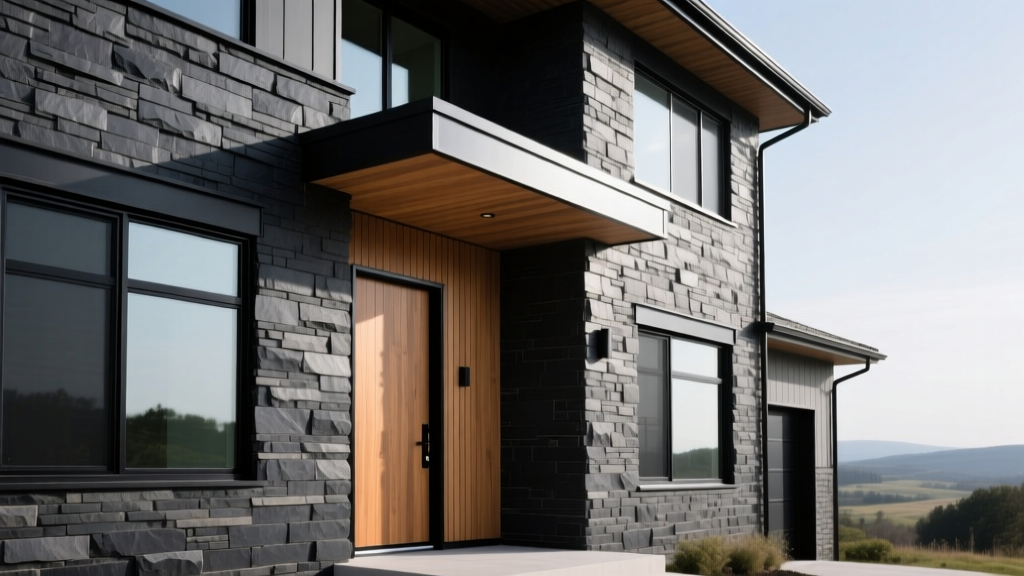
Characterized by tight, horizontal lines with minimal to no visible mortar joints. Stacked profiles, such as Cultured Stone's Dressed Fieldstone or Coronado's Ledgerock, are ideal for modern and transitional architecture. Because the joints are dry-stacked or tightly mortared, water drainage relies heavily on the surface slope and the weather-resistive barrier (WRB) behind the veneer.
Ashlar and Cut Stone
Featuring precise, geometric rectangles and squares with consistent mortar joints. This profile mimics traditional masonry and is heavily utilized in Tudor, Colonial, and Craftsman exteriors. The uniform joint spacing makes it the easiest profile for less experienced masons to install plumb and level.
Fieldstone and Cobble
Irregular, rounded shapes that mimic river rock or glacial till. This profile requires a high degree of masonry skill to fit the varying radii together without creating excessively wide, visually clumsy mortar joints. Best suited for rustic, Mediterranean, or heavy timber-frame applications.
Installation Methodologies: Traditional vs. Mortarless
The installation system you choose will impact your labor budget more than the stone itself. The industry is currently split between traditional cementitious systems and modern mortarless polymers.
Traditional Cementitious Installation
Regulated by the ASTM C1670 standard for manufactured stone, this method requires a multi-step build-out. The wall must be prepped with a weather-resistive barrier (WRB), followed by corrosion-resistant metal lath, a 0.5-inch scratch coat of Type S mortar, and finally the setting bed.
Labor Reality: A skilled masonry crew will install approximately 40 to 60 square feet per day using this method. Expect labor costs to range from $14 to $22 per square foot, heavily dependent on regional union rates and scaffold requirements.
Mortarless and Interlocking Systems
Brands like Evolve Stone and GenStone have disrupted the market with high-density polyurethane and polymer-based panels. These systems weigh less than 2 lbs per square foot and are fastened directly to the sheathing or furring strips using stainless steel cap nails or structural adhesives.
Labor Reality: Installation speeds exceed 150 square feet per day per installer. While the material cost is higher ($11 to $16 per sq. ft.), the elimination of masonry labor, mortar mixing, and cleanup reduces the total installed cost by up to 40% for DIYers and general contractors.
Water Management and Building Code Compliance
The most common cause of stone veneer failure is not material degradation, but trapped moisture. Stone veneer is a reservoir cladding; it absorbs and holds water during wind-driven rain events. If that water cannot drain and dry, it will rot the wood framing behind it.
Buyers must explicitly include weep screeds, flashing at all roof-to-wall intersections, and kicker flashing at the bottom of the veneer in their contractor's scope of work. Omitting these components to save $300 on a $15,000 project is the primary catalyst for catastrophic mold and framing rot.
Real-World Cost Breakdown (Material + Labor)
Pricing fluctuates based on regional freight costs (stone is incredibly heavy to ship) and local masonry labor rates. The following data reflects average national installed costs for a standard 500-square-foot exterior facade project.
| System Type | Material Cost (per sq. ft.) | Labor & Prep Cost (per sq. ft.) | Total Installed Cost (per sq. ft.) |
|---|---|---|---|
| MSV - Traditional Mortar | $7.50 - $11.00 | $16.00 - $24.00 | $23.50 - $35.00 |
| NSV - Traditional Mortar | $13.00 - $20.00 | $18.00 - $28.00 | $31.00 - $48.00 |
| Mortarless Polymer Panels | $11.00 - $15.00 | $4.00 - $8.00 | $15.00 - $23.00 |
Common Buyer Mistakes and Failure Modes
- Ignoring Efflorescence Prevention: White, powdery salt deposits on the stone surface occur when water moves through the Portland cement mortar and evaporates. Buyers should specify integral water repellents in the mortar mix and apply a breathable, siloxane-based masonry sealer 28 days after installation.
- Burying the Weep Screed: Landscapers often pile mulch or soil over the bottom edge of the stone veneer. This bridges the drainage plane, allowing ground moisture to wick up into the wall assembly and providing a direct pathway for subterranean termites. Maintain a strict 4-inch clearance between the weep screed and final grade.
- Using the Wrong Mortar: Never use Type N or standard tile thinset for exterior stone veneer. You must use Type S mortar, which offers higher tensile strength and better adhesion to withstand freeze-thaw cycles. For natural stone with high absorption rates, a polymer-modified setting bed is required to prevent the stone from sucking the moisture out of the mortar before it cures.
The Final Selection Framework
Use this decision matrix to finalize your specification:
Choose Manufactured Stone Veneer (MSV) if: You are cladding a wood-framed structure, require specific color matching to existing masonry, need readily available corner wraps, or are working within a strict $25-$35/sq. ft. installed budget.
Choose Natural Stone Veneer (NSV) if: You are building a custom luxury home where geological authenticity is paramount, the structure has a continuous masonry or concrete ledge to bear the 15+ lb/sq. ft. load, and your budget exceeds $35/sq. ft.
Choose Mortarless Polymer Systems if: You are executing a DIY interior accent wall, retrofitting a non-structural exterior column, or require a project timeline that cannot accommodate the 28-day curing and weather-dependency of traditional cementitious masonry.
Written by
Elena RodriguezElena Rodriguez is a civil engineer and technical writer specializing in concrete technology, masonry systems, and ASTM/ACI compliance. She earned her B.S. in Civil Engineering from Texas A&M University and spent a decade at a materials testing laboratory, performing over 2,000 concrete compressive strength tests and masonry prism evaluations. Elena is an ACI-certified Field Testing Technician (Grade I) and a member of ASTM Committee C12 on Natural Building Stone. She currently consults on forensic engineering cases involving concrete failures and moisture intrusion. Based in San Antonio, TX, Elena is a proud member of the Society of Women Engineers (SWE) and coaches her daughter's FIRST Robotics team.
More from Elena Rodriguez
View all
Walls & Panels
Cost Analysis: Light Gauge Steel Framing Advantages and Disadvantages
Evaluate light gauge steel framing advantages and disadvantages through a strict cost analysis lens, comparing material, labor, and lifecycle expenses.
Aug 4, 2026

Walls & Panels
Gypsum Board Types: Exact Specifications, Thickness & Dimensions
Compare standard, Type X, and moisture-resistant gypsum board types. Get exact specifications, thicknesses, dimensions, and ASTM standards for your project.
Aug 4, 2026

Fire Resistance
Best Fire-Resistant Outdoor Decking Materials: 2026 Buyer Guide
Discover the best fire-resistant outdoor decking materials for 2026. Compare Class A PVC, aluminum, and hardwood options for WUI compliance and safety.
Aug 4, 2026