Stone Veneer Complete Guide: Types, Costs, and Installation
Explore the complete guide to stone veneer. Compare natural vs. manufactured types, analyze costs, and learn expert installation and moisture tips.

Understanding Stone Veneer: Natural vs. Manufactured
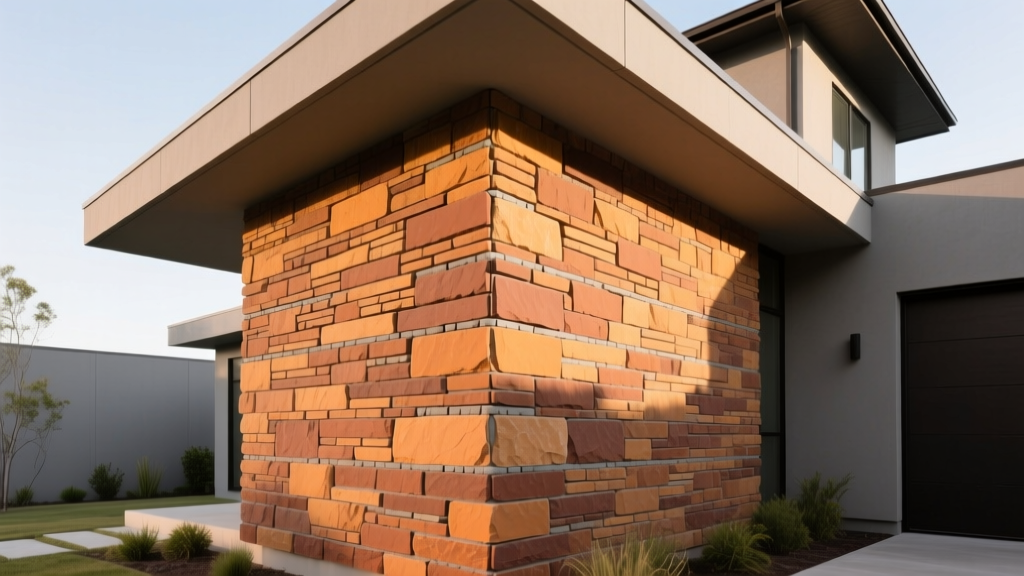
Stone veneer provides the aesthetic weight and texture of solid masonry without the structural requirements of full-bed stone. The material category splits into two distinct engineering classifications: natural thin stone and adhered manufactured stone masonry veneer (MSV). Selecting between them requires evaluating structural load limits, freeze-thaw durability, and budget constraints.
Natural Stone Veneer Profiles
Natural stone veneer is quarried and sawn to a uniform thickness, typically between 0.75 and 1.5 inches. Because it is sliced from real geological formations, it carries the exact mineral properties of its source. Limestone, slate, and quartzite are the most common exterior grades. Natural veneer weighs between 10 and 15 pounds per square foot. According to guidelines published by the Building Stone Institute, natural stone must be sealed if it possesses high porosity, such as certain sandstones, to prevent spalling in freeze-thaw climates.
Manufactured Stone Veneer (MSV) Advances
MSV is a portland cement-based architectural product cast in molds taken from real stone. It incorporates lightweight aggregates (like pumice or expanded shale) and iron oxide pigments. Governed by the National Concrete Masonry Association (NCMA) and ASTM C1670 standards, modern MSV weighs between 6 and 10 pounds per square foot. The primary advantage of MSV is its integrated color consistency and the availability of engineered corner returns that hide the veneer's thin profile.
Cost Breakdown: Material and Labor Economics
Pricing for stone veneer fluctuates based on the complexity of the profile (e.g., flat ledge vs. rounded fieldstone) and regional freight costs. Labor remains the most significant variable, as intricate dry-stack profiles require 30% more installation time than standard grouted applications.
| Veneer Classification | Material Cost (per sq ft) | Labor Cost (per sq ft) | Total Installed | Structural Footing Required? |
|---|---|---|---|---|
| Manufactured (Standard Profile) | $6.50 - $9.00 | $14.00 - $18.00 | $20.50 - $27.00 | No (Adhered to wall sheathing) |
| Manufactured (Premium Ledge) | $9.50 - $14.00 | $18.00 - $24.00 | $27.50 - $38.00 | No |
| Natural (Sawn Limestone) | $12.00 - $18.00 | $16.00 - $22.00 | $28.00 - $40.00 | Depends on height/load |
| Natural (Thick Fieldstone) | $16.00 - $26.00 | $22.00 - $30.00 | $38.00 - $56.00 | Yes (Requires masonry ledge) |
Critical Installation Framework: Avoiding Moisture Failure
The most common catastrophic failure in stone veneer installations is water intrusion leading to sheathing rot. Stone is a reservoir cladding; it absorbs and holds significant moisture during rain events. If the veneer is installed directly against the weather-resistant barrier (WRB) without a drainage plane, capillary action will drive water into the wood framing.
Compliance with the International Residential Code (IRC) Section R703 requires a continuous drainage plane behind all adhered masonry veneer. You must install a corrugated drainage mat (such as Mortairvent or Keene DriWall) over the WRB, and terminate the bottom of the wall with a weep screen positioned maximum 33 inches on center to allow hydrostatic pressure to escape.
Step-by-Step Substrate Preparation
- Weather-Resistant Barrier (WRB): Apply two layers of Grade D building paper or a code-approved housewrap over the OSB/plywood sheathing. The outer layer acts as a sacrificial bond-break.
- Drainage Mat: Fasten a 1/4-inch to 3/8-inch polymer drainage mat vertically. Ensure the weep channels align with the flashing at the foundation.
- Metal Lath: Install self-furring, 2.5 lb/sq yd galvanized metal lath (ASTM C847). Fasten with corrosion-resistant nails or staples penetrating the wall studs by a minimum of 1 inch. Overlap horizontal seams by 1 inch and vertical seams by 2 inches.
- Scratch Coat: Apply a 1/2-inch thick layer of Type S mortar to the lath. Scarify the surface horizontally with a raking tool to create a mechanical key. Allow to cure for a minimum of 48 hours before applying stone.
Top Manufacturer Profiles and Product Lines
When specifying MSV, rely on manufacturers that provide comprehensive installation manuals and warranty backing for freeze-thaw cycling.
- Cultured Stone (by Westlake Royal): The industry originator. Their Cobblefield and Dressed Fieldstone profiles offer deep shadow lines. They utilize a proprietary high-density concrete mix that resists chipping during transit.
- Eldorado Stone: Known for high-fidelity color blending. Their Cliffstone profile mimics layered sedimentary rock. Eldorado provides specific polymer-modified mortar recommendations for installations in seismic zones.
- Coronado Stone Products: Specializes in ultra-thin veneers and interior-specific profiles that do not require a scratch coat when used with their specialized mastic adhesives on approved cement boards.
Decision Matrix: Selecting the Right Veneer
Use this framework to determine the optimal material for your specific architectural constraints:
- Scenario A: Retrofit over existing wood siding without foundation upgrades.
Decision: Manufactured Stone Veneer (Standard Profile). The 8 lb/sq ft weight will not overload existing roof eaves or require a new concrete footing. - Scenario B: High-end custom build in a coastal salt-spray environment.
Decision: Natural Quartzite or Slate Veneer. MSV can suffer from efflorescence and salt degradation over decades; natural metamorphic stone is virtually impervious to salt crystallization. - Scenario C: Interior fireplace surround with zero-clearance firebox.
Decision: MSV or Natural, but strictly utilize non-combustible cement board (e.g., Durock) as the substrate. Never apply veneer directly over drywall or greenboard due to the weight and heat differential.
Expert FAQ on Stone Veneer Durability
Does manufactured stone veneer fade in direct UV exposure?
High-quality MSV utilizes inorganic iron oxide pigments that are mixed throughout the entire concrete matrix, not just painted on the surface. While the top 1/16th of an inch may experience microscopic weathering over 20 years, the color will not peel or fade significantly. Avoid budget-tier products that rely on surface-applied stains.
Can I use Type N mortar for stone veneer?
No. Type N mortar lacks the flexural bond strength required for vertical adhered applications subject to wind loads and thermal expansion. You must use Type S mortar, which contains a higher ratio of lime and portland cement, providing the necessary adhesion and slight flexibility to prevent micro-cracking.
How do I clean efflorescence from stone veneer?
Efflorescence (white salt deposits) occurs when water migrates through the masonry and evaporates on the surface. Never use muriatic acid on MSV or limestone, as it will etch the cement and calcium carbonate. Use a specialized, non-acidic efflorescence cleaner and a stiff natural-bristle brush. Ensure your roof gutters and weep holes are functioning to stop the water source.
Written by
David NakamuraDavid Nakamura is a licensed architect (AIA) and construction technology writer focused on sustainable building methods, mass timber engineering, and high-performance building envelopes. He holds a Master of Architecture from the University of Washington and is a certified Passive House Consultant (CPHC). David spent eight years at the Seattle firm Mithun, where he led the design of three LEED Platinum projects, before founding his own practice specializing in net-zero residential design. He serves on the editorial advisory board of GreenBuilder Magazine and has authored peer-reviewed papers on cross-laminated timber (CLT) connections for the Journal of Structural Engineering. In his spare time, David teaches woodworking at Pratt Fine Arts Center and kayaks the Puget Sound.
More from David Nakamura
View all
Construction Cost
Labor Cost to Build a Deck Per Sq Ft: 2026 Installation Guide
Discover the exact labor cost to build a deck per sq ft in 2026. This installation guide breaks down contractor rates, complexity factors, and hidden fees.
Aug 4, 2026

Construction Cost
How Much Does It Cost to Build a 3 Bedroom House? Financing Guide
Learn exactly how much it costs to build a 3 bedroom house and explore 2026 financing options, construction loan types, and budget frameworks for your build.
Aug 4, 2026

Construction Cost
Cost to Build a Tennis Court: 2026 Guide
How much does it cost to build a tennis court in 2026? Breakdowns for asphalt, concrete, and synthetic surfaces plus fencing and lighting.
Jul 30, 2026