Thin Veneer Natural Stone: 2026 Buyer's Selection Guide
Compare thin veneer natural stone types, weights, and 2026 costs. Learn substrate requirements, mortar specs, and installation best practices.

The 15-Pound Threshold: Defining Thin Veneer Natural Stone
When sourcing exterior or interior cladding, the distinction between full-bed stone and thin veneer natural stone (TVNS) fundamentally alters your structural requirements and budget. Thin veneer natural stone is real, quarried stone—typically granite, limestone, quartzite, or slate—that has been precision-sliced to a thickness of 0.75 to 1.5 inches.
The defining characteristic of TVNS is its weight. To qualify as adhered masonry veneer under the International Building Code (IBC) without requiring additional structural footings or steel supports, the assembled weight must not exceed 15 pounds per square foot (psf). Full-bed natural stone routinely weighs 35 to 45 psf, necessitating expensive concrete masonry unit (CMU) backup walls or reinforced concrete footings. By slicing the stone, TVNS delivers the exact geological aesthetic and mineral durability of full-bed stone while allowing installation directly over standard wood or steel stud framing.
Code Compliance Alert: The 15 PSF Rule
According to IBC Chapter 14, adhered veneer units weighing 15 psf or less can be installed on standard exterior walls without specialized structural engineering for the stone load. However, if your chosen stone profile (such as a heavily rusticated fieldstone) pushes the installed weight to 16 psf, the entire wall assembly must be engineered to support the dead load. Always request a certified weight test report from your stone supplier before purchasing.
Material Matrix: Selecting Your Stone Profile
Not all thin veneer natural stone performs identically in exterior environments. The mineral composition dictates porosity, freeze-thaw resilience, and susceptibility to efflorescence. Below is a technical breakdown of the most common TVNS materials for 2026 construction projects.
| Stone Type | Mohs Hardness | Porosity & Frost Resistance | Best Application | 2026 Material Cost (psf) |
|---|---|---|---|---|
| Quartzite | 7.0 - 8.0 | Extremely low porosity; superior freeze-thaw performance. | High-moisture exteriors, water features, harsh climates. | $14.00 - $22.00 |
| Limestone | 3.0 - 4.0 | Moderate porosity; requires high-quality sealant in freeze-thaw zones. | Interior feature walls, covered exterior porticos, traditional facades. | $9.00 - $16.00 |
| Granite | 6.0 - 7.0 | Near-zero water absorption; highly resistant to staining and acids. | Commercial facades, high-traffic wainscoting, modern exteriors. | $16.00 - $26.00 |
| Slate | 5.0 - 6.0 | Low absorption, but prone to delamination if low-grade. | Interior fireplaces, accent bands, contemporary stacked profiles. | $11.00 - $18.00 |
Thin Veneer vs. Full Bed vs. Manufactured: A Buyer's Comparison
Buyers often conflate thin veneer natural stone with manufactured stone veneer (MSV) or assume full-bed is inherently superior. Understanding the trade-offs is critical for value engineering your project.
- Thin Veneer Natural Stone (TVNS): Offers the authentic geological variation, UV stability, and longevity of real stone without the structural costs of full-bed. Drawback: Higher material cost than MSV; requires skilled masons for corner detailing since real stone corners are expensive and harder to fabricate.
- Full-Bed Natural Stone: Unmatched impact resistance and traditional mass. Drawback: Requires a continuous concrete footing extending below the frost line, adding $15 to $30 per linear foot to foundation costs. Not viable for upper-story wood-framed walls without heavy steel reinforcement.
- Manufactured Stone Veneer (MSV): Concrete-based, cast in molds, and colored with iron oxides. Lighter and cheaper ($7 - $12 psf). Drawback: Susceptible to UV fading over 15-20 years; chips reveal the gray concrete core; lacks the unique mineral inclusions of real stone.
Substrate and Mortar Specifications (Do Not Skip)
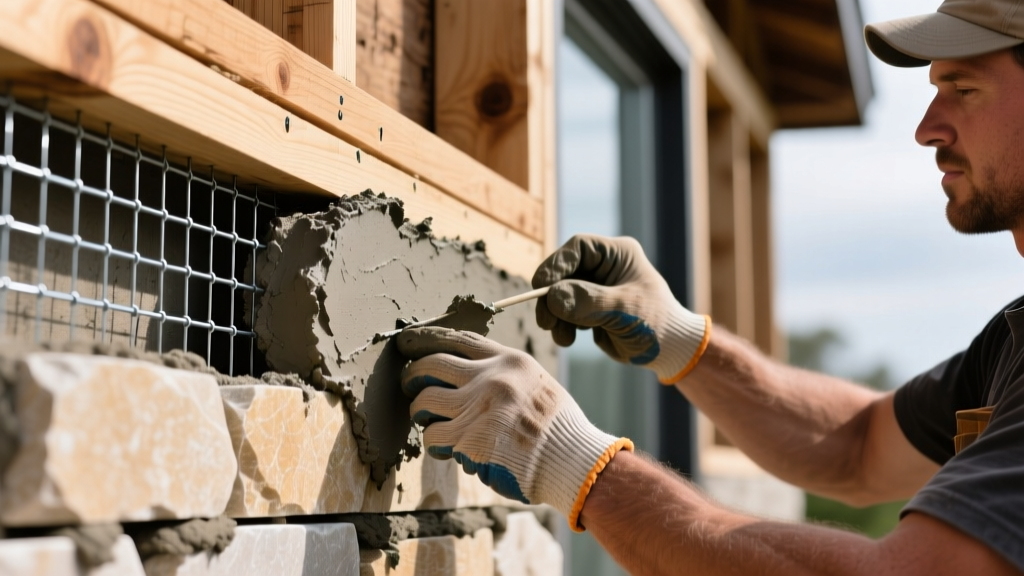
The most common cause of TVNS failure is not the stone itself, but the failure of the substrate assembly. Adhered veneer relies entirely on the mechanical bond between the mortar, the metal lath, and the structural framing. Technical guidelines from the Natural Stone Institute emphasize that proper moisture management behind the veneer is non-negotiable.
The Mortar Debate: Type S vs. Type N
For exterior thin veneer natural stone, you must specify Type S mortar. Type S achieves a compressive strength of 1,800 psi and possesses high tensile bond strength, which is critical for resisting wind uplift and seismic shear forces on exterior walls. Type N mortar (750 psi) is acceptable for interior, climate-controlled applications like fireplace surrounds, but it lacks the flexibility and bond strength required for exterior thermal expansion and contraction cycles.
Weather-Resistive Barriers and Lath Requirements
Directly adhering stone to plywood or OSB sheathing is a catastrophic error that guarantees rot and structural failure. The required assembly from the studs outward is:
- Sheathing: OSB or plywood.
- WRB: Two layers of Grade D asphalt-impregnated felt paper or a high-performance fluid-applied membrane. The first layer acts as a slip sheet; the second is the primary weather barrier.
- Weep Screed: A galvanized or PVC weep screed installed at the base of the wall, minimum 2 inches above final grade or 4 inches above paving, to allow trapped moisture to escape.
- Metal Lath: Minimum 2.5 lb (preferably 3.4 lb) self-furring galvanized welded wire lath. The 'self-furring' dimples hold the lath 1/4 inch away from the WRB, allowing the scratch coat to fully encapsulate the wire.
- Fasteners: Corrosion-resistant staples or nails penetrating directly into the wall studs (not just the sheathing) at 6 inches on center vertically and 16 inches horizontally.
2026 Cost Breakdown: What You Will Actually Pay
Budgeting for thin veneer natural stone requires looking beyond the per-square-foot price of the stone pallets. Labor and substrate preparation constitute the majority of the financial outlay. The following table outlines realistic 2026 national average costs for a standard 1,000-square-foot exterior installation.
| Cost Category | Low End (psf) | High End (psf) | Notes & Variables |
|---|---|---|---|
| Stone Material | $9.00 | $22.00 | Flats only. Add 15% waste factor. |
| Corner Units (Linear Ft) | $18.00 | $35.00 | Priced per linear foot, not square foot. |
| Substrate Prep (WRB, Lath, Scratch) | $4.50 | $7.50 | Includes materials and prep labor. |
| Masonry Installation Labor | $14.00 | $26.00 | Highly dependent on profile complexity (stacked vs. mosaic). |
| Total Installed Cost | $27.50 | $55.50 | Excludes scaffolding and structural engineering. |
Seismic and High-Wind Considerations
While TVNS is lightweight, it is still a brittle, heavy cladding. In regions with high seismic design categories (SDC D, E, or F) or coastal high-velocity hurricane zones (HVHZ), standards outlined by The Masonry Society and local building codes may require supplemental mechanical anchoring. This involves installing stainless steel veneer ties that screw into the studs and embed into the mortar joints every 16 to 24 inches. If you are building in California, the Pacific Northwest, or the Gulf Coast, consult your structural engineer to determine if mechanical ties are required for your specific wall height and stone weight.
Three Critical Mistakes Buyers Make
- Omitting the Weep Screed: Masons sometimes terminate the lath and mortar directly into the concrete slab or flashing. This traps water behind the stone. When the water freezes, it expands, causing the mortar to de-bond and the stone to spall or fall off. Always mandate a weep screed with a minimum 3/16-inch drainage gap.
- Using the Wrong Mortar Mix: Attempting to save money by using Type N mortar or a pre-mixed thin-set designed for tile on an exterior wall. Thin-set lacks the compressive strength and vapor permeability required for exterior masonry. Stick to a properly proportioned Type S Portland cement, hydrated lime, and masonry sand mix.
- Ignoring the 15% Waste Factor: Natural stone is irregular. When cutting pieces to fit around windows, outlets, and rooflines, breakage is inevitable. Furthermore, blending stones from different pallets to ensure consistent color distribution requires excess material. Always order a minimum of 15% over your net square footage (20% for complex mosaic or fieldstone profiles).
Selecting thin veneer natural stone is an investment in permanent, maintenance-free architectural character. By enforcing strict adherence to substrate preparation, specifying the correct Type S mortar, and understanding the structural limitations of the 15 psf threshold, you ensure your cladding performs flawlessly for decades.
Written by
David NakamuraDavid Nakamura is a licensed architect (AIA) and construction technology writer focused on sustainable building methods, mass timber engineering, and high-performance building envelopes. He holds a Master of Architecture from the University of Washington and is a certified Passive House Consultant (CPHC). David spent eight years at the Seattle firm Mithun, where he led the design of three LEED Platinum projects, before founding his own practice specializing in net-zero residential design. He serves on the editorial advisory board of GreenBuilder Magazine and has authored peer-reviewed papers on cross-laminated timber (CLT) connections for the Journal of Structural Engineering. In his spare time, David teaches woodworking at Pratt Fine Arts Center and kayaks the Puget Sound.
More from David Nakamura
View all
Construction Cost
Labor Cost to Build a Deck Per Sq Ft: 2026 Installation Guide
Discover the exact labor cost to build a deck per sq ft in 2026. This installation guide breaks down contractor rates, complexity factors, and hidden fees.
Aug 4, 2026

Construction Cost
How Much Does It Cost to Build a 3 Bedroom House? Financing Guide
Learn exactly how much it costs to build a 3 bedroom house and explore 2026 financing options, construction loan types, and budget frameworks for your build.
Aug 4, 2026

Construction Cost
Cost to Build a Tennis Court: 2026 Guide
How much does it cost to build a tennis court in 2026? Breakdowns for asphalt, concrete, and synthetic surfaces plus fencing and lighting.
Jul 30, 2026