Thinnest Stone Veneer Cost Analysis: 2026 Price & ROI Guide
Analyze the 2026 costs of the thinnest stone veneer options. Compare natural vs. manufactured ultra-thin profiles, hidden structural savings, and ROI.
The Economics of Ultra-Thin Stone Veneer
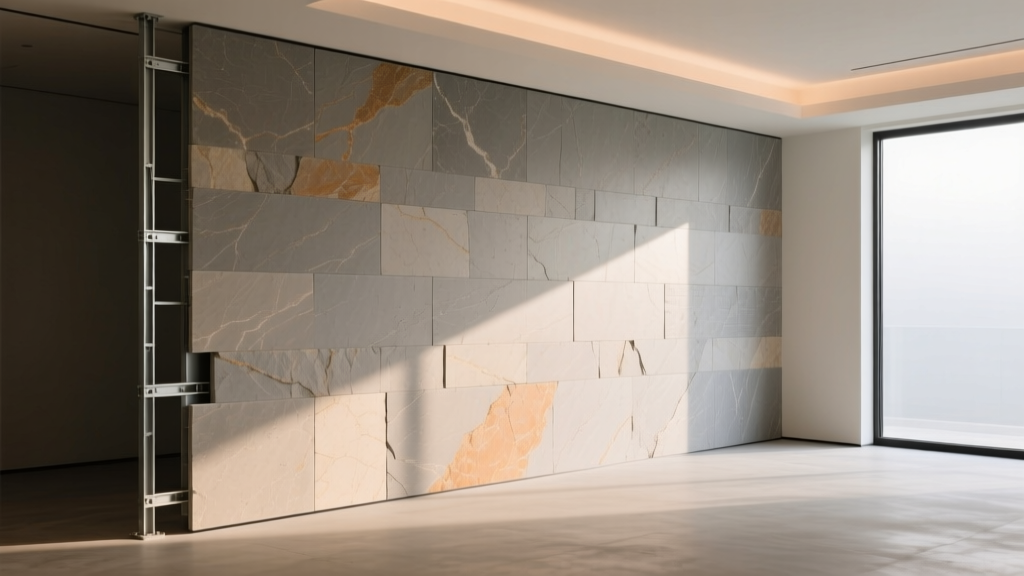
The pursuit of the thinnest stone veneer is driven by spatial constraints, weight limitations, and the desire to avoid costly structural reinforcements. In 2026, ultra-thin stone profiles—typically ranging from 1/2 inch to 3/4 inch in depth and weighing between 8 and 12 pounds per square foot—have matured from niche architectural products into mainstream residential and commercial solutions. While the raw material cost per square foot for ultra-thin profiles is often higher than standard thickness veneers, evaluating the true cost requires a comprehensive analysis of installed pricing, structural savings, and long-term return on investment.
Traditional full-bed natural stone requires a masonry ledge, wall ties, and a scratch coat, pushing the total installed weight to over 40 pounds per square foot. Ultra-thin veneer, governed by standards such as ASTM C1670 for Manufactured Stone Masonry Veneer, adheres directly to properly prepared substrates using polymer-modified thin-set mortars. This fundamental shift in installation methodology drastically alters the cost structure of stone cladding projects.
2026 Material Cost Matrix: Ultra-Thin vs. Standard Profiles
When budgeting for stone cladding, contractors and homeowners must look beyond the base material price. The following matrix breaks down the 2026 market rates for various stone veneer profiles, highlighting the premium placed on ultra-thin manufacturing and natural slicing processes.
| Material Profile | Thickness | Weight (lbs/sq ft) | Material Cost (2026) | Required Adhesive |
|---|---|---|---|---|
| Ultra-Thin Manufactured | 1/2' - 3/4' | 8 - 12 | $14.50 - $22.00 | ANSI A118.15 Thin-set |
| Sliced Natural Granite/Slate | 3/4' - 1' | 12 - 16 | $28.00 - $45.00 | ANSI A118.15 Thin-set |
| Standard Manufactured Veneer | 1.5' - 2.5' | 15 - 20 | $9.00 - $16.00 | Type S Mortar |
| Full-Bed Natural Stone | 3' - 4' | 35 - 45 | $18.00 - $35.00 | Type S Mortar + Ledge |
As demonstrated, ultra-thin manufactured options from leading producers like Eldorado Stone carry a 30% to 50% material premium over standard manufactured veneers. However, natural sliced stone commands the highest premium due to the precision diamond-wire cutting required to achieve sub-inch tolerances without shattering the material.
Hidden Cost Drivers in Ultra-Thin Applications
The thinnest stone veneer profiles are unforgiving. Unlike standard 2-inch veneers, which allow masons to use a 1/2-inch scratch coat to absorb wall irregularities, ultra-thin profiles require a perfectly flat substrate. This introduces several hidden costs that must be factored into the initial estimate.
Substrate Preparation and Flatness Tolerances
For interior applications over drywall or exterior applications over cement board, the substrate must meet a strict flatness tolerance of 1/8 inch in 10 feet. If a wall is out of plumb by 1/4 inch, the installer must float the wall with a leveling compound or install furring strips before applying the cement backer board. This preparatory labor adds $3.00 to $5.50 per square foot to the project cost. Skipping this step results in 'lippage'—where the edges of adjacent thin stones protrude unevenly, casting harsh shadows under directional lighting.
Specialty Adhesives vs. Standard Mortar
Standard Type S masonry mortar lacks the tensile bond strength required for 1/2-inch stone on vertical interior surfaces. Installers must use a high-performance, polymer-modified thin-set mortar meeting ANSI A118.15 specifications. While a 50-pound bag of Type S mortar costs roughly $12 and covers 100 square feet, a 50-pound bag of premium polymer-modified thin-set costs $45 to $65 and covers only 40 to 50 square feet. This increases the adhesive cost from $0.12 per square foot to over $1.30 per square foot.
When budgeting for ultra-thin veneer, do not calculate corners by the square foot. Manufacturers sell ultra-thin corner returns by the linear foot. Because they require specialized molding and curing processes, linear corner pieces often cost 3x to 4x the price of the field stone per linear foot. A project with multiple window returns and external building corners can see a 15% budget overrun if corners are estimated as flat wall space.
Structural Savings: Where Thin Veneer Pays for Itself
While material and prep costs are higher, the thinnest stone veneer profiles generate massive structural savings, particularly in new construction or major additions. According to structural engineering guidelines and remodeling data tracked by the National Association of the Remodeling Industry, eliminating masonry support structures significantly offsets the premium material costs.
- Elimination of Brick Ledges: Full-bed stone requires a continuous concrete masonry ledge poured into the foundation. Adding a brick ledge costs $6.00 to $10.00 per linear foot in formed concrete labor and materials. For a 2,500-square-foot home with 150 linear feet of exterior stone wainscoting, utilizing ultra-thin veneer saves $900 to $1,500 on the foundation pour alone.
- No Masonry Wall Ties: Traditional veneer requires corrugated metal wall ties anchored to the structural studs every 16 inches vertically and horizontally. Ultra-thin veneer relies entirely on the chemical bond of the thin-set to the approved backer board, eliminating the $0.50 per tie material cost and the associated labor.
- Header and Lintel Sizing: Because ultra-thin veneer can be supported by standard wood framing and shelf angles without overloading the structural headers, builders can avoid upsizing LVL (Laminated Veneer Lumber) or steel lintels above large window and door spans.
Labor Rates and Installation Timelines
Productivity rates heavily influence the final installed cost. A skilled mason installing full-bed natural stone typically lays 60 to 80 square feet per day, factoring in the time required to butter the back of each heavy stone and maintain consistent 1/2-inch mortar joints.
Conversely, ultra-thin manufactured stone veneer is installed using a trowel-applied thin-set method, similar to large-format porcelain tile. An experienced installer can lay 120 to 150 square feet per day. Furthermore, many ultra-thin profiles are designed with tight, dry-stack, or zero-clearance joints, eliminating the time-consuming pointing and tooling phase required for standard mortar joints. At an average 2026 masonry labor rate of $85 to $120 per hour, the accelerated installation timeline reduces the labor cost per square foot from $18-$25 (standard veneer) down to $10-$14 (ultra-thin veneer).
Long-Term ROI and Maintenance Costs
The financial analysis of stone cladding extends beyond the initial installation. Ultra-thin manufactured stone veneer is engineered to be virtually maintenance-free. Unlike porous natural sliced stone, which requires the application of a penetrating siloxane sealer every 3 to 5 years to prevent efflorescence and water intrusion (costing $1.50 to $2.50 per square foot per treatment), high-quality manufactured thin veneer integrates iron-oxide pigments and lightweight aggregates that resist moisture absorption out of the box.
From a resale perspective, stone veneer accents consistently yield a high return on investment. The ability to install the thinnest stone veneer directly over existing interior drywall or exterior siding (with proper water-resistive barriers) allows homeowners to achieve a luxury aesthetic without the demolition costs associated with traditional masonry retrofits.
Frequently Asked Questions
Can I install the thinnest stone veneer directly over painted drywall?
No. While ultra-thin veneer is lightweight, the polymer-modified thin-set requires a porous, stable substrate to achieve a mechanical bond. Painted drywall will delaminate under the weight and shear stress. You must either score the drywall deeply to expose the gypsum core, or ideally, install a 1/4-inch cement backer board over the studs before applying the veneer.
Does ultra-thin exterior stone veneer require weep holes?
When installed over a proper drainable water-resistive barrier (WRB) and metal lath system on exterior sheathing, the thin-set mortar bed acts as a secondary water barrier. However, if the system is designed as a drained cavity using furring strips, weep holes at the base of the wall are mandatory to allow trapped moisture to escape, regardless of the veneer thickness.
Written by
Marcus ChenMarcus Chen is a licensed structural engineer (PE) and building materials analyst with over 12 years of experience across residential, commercial, and industrial construction. He holds a Master of Science in Civil Engineering from UC Berkeley and spent six years at Thornton Tomasetti before transitioning to independent consulting and technical writing. Marcus specializes in material selection for seismic-prone regions, concrete reinforcement strategies, and lifecycle cost analysis. His work has been cited by the American Concrete Institute (ACI) and the Structural Engineers Association of California (SEAOC). When he is not on a job site or at his desk, you will find him hiking the Sierra Nevada or restoring a 1920s craftsman bungalow in Oakland, CA.
More from Marcus Chen
View all
Construction Cost
How Much Did the Eiffel Tower Cost to Build?
How much did the Eiffel Tower cost to build in 1889? We adjust for inflation and compare its budget to modern skyscraper construction.
Aug 4, 2026

Fire Resistance
What Is a Fire Resistant Material? Testing & Certification Guide
Discover what is a fire resistant material through ASTM and UL testing. Learn how fire ratings, certifications, and assemblies work in construction.
Aug 4, 2026

Construction Cost
How Much Did the Burj Khalifa Cost to Build?
How much did the Burj Khalifa cost to build? We break down the $1.5B project and extract 5 money-saving strategies for your next build.
Jul 30, 2026