The Complete Material Guide to Building a White Stone Veneer Fireplace
Explore natural and manufactured white stone veneer options for fireplaces. Compare costs, profiles, and installation methods for a flawless remodel.

Natural vs. Manufactured White Stone Veneer
Selecting the right white stone veneer for a fireplace requires understanding the fundamental differences between natural quarried stone and manufactured architectural veneer. Both offer distinct aesthetic and structural properties that dictate installation methods, heat tolerance, and long-term maintenance.
Natural White Stone is quarried and sliced into thin panels (typically 0.5 to 1 inch thick). The most common varieties for fireplaces include white quartzite, white limestone, and occasionally white marble. Quartzite is highly preferred for fireplace surrounds due to its extreme heat resistance and Mohs hardness rating of 7, which prevents scratching and chipping during hearth use. Limestone is softer and more porous, making it susceptible to soot staining and acidic cleaners.
Manufactured Stone Veneer (MSV) is cast from Portland cement, lightweight aggregates, and iron oxide pigments in molds taken from real stone. Brands like Eldorado Stone and Cultured Stone offer specific white profiles (e.g., "Alpine White" or "White Oak"). MSV is significantly lighter than natural stone, reducing the need for structural reinforcement, but it is more vulnerable to thermal shock and impact damage.
| Feature | Natural White Quartzite | Manufactured White Stone |
|---|---|---|
| Weight (per sq. ft.) | 12 - 18 lbs | 6 - 10 lbs |
| Heat Tolerance | Exceptional (up to 2000°F+) | Moderate (risk of micro-cracking near direct flame) |
| Porosity | Low (requires minimal sealing) | High (requires penetrating sealer) |
| Color Consistency | Variable (natural veining and mineral deposits) | Highly consistent (factory-controlled pigments) |
| Material Cost | $9.00 - $16.00 / sq. ft. | $5.00 - $9.50 / sq. ft. |
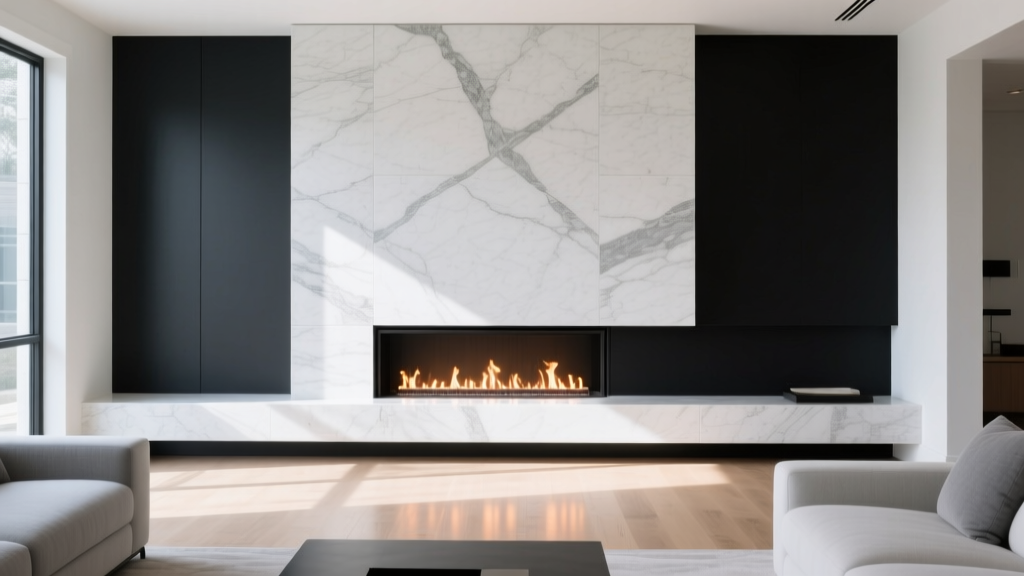
Popular White Stone Profiles for Fireplaces
The profile (or cut style) of the veneer dictates the architectural style of the room. When working with white stone, the profile heavily influences how shadows and light interact with the surface.
Ledgestone (Linear Profile)
Ledgestone consists of long, horizontal rectangular strips. This is the dominant choice for modern and transitional fireplaces. White quartzite ledgestone panels (often sold in 6x24 inch interlocking Z-brick formats) create continuous horizontal lines that draw the eye upward, making them ideal for floor-to-ceiling fireplace accent walls. The tight, dry-stack joints typical of ledgestone eliminate the need for mortar pointing, drastically reducing installation time and preventing mortar smudging.
Fieldstone (Rounded Profile)
Fieldstone mimics naturally rounded river rocks. White manufactured fieldstone provides a rustic, farmhouse, or craftsman aesthetic. Because of the irregular, rounded shapes, fieldstone requires wide, heavily tooled mortar joints. On a white stone fireplace, these joints become a prominent design element; using a stark white or light gray mortar is critical to maintain a cohesive look.
Ashlar (Squared Profile)
Ashlar features precisely cut, squared stones of varying heights and lengths. It bridges the gap between traditional masonry and modern design. White limestone ashlar is frequently used in French country or classic colonial fireplace designs, often paired with a thick, contrasting wood mantel.
Critical Installation Variables & Failure Modes
Fireplace surrounds present unique environmental challenges, including extreme temperature fluctuations, soot, and high humidity (if located in bathrooms or outdoor patios). Ignoring these variables leads to catastrophic aesthetic failures.
Applying standard gray Type N or Type S mortar to white natural stone is the most common and expensive mistake in veneer installation. Gray mortar will permanently stain the porous edges of white quartzite or limestone. Muriatic acid, the standard masonry cleaner, will etch natural stone and strip the iron oxide pigments from manufactured stone. Solution: Always use a bright white, polymer-modified thin-set mortar (ANSI A118.4) for interior white stone applications, or use a mortar bag for precise joint pointing to keep the stone face completely clean.
Substrate Preparation
Never apply stone veneer directly to drywall, greenboard, or painted surfaces. The weight of the stone and the moisture from the mortar will compromise the paper facing of the drywall, leading to delamination. The substrate must consist of 1/2-inch cement backer board (such as Durock or HardieBacker) screwed into wood or metal studs at 6-inch centers. For manufactured stone, a weather-resistant barrier and corrosion-resistant metal lath with a 1/2-inch scratch coat are required per manufacturer installation guidelines. However, for interior natural stone panels, a high-quality white thin-set applied directly to the cement board is often sufficient and preferred to minimize moisture introduction.
Thermal Shock and Clearances
Manufactured stone veneer contains Portland cement, which can suffer from thermal shock when exposed to rapid, extreme temperature changes. If placed too close to a high-BTU gas insert or an open wood-burning firebox, the veneer can develop micro-cracks or spall. Always adhere to NFPA 211 standards and the specific fireplace insert manufacturer's clearance requirements. Typically, combustible materials (including the wood framing behind the cement board) must maintain a 2-inch to 8-inch clearance from the firebox, while the non-combustible veneer itself can abut the metal chassis of zero-clearance inserts.
Cost Breakdown: Material, Labor, and Hidden Expenses
Budgeting for a white stone veneer fireplace requires looking beyond the per-square-foot cost of the stone. The complexity of the fireplace (e.g., corners, hearth extensions, and mantel integration) significantly impacts labor rates.
| Cost Component | Natural White Quartzite | Manufactured White Stone |
|---|---|---|
| Material (Panels/Loose) | $9.00 - $16.00 / sq. ft. | $5.00 - $9.50 / sq. ft. |
| Corner Pieces (Linear Ft.) | $18.00 - $30.00 / lin. ft. | $10.00 - $16.00 / lin. ft. |
| Substrate & Lath Prep | $2.50 - $4.00 / sq. ft. | $3.50 - $5.50 / sq. ft. |
| Professional Installation Labor | $14.00 - $22.00 / sq. ft. | $12.00 - $18.00 / sq. ft. |
| Total Estimated Cost (per sq. ft.) | $25.50 - $42.00 | $20.50 - $33.00 |
Note: A standard 5-foot wide by 8-foot tall fireplace surround requires approximately 40 square feet of flat veneer and 16 linear feet of corner pieces. Always order 10% to 15% overage to account for cutting waste and color blending.
Sealing and Maintenance Protocols
White stone shows soot, dust, and environmental pollutants more readily than any other color. Proper sealing is non-negotiable, but the type of sealer used is critical in a high-heat environment.
Never use film-forming acrylic or urethane topical sealers on a fireplace surround. When exposed to the ambient heat of a fire, topical sealers will soften, turn milky-white, and eventually yellow or peel, ruining the appearance of the white stone. Instead, use a penetrating siloxane or silane impregnating sealer (such as Miracle Sealants 511 Impregnator). These sealers penetrate the pores of the stone and react chemically to create a hydrophobic barrier below the surface, leaving no surface film to be damaged by heat. For detailed maintenance protocols, refer to the Natural Stone Institute's care guidelines.
Routine Cleaning
For routine dusting, use a microfiber cloth or a soft-bristle brush. If soot accumulates near the firebox, clean the stone using a pH-neutral stone cleaner and a soft nylon brush. Avoid acidic cleaners (like vinegar or standard bathroom tile cleaners) at all costs; acids will instantly etch calcium-based stones like white limestone and marble, leaving permanent dull spots on the surface.
Written by
Elena RodriguezElena Rodriguez is a civil engineer and technical writer specializing in concrete technology, masonry systems, and ASTM/ACI compliance. She earned her B.S. in Civil Engineering from Texas A&M University and spent a decade at a materials testing laboratory, performing over 2,000 concrete compressive strength tests and masonry prism evaluations. Elena is an ACI-certified Field Testing Technician (Grade I) and a member of ASTM Committee C12 on Natural Building Stone. She currently consults on forensic engineering cases involving concrete failures and moisture intrusion. Based in San Antonio, TX, Elena is a proud member of the Society of Women Engineers (SWE) and coaches her daughter's FIRST Robotics team.
More from Elena Rodriguez
View all
Walls & Panels
Cost Analysis: Light Gauge Steel Framing Advantages and Disadvantages
Evaluate light gauge steel framing advantages and disadvantages through a strict cost analysis lens, comparing material, labor, and lifecycle expenses.
Aug 4, 2026

Walls & Panels
Gypsum Board Types: Exact Specifications, Thickness & Dimensions
Compare standard, Type X, and moisture-resistant gypsum board types. Get exact specifications, thicknesses, dimensions, and ASTM standards for your project.
Aug 4, 2026

Fire Resistance
Best Fire-Resistant Outdoor Decking Materials: 2026 Buyer Guide
Discover the best fire-resistant outdoor decking materials for 2026. Compare Class A PVC, aluminum, and hardwood options for WUI compliance and safety.
Aug 4, 2026