Best Sustainable Housing Building Materials Compared
Compare top sustainable housing building materials. Analyze costs, R-values, embodied carbon, and structural performance for eco-friendly residential builds.

The Material Selection Matrix: Embodied Carbon vs. Operational Efficiency
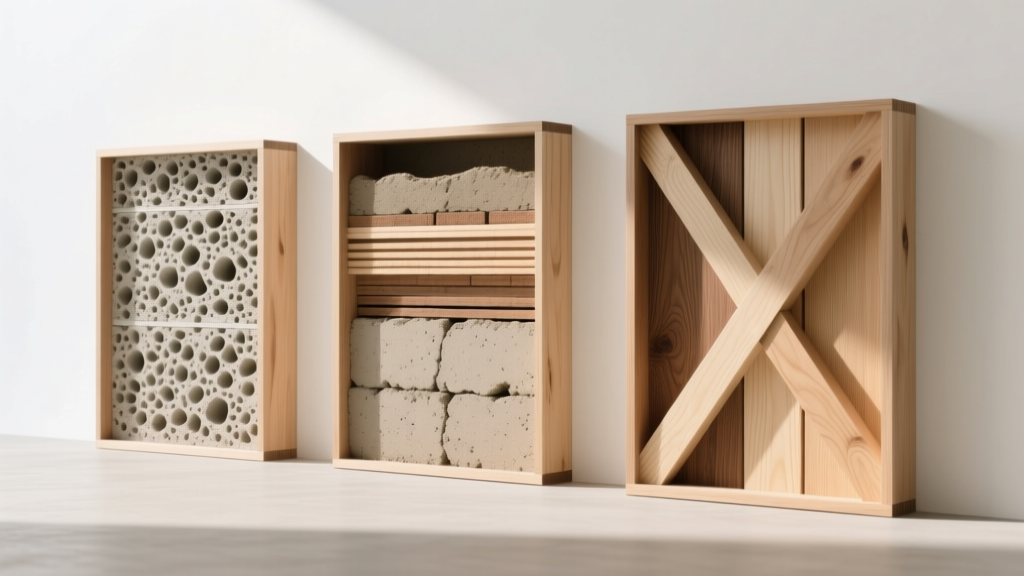
Selecting the optimal envelope and structural systems for low-carbon residential construction requires balancing upfront embodied carbon with long-term operational energy demands. The most effective sustainable housing building materials do not merely reduce greenhouse gas emissions during manufacturing; they actively sequester carbon, regulate interior humidity without mechanical intervention, and minimize thermal bridging. This analysis evaluates three dominant alternative building systems—Cross-Laminated Timber (CLT), Hempcrete, and Stabilized Rammed Earth—based on 2026 material science data, installed costs, and hygrothermal performance.
Cross-Laminated Timber (CLT): The Structural Carbon Sink
CLT panels consist of kiln-dried lumber boards stacked in alternating directions and bonded with structural adhesives. For residential applications, 3-ply (4.125 inches thick) and 5-ply (6.75 inches thick) panels are the standard. A 5-ply CLT wall assembly inherently achieves a 2-hour fire resistance rating through predictable charring rates (approximately 1.5 inches per hour) without requiring gypsum encapsulation.
From a carbon perspective, CLT acts as a biogenic carbon sink. According to lifecycle assessments cited by WoodWorks, one cubic meter of CLT sequesters roughly 700 kg of CO2. However, the adhesive chemistry matters for indoor air quality. Specifying panels bonded with Polyurethane (PUR) adhesives rather than Melamine-Urea-Formaldehyde (MUF) ensures near-zero VOC off-gassing, a critical requirement for LEED Indoor Environmental Quality (IEQ) credits.
Cost and Installation: Material costs for residential-grade CLT range from $45 to $65 per square foot of wall area. Specialized crane mobilization and structural fasteners (such as Rothoblaas self-tapping screws) add $15 to $22 per square foot to the installed cost. The primary financial advantage is the 30-40% reduction in framing labor time compared to advanced 2x6 stick framing.
Hempcrete (Hemp-Lime): The Hygroscopic Insulator
Hempcrete is a non-load-bearing biocomposite made of hemp hurd (the woody core of the plant), a lime-based binder, and water. It is cast around a structural post-and-beam or timber stud frame. Its defining characteristic is hygroscopicity—the ability to absorb and release moisture vapor, which buffers interior relative humidity between 45% and 55%, drastically reducing the latent load on HVAC systems.
The standard mix ratio for residential walls is 1 part Natural Hydraulic Lime (NHL 3.5) to 1.5 parts hemp hurd by volume. Unlike Portland cement, lime undergoes a carbonation process during curing (Ca(OH)2 + CO2 → CaCO3 + H2O), meaning the binder reabsorbs a significant portion of the CO2 emitted during its calcination. A 12-inch thick hempcrete wall yields an R-value of approximately R-30 (R-2.5 per inch), but its true thermal performance is amplified by its high thermal mass and airtightness when properly detailed.
Cost and Installation: Installed costs range from $18 to $28 per square foot of wall area. The curing process is highly moisture-dependent, requiring 28 to 90 days to fully carbonate and dry to a moisture content below 12% before interior finishes can be applied, which impacts construction scheduling.
Stabilized Rammed Earth: The High-Mass Envelope
Rammed earth utilizes a precisely graded soil mixture—typically 70% sand/gravel aggregate and 30% silt/clay—compacted in 6-inch lifts within rigid formwork. For modern residential builds in varied climates, the soil is stabilized with 5% to 8% Portland cement or a geopolymer blend (fly ash/slag) to achieve a compressive strength of 400 to 600 psi and improve water resistance.
Rammed earth excels in thermal mass rather than thermal resistance. An 18-inch thick stabilized rammed earth wall has an R-value of only R-6 to R-9. However, its thermal lag (the time it takes heat to transfer through the wall) can exceed 12 hours. In diurnal climates with hot days and cold nights, this mass absorbs solar gain during the day and radiates it inward at night, flattening peak cooling loads. To meet modern energy codes in colder zones, rammed earth must be paired with continuous exterior or interior rigid insulation.
Cost and Installation: Due to intensive formwork construction and pneumatic tamping labor, costs are high, ranging from $85 to $130 per square foot. The aesthetic payoff is a monolithic, textured interior finish that requires no drywall or paint.
Head-to-Head Cost and Performance Breakdown
| Material System | Installed Cost (per sq ft) | Embodied Carbon (kgCO2e/m2) | Assembly R-Value | Optimal Climate Zone (IECC) |
|---|---|---|---|---|
| 5-Ply CLT (with exterior mineral wool) | $60 - $87 | -45 (Net Negative) | R-28 to R-40 | Zones 4, 5, 6, 7 |
| 12-inch Hempcrete (NHL 3.5 binder) | $18 - $28 | -15 (Net Negative) | R-28 to R-32 | Zones 3, 4, 5 (Marine) |
| 18-inch Stabilized Rammed Earth | $85 - $130 | 180 (Positive) | R-6 to R-9 (Mass) | Zones 2, 3 (Hot-Dry/Mixed-Dry) |
Real-World Failure Modes and Edge Cases
- CLT Checking and Tenting: If CLT panels are exposed to rain during the erection phase without a temporary weather barrier, moisture gradients cause surface checking (cracking). In roof applications, failure to specify slip joints at the ridge can result in 'tenting'—where differential shrinkage pushes the ridge beam upward, compromising the roof membrane.
- Hempcrete Shrinkage: Mixing hempcrete with excessive water to make it easier to tamp will cause severe volumetric shrinkage as it dries, pulling away from the structural studs and creating massive thermal bypasses. The mix must remain relatively dry (the 'snowball test'—it should hold shape when squeezed but not drip water).
- Rammed Earth Capillary Rise: Rammed earth is highly susceptible to capillary water wicking. If a continuous capillary break (such as a 4-inch layer of crushed gravel or a specialized damp-proof course) is omitted between the concrete stem wall and the first lift of earth, basal spalling and structural degradation will occur within 3 to 5 years.
LEED v4.1 and Living Building Challenge Compliance
Navigating green building certification requires precise documentation of material lifecycles. Under USGBC LEED v4.1, the Materials and Resources (MR) credit category heavily rewards Environmental Product Declarations (EPDs) and sourcing of raw materials. CLT manufacturers that provide Type III EPDs and source timber from FSC-certified forests allow projects to achieve maximum points in the Building Product Disclosure and Optimization credits.
For the rigorous Living Building Challenge (LBC), the Red List imperative bans specific toxic chemicals. Hempcrete naturally complies with LBC requirements as it contains no synthetic resins, formaldehyde, or petrochemical foams. Rammed earth also easily passes Red List screening, provided the stabilizers used are free of hexavalent chromium and the sealants applied to the finished walls are water-based silicates rather than acrylic or polyurethane coatings. The EPA Green Building guidelines further emphasize the use of regional materials; rammed earth scores exceptionally well here, as the primary aggregate is typically sourced within a 50-mile radius of the site, minimizing transportation emissions.
Decision Framework: Matching Material to Climate and Budget
Selecting the right sustainable housing building material requires aligning the physical properties of the assembly with the specific microclimate and financial parameters of the project.
- Choose CLT if: You are building in a heating-dominated climate (Zones 5-7), require a fast construction schedule to reduce financing costs, need the structural system to act as the finished interior aesthetic, and have the budget to absorb premium panel and crane costs.
- Choose Hempcrete if: You are in a mixed-humid or marine climate where latent cooling loads (dehumidification) are high, you prioritize non-toxic indoor air quality above all else, and your construction timeline allows for a 60-day curing and drying window before drywall or plaster application.
- Choose Rammed Earth if: You are building in a hot-dry, high-diurnal climate (like the American Southwest), possess a high aesthetic budget for monolithic masonry finishes, and can utilize passive solar design principles to leverage the wall's thermal mass for natural temperature regulation.
Written by
Sarah WhitfieldSarah Whitfield is a chartered quantity surveyor (MRICS) and construction cost analyst with 15 years of experience in material pricing, procurement strategy, and project budgeting. She earned her degree in Construction Management from the University of Reading (UK) and has worked on projects ranging from $2M custom homes to $180M mixed-use developments across North America and Europe. Sarah currently leads cost estimating for BuildMat Insight, maintaining a proprietary database of 4,000+ material price points updated quarterly. She is a frequent contributor to RSMeans cost data panels and has presented at the International Cost Engineering Council (ICEC) congress. Based in Denver, CO, Sarah is an avid trail runner and volunteer mentor for Women in Construction.
More from Sarah Whitfield
View all
Wood & Lumber
What Are the Different Types of Wood? A Builder's Guide
Compare structural softwoods, finish hardwoods, and engineered lumber. Analyze Janka ratings, MOE values, and 2026 pricing for construction.
Aug 4, 2026

Walls & Panels
Steel Framing vs Wood Framing: Corrosion and Moisture Defense
Compare steel framing vs wood framing for moisture resistance. Learn about galvanized coatings, condensation risks, and corrosion protection strategies.
Jul 21, 2026

Stone & Masonry
How to Cut Stone Veneer: Wet Saw vs Grinder Comparison
Compare the best tools for cutting stone veneer. We review wet saws, angle grinders, and chop saws to help you achieve clean, chip-free cuts.
Jul 21, 2026