Life Cycle Impact of Recycled Materials for Building Construction
Analyze the environmental impact of recycled materials for building construction using LCA data, EPDs, and embodied carbon metrics for green projects.
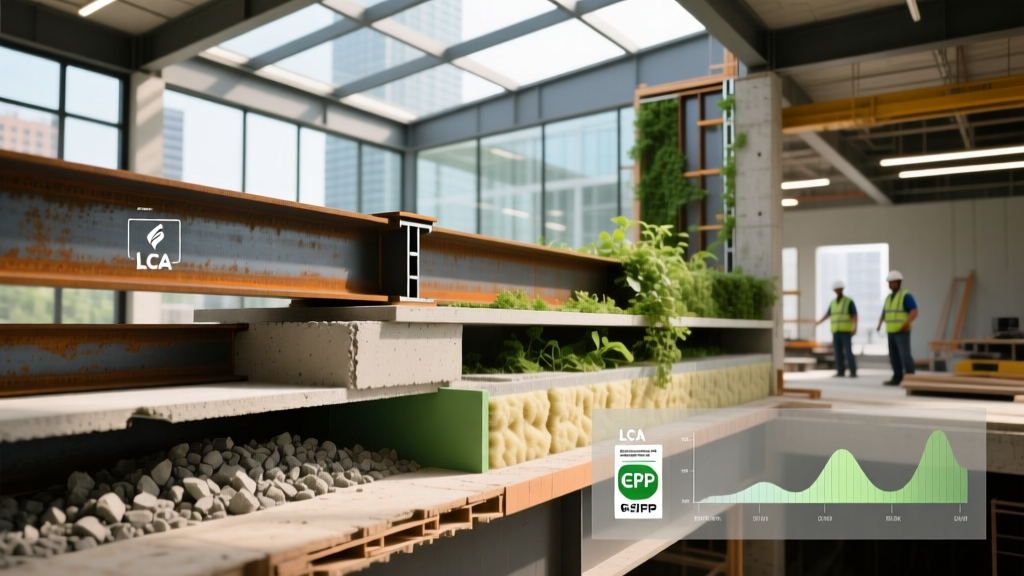
The Hidden Carbon Cost: Beyond the Recycled Label
Specifying recycled materials for building construction is a foundational strategy in sustainable architecture, but the term 'recycled' does not automatically equate to 'low carbon.' As the industry transitions toward stringent net-zero mandates in 2026, environmental impact analysis requires moving past binary recycled-vs-virgin classifications. The true environmental footprint of a material is dictated by its Life Cycle Assessment (LCA), which quantifies the energy consumed during collection, sorting, reprocessing, and transport.
For instance, while recycled aluminum diverts waste from landfills, the remelting process still requires significant electrical energy. If the regional grid powering the recycling facility relies on coal, the embodied carbon of the recycled aluminum may exceed that of virgin aluminum produced in a region powered by hydroelectricity. Therefore, rigorous impact analysis demands a granular evaluation of system boundaries, specifically distinguishing between cradle-to-gate (A1-A3) and cradle-to-grave (A1-C4) metrics.

Embodied Carbon Matrix: Virgin vs. Recycled Materials
To understand the tangible impact of recycled materials for building construction, we must look at the specific Global Warming Potential (GWP) measured in kilograms of CO2 equivalent (kgCO2e) per kilogram of material. The following matrix contrasts industry-average virgin production with high-recycled-content alternatives, highlighting the primary impact drivers for each.
| Material | Virgin kgCO2e/kg | Recycled kgCO2e/kg | Primary Impact Driver |
|---|---|---|---|
| Structural Steel (EAF vs BOF) | 2.0 - 2.4 | 0.6 - 0.8 | Grid electricity for Electric Arc Furnace |
| Recycled Concrete Aggregate (RCA) | 0.15 (Natural Agg) | 0.09 - 0.12 | Crushing energy and transport distance |
| Float Glass (Cullet) | 1.2 - 1.5 | 0.8 - 1.0 | Furnace temperature reduction limits |
| PET Insulation (rPET) | 12.0 - 15.0 (Fiber) | 3.5 - 4.2 | Sorting, washing, and extrusion heat |
| Aluminum (Secondary) | 18.0 - 22.0 | 3.0 - 5.0 | Remelting thermal energy requirements |
According to Architecture 2030, embodied carbon from structural materials and enclosures accounts for the vast majority of a new building's upfront emissions. Transitioning from Basic Oxygen Furnace (BOF) virgin steel to Electric Arc Furnace (EAF) recycled steel (typically 90%+ recycled content) yields a massive 60-70% reduction in upfront embodied carbon, making it one of the highest-impact substitutions a structural engineer can specify.
Evaluating Environmental Product Declarations (EPDs)
You cannot manage what you do not measure. In 2026, relying on manufacturer marketing claims of 'green' or 'eco-friendly' recycled materials is a liability. Specifiers must demand Type III Environmental Product Declarations (EPDs), which are third-party verified documents compliant with ISO 14025 standards. The USGBC explicitly requires EPDs for achieving credits in the LEED v4.1 Building Product Disclosure and Optimization category.
How to Audit an EPD for Recycled Content
When reviewing an EPD for a product claiming high recycled content, drill down into the following specific data points:
- Module A1 (Raw Material Supply): Check the exact percentage of post-consumer vs. pre-consumer (post-industrial) recycled content. Post-consumer waste carries a higher environmental benefit as it represents true diversion from the waste stream.
- Module A4 (Transport): Recycled materials often require complex reverse-logistics networks. If the recycling facility is 800 miles away, the diesel transport emissions in A4 may negate the extraction savings achieved in A1.
- Module C3-C4 (End of Life): Does the EPD assume the recycled material will be landfilled at the end of its second life, or does it model closed-loop recycling? Downcycled materials (e.g., mixed plastics turned into park benches that will eventually be landfilled) must account for their final disposal emissions.
The Rebound Effect: Processing Energy vs. Extraction Savings
A critical, often overlooked phenomenon in environmental impact analysis is the 'recycling rebound effect.' This occurs when the energy required to clean, separate, and reprocess a complex composite material exceeds the environmental cost of extracting and refining virgin raw materials.
'The assumption that all recycling is inherently beneficial is a dangerous oversimplification. When dealing with multi-layer laminates or chemically bonded composites, the thermal and chemical energy required to separate the polymers for recycling can generate a higher carbon footprint than producing virgin equivalents, especially on carbon-intensive regional grids.'
— Dr. Elena Rostova, Materials Science & Circular Economy Researcher
For example, mechanical recycling of mixed construction plastics often results in severe degradation of polymer chains, requiring the addition of virgin resins and chemical compatibilizers to meet structural building codes. In these edge cases, specifying a mono-material virgin product with a clear end-of-life recycling pathway may yield a lower 60-year life cycle impact than a 'recycled' composite that is destined for the landfill.
Quantifying Impact: Water and Chemical Footprints
Carbon is only one vector of environmental impact. Recycled materials for building construction also alter water consumption and chemical toxicity profiles. Recycled Concrete Aggregate (RCA) is a prime example. While RCA reduces the need for virgin quarrying and lowers transport emissions when crushed on-site, its porous nature increases the water demand of the concrete mix by 5% to 10%.
If the mix design is not adjusted with supplementary cementitious materials (SCMs) like fly ash or slag, the batch plant may be forced to increase the cement paste volume to maintain workability. Since Portland cement is highly carbon-intensive, a 5% increase in cement content can entirely wipe out the carbon savings gained by using the recycled aggregate. Specifiers must mandate optimized mix designs using polycarboxylate ether (PCE) superplasticizers to mitigate the water demand of RCA without increasing cement ratios.
Sourcing Framework: Decision Tree for Specifiers
To systematically evaluate recycled materials for building construction, project teams should implement the following decision framework during the schematic design phase. This ensures that environmental claims are validated against hard LCA data and project-specific logistics.
The 4-Step Recycled Material Vetting Protocol
- Request the EPD & LCA Report: Reject any product that cannot provide a current, third-party verified EPD. Ensure the EPD covers the specific manufacturing plant supplying your region, not just an industry-wide average.
- Calculate the A4 Transport Penalty: Map the distance from the recycling facility to the job site. If the one-way transport exceeds 500 miles via heavy-duty diesel truck, run a quick calculation to see if the A4 emissions eclipse the A1 virgin extraction savings.
- Verify Structural & Durability Parity: Ensure the recycled material meets the exact ASTM or ANSI performance standards of the virgin baseline. A recycled material that degrades 20% faster will require premature replacement, doubling its life cycle impact.
- Map the End-of-Life (Module C): Confirm with the local EPA guidelines or local waste management authorities that the material can actually be recycled in your municipality at the end of the building's life. If local infrastructure cannot process it, model it as landfill waste in your whole-building LCA.
By shifting the focus from simplistic 'recycled content' percentages to rigorous, data-driven Life Cycle Assessments, architects and engineers can ensure that their material selections deliver genuine, quantifiable environmental benefits. The future of sustainable construction relies not just on what we reuse, but on the precise, measured impact of how we reuse it.
Written by
James ThorntonJames Thornton is a construction industry veteran with 25 years of hands-on experience in wood framing, lumber grading, and residential building codes. He started as a framing carpenter in rural Oregon, earned his ICC Residential Building Inspector certification, and eventually became a senior plan reviewer for the City of Portland Bureau of Development Services. James holds a B.S. in Wood Science & Technology from Oregon State University and is a certified lumber grader through the West Coast Lumber Inspection Bureau (WCLIB). He has inspected over 3,000 residential construction sites and authored the city's internal guide on advanced framing techniques (2x6 at 24" O.C.). James lives in Bend, OR, where he builds custom timber-frame cabins and competes in lumberjack sports.
More from James Thornton
View all
Insulation
Best Home Insulation Materials: Complete 2026 Guide
Compare top home insulation materials for 2026. Find R-values, installed costs per square foot, and best uses for fiberglass, spray foam, and mineral wool.
Aug 4, 2026

Sustainable Building
Certify Your Green Building Material for LEED and WELL
Step-by-step guide to certifying a green building material for LEED v5 and WELL v2. Master EPDs, HPDs, and VOC limits for 2026 project specifications.
Aug 4, 2026

Stone & Masonry
Veneer Stacked Stone Panels: Interior Design & Style Showcase
Discover how veneer stacked stone panels transform interiors. Explore modern design profiles, material pairings, and technical installation specs.
Aug 4, 2026