Eco Friendly Materials for Building Construction: A Deep Comparison
Compare top eco friendly materials for building construction. Analyze costs, R-values, and structural limits of hempcrete, rammed earth, and mass timber.

The Shift from Niche to Mainstream: Defining True Sustainability
When sourcing eco friendly materials for building construction, architects and developers must look past superficial green labels and evaluate lifecycle performance, embodied carbon, and structural viability. The transition toward low-carbon construction has elevated three primary material categories from experimental curiosities to code-compliant, commercially viable systems: Mass Timber, Hempcrete, and Rammed Earth. Each offers distinct thermodynamic and structural properties that dictate their ideal application. According to Architecture 2030, embodied carbon in building materials accounts for a significant percentage of global emissions, making the selection of bio-based and low-energy materials a critical lever for meeting 2030 climate targets.
Head-to-Head Matrix: Structural & Thermal Performance
The following comparison matrix benchmarks these three materials against critical building science metrics. Data reflects 2026 industry averages for commercial and high-end residential applications.
| Metric | Mass Timber (CLT) | Hempcrete (Hemp-Lime) | Rammed Earth (Stabilized) |
|---|---|---|---|
| Compressive Strength | 4,350 - 7,250 psi (E1 grade) | 75 - 145 psi (0.5 - 1.0 MPa) | 435 - 1,015 psi (3 - 7 MPa) |
| R-Value per Inch | 1.25 | 2.4 - 2.8 | 0.25 (Relies on thermal mass) |
| Embodied Carbon (kgCO2e/m²) | -15 to +20 (Biogenic storage) | -35 to -50 (Carbon negative) | 40 to 80 (Cement dependent) |
| Vapor Permeability | Moderate (Requires smart membranes) | High (Vapor open, µ ≈ 5-10) | High (Unsealed) / Low (Sealed) |
| Avg. Installed Cost (2026) | $45 - $75 / sq ft (Panel only) | $35 - $55 / sq ft (Infill) | $85 - $130 / sq ft (Formwork heavy) |
Material 1: Cross-Laminated Timber (CLT) & Mass Timber
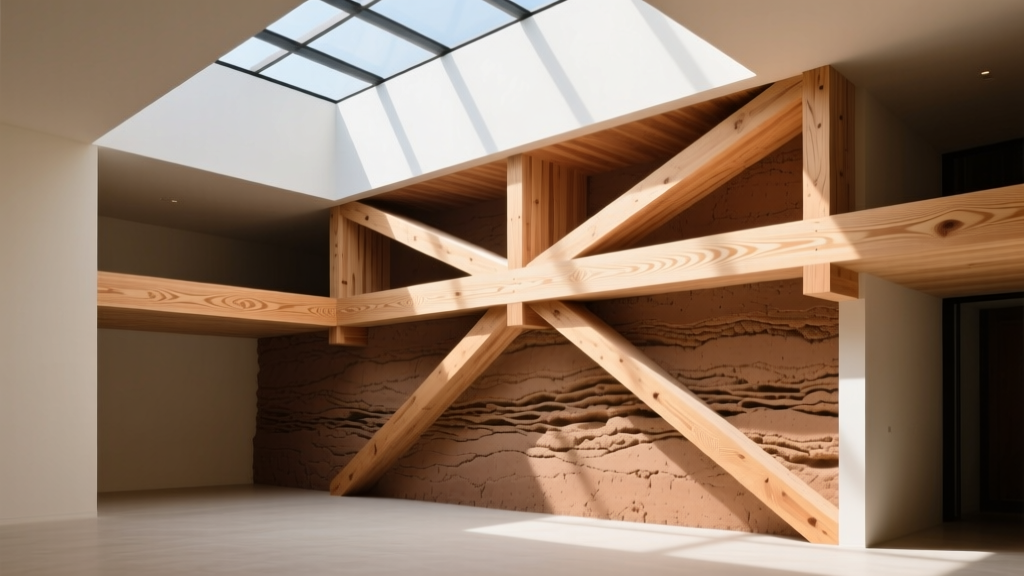
Mass timber, specifically Cross-Laminated Timber (CLT), has redefined mid-rise and high-rise sustainable construction. Manufactured by gluing dimensional lumber at alternating 90-degree angles, CLT panels act as monolithic structural slabs capable of spanning up to 20 feet without intermediate support.
Performance and Code Compliance
Under the ANSI/APA PRG 320 standard, CLT panels are graded for structural integrity and fire resistance. A common misconception is that mass timber is a fire hazard; in reality, heavy timber chars at a predictable rate of 1.5 inches per hour. A 5-ply CLT panel (approx. 6.875 inches thick) inherently achieves a 2-hour fire resistance rating without the need for gypsum encapsulation, as the char layer insulates the unburned core. For acoustic decoupling in multi-family projects, a floating floor system with a 1-inch mineral wool mat and 2-inch concrete topping slab is required to meet IBC impact insulation class (IIC) requirements.
Procurement and Site Logistics
CLT requires precision CNC prefabrication. Tolerances are measured in millimeters, meaning site foundations must be poured with laser-guided precision (typically within 1/8 inch over 40 feet). In 2026, North American CLT supply chains have stabilized, but lead times for custom V1 grade panels remain at 12 to 16 weeks.
Material 2: Hempcrete (Hemp-Lime Biocomposite)
Hempcrete is a bio-aggregate composite made from the woody core of the hemp plant (hurd) mixed with a lime-based binder and water. It is strictly a non-load-bearing infill material, requiring a structural skeleton of timber, steel, or concrete to support roof and floor loads.
Thermodynamics and Moisture Management
Hempcrete excels in hygrothermal performance. Its high vapor permeability allows walls to 'breathe,' regulating interior humidity and eliminating the risk of interstitial condensation when detailed correctly. The standard mix ratio for structural infill is 1 part lime binder to 2.5 parts hemp hurd by weight. While its R-value of ~2.6 per inch is moderate, its high thermal mass and airtightness create a highly efficient building envelope. To maintain vapor openness, exterior finishes must be lime render or silicate paints; applying standard acrylic stucco or impermeable house wraps like Tyvek will trap moisture and cause the biocomposite to degrade.
Carbon Sequestration
Hemp is a rapid-growth crop that sequesters significant CO2 during its 100-day lifecycle. When combined with a lime binder (which reabsorbs CO2 during the carbonation curing process), hempcrete achieves a net-negative carbon footprint. The U.S. Green Building Council (USGBC) recognizes biogenic carbon storage in LEED v4.1, allowing hempcrete projects to earn significant credits in the Building Life-Cycle Impact Reduction category.
Material 3: Rammed Earth & Stabilized Earth Blocks
Rammed earth involves compacting a damp mixture of subsoil, clay, sand, and a stabilizing agent (typically 5-10% Portland cement or a geopolymer alternative) into temporary formwork. The result is a dense, monolithic wall with exceptional thermal mass and a striking, stratified aesthetic.
Thermal Mass vs. Insulation
The primary failure mode in modern rammed earth design is confusing thermal mass with thermal resistance. Rammed earth has an abysmal R-value of roughly 0.25 per inch. In heating-dominated climates (IECC Zones 5 and above), uninsulated rammed earth fails energy codes. The solution is Insulated Rammed Earth (IRE), where a continuous layer of rigid mineral wool or expanded polystyrene (EPS) is sandwiched between two 8-inch wythes of rammed earth, yielding an assembly R-value of R-20 to R-30 while preserving the exposed interior thermal mass.
Formwork and Labor Realities
The high cost of rammed earth ($85-$130/sq ft) is driven almost entirely by labor and formwork. Building the heavy-duty plywood or aluminum forms required to withstand the pneumatic tamping process is akin to commercial concrete work. Once the forms are stripped, the walls require minimal finishing, but any embedded electrical conduit or plumbing must be precisely mapped and sleeved before the first layer of earth is tamped.
Structural Limitations and Real-World Failure Modes
Sustainable materials are unforgiving of poor detailing. Understanding edge cases and failure modes is critical for risk mitigation.
- CLT Moisture Trapping: If CLT panels are delivered to a site and exposed to rain before the roof is dried-in, moisture can become trapped between the laminations, leading to delamination and mold. Sites must utilize temporary weather enclosures or 'tenting' during the erection phase.
- Hempcrete Shrinkage Cracking: Lime binders shrink as they cure. If the hemp hurd is not adequately pre-wetted before mixing, it will absorb the mixing water too rapidly, resulting in a weak, crumbly matrix and severe shrinkage cracking at the framing joints.
- Rammed Earth Spalling: In freeze-thaw climates, exterior rammed earth must be treated with a penetrating silane/siloxane water repellent. If left unsealed, water absorption followed by freezing will cause the outer 1/4 inch of the wall to spall and flake off over successive winters.
Decision Framework: Selecting the Right Material
Project Typology Matching Guide
Choose Mass Timber (CLT) if: You are designing a multi-story commercial, educational, or multi-family residential building (3 to 18 stories) where speed of erection, reduced foundation loads, and exposed interior aesthetics are primary drivers.
Choose Hempcrete if: You are building a low-rise (1-3 story) residential or boutique commercial project in a mixed-humid climate, prioritizing vapor-open wall assemblies, non-toxic interiors, and maximum embodied carbon reduction.
Choose Rammed Earth if: Your project is located in an arid or high-desert climate with significant diurnal temperature swings, and the client values high thermal mass, acoustic isolation, and bespoke architectural finishes over rapid construction timelines.
Selecting the optimal eco friendly materials for building construction requires aligning the material's inherent physical properties with the specific climatic, structural, and programmatic demands of the project. By prioritizing building science over greenwashing, developers can deliver structures that are both ecologically restorative and highly durable.
Written by
Priya KapoorPriya Kapoor is a real estate market analyst and construction economics researcher with expertise in housing affordability, development feasibility, and infrastructure investment. She holds a Master of Regional Planning from Cornell University and previously worked as a senior analyst at CBRE's Investment Properties group, where she modeled returns for $4B in mixed-use development pipelines. Priya now runs an independent research practice advising developers, municipalities, and REITs on construction cost forecasting and market timing. She publishes the quarterly "BuildMat Market Pulse" report tracking material price indices across 12 commodity categories. Based in Austin, TX, Priya serves on the board of Habitat for Humanity Austin and is a marathon runner.
More from Priya Kapoor
View all
Construction Cost
Cost to Build a 1600 Sq Ft Home in 2026: Full Breakdown
Accurate 2026 cost to build a 1600 sq ft home—material, labor, and regional pricing breakdowns included. Plan your budget with real-time estimates.
Aug 11, 2026

Wood & Lumber
Name the Types of Wood for Pressure Treatment and Preservation
Learn how to name the types of wood best suited for pressure treatment. Compare species treatability, chemical retention levels, and 2026 preservation costs.
Aug 4, 2026

Stone & Masonry
Stone Veneer Suppliers Lindenhurst: 2026 Cost Analysis
Analyze 2026 stone veneer costs in Lindenhurst, NY. Compare local supplier pricing, delivery fees, and Suffolk County installation labor rates.
Aug 4, 2026