Eco-Friendly Flooring Options Richmond VA: 2026 Cost vs Benefit
Compare 2026 costs and benefits of eco-friendly flooring options in Richmond, VA. Discover ROI, humidity resistance, and historic home compatibility.
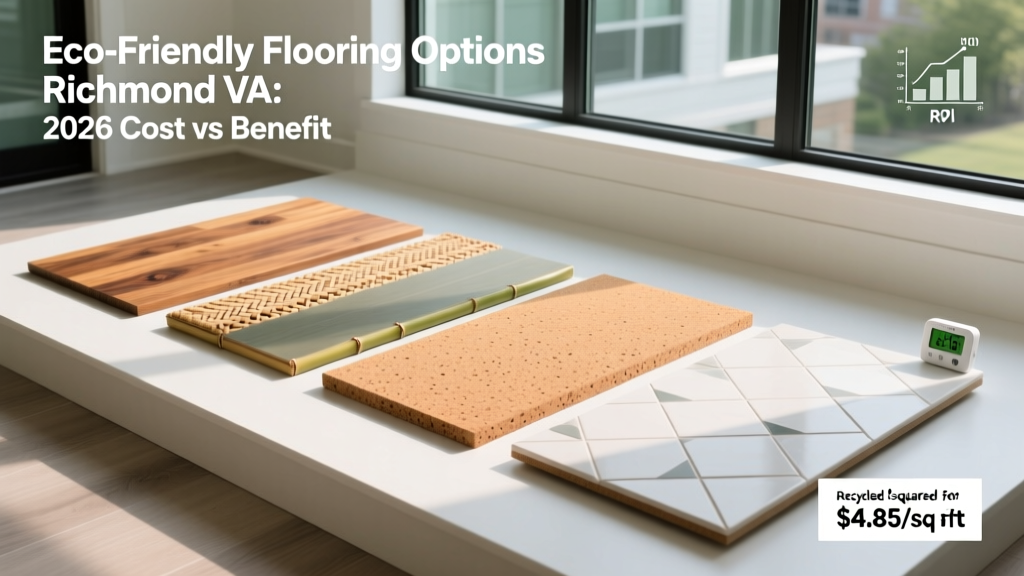
The Richmond Climate Factor: Why Material Choice Matters
Choosing sustainable flooring in Richmond, Virginia, requires navigating a specific set of environmental and architectural challenges. Richmond’s humid subtropical climate brings summer relative humidity levels that frequently exceed 75%, followed by dry, artificially heated winters. This extreme moisture fluctuation causes traditional solid hardwoods to expand, cup, and gap. When evaluating eco-friendly flooring options in Richmond, VA, dimensional stability and moisture resistance must be weighted just as heavily as the material's carbon footprint.
Furthermore, Richmond’s housing stock is heavily concentrated in historic neighborhoods like the Fan District, Church Hill, and Ginter Park, where pre-1940s homes feature uneven joist framing and diagonal pine subfloors. A material that is technically sustainable but requires a perfectly level concrete slab will incur massive hidden subfloor preparation costs in these historic zones. This guide breaks down the true cost versus benefit of the top green flooring materials for Richmond homes in 2026, factoring in local installation realities, long-term durability, and real estate ROI.
Top Eco-Friendly Flooring Options: Cost vs. Benefit Breakdown
1. Reclaimed Appalachian Heart Pine
For historic renovations, reclaimed heart pine is the gold standard. Sourced from deconstructed regional barns, textile mills, and river-logged timber across Virginia and the Carolinas, this material keeps carbon sequestered while perfectly matching the original millwork of 19th-century Richmond homes.
- Material Cost: $12.00 – $18.00 per square foot.
- Installed Cost: $18.00 – $26.00 per square foot (includes sanding and finishing on-site).
- Janka Hardness: 1,225 (comparable to red oak, but vastly more stable due to tight growth rings).
- The Benefit: Qualifies for LEED regional material credits because it is sourced and milled within a 100-mile radius of Richmond. It also commands a premium from local buyers seeking authentic historic restoration.
- The Drawback: Requires specialized nail-down installation over a reinforced subfloor. On-site finishing with low-VOC water-based polyurethane adds 3-4 days of labor and curing time.
2. FSC-Certified Strand-Woven Bamboo
Bamboo is a rapidly renewable grass that harvests in 3-5 years. However, traditional horizontal bamboo is too soft and moisture-sensitive for Richmond's climate. Strand-woven bamboo, which compresses shredded bamboo fibers under extreme heat and pressure, solves this issue.
- Material Cost: $6.50 – $10.00 per square foot.
- Installed Cost: $10.00 – $14.50 per square foot (floating or glue-down).
- Janka Hardness: 3,000+ (over twice as hard as Brazilian cherry).
- The Benefit: Exceptional dimensional stability. Strand-woven bamboo expands and contracts at roughly half the rate of solid oak, making it highly resistant to Richmond's summer humidity spikes.
- The Drawback: Must be verified by the Forest Stewardship Council (FSC) to ensure it wasn't harvested from endangered old-growth forests or manufactured with urea-formaldehyde binders.
3. Marmoleum (Natural Linoleum)
Often confused with synthetic vinyl, true linoleum (like Forbo’s Marmoleum) is made from oxidized linseed oil, pine rosin, wood flour, and jute backing. It is entirely biodegradable and inherently antimicrobial.
- Material Cost: $4.50 – $7.50 per square foot (modular tiles or sheet goods).
- Installed Cost: $8.00 – $12.00 per square foot.
- The Benefit: Ideal for high-moisture areas like mudrooms and kitchens. It naturally resists mold and mildew, a common issue in Richmond's damp basements and ground-level additions.
- The Drawback: Sheet goods require professional heat-welding for waterproof seams. It also requires a perfectly smooth subfloor, as any imperfections will telegraph through the surface over time.
Comparative Cost & ROI Matrix (2026 Data)
| Material | Avg. Installed Cost (Sq Ft) | Expected Lifespan | Richmond Humidity Tolerance | Resale Value Impact |
|---|---|---|---|---|
| Reclaimed Heart Pine | $22.00 | 75+ Years | Moderate (Requires acclimation) | High (Historic premium) |
| Strand-Woven Bamboo | $12.25 | 25-30 Years | High | Moderate |
| Marmoleum (Linoleum) | $10.00 | 30-40 Years | High (if seams welded) | Niche (Eco-conscious buyers) |
| Cork (Floating) | $11.50 | 20-25 Years | Low (Requires vapor barrier) | Moderate |
Hidden Costs: Subfloor Prep in Historic Richmond Homes
Many eco-friendly flooring options, particularly floating bamboo and cork, require a subfloor deflection of no more than 3/16 inch over a 10-foot radius. Historic homes in neighborhoods like Church Hill often feature 1x8 diagonal pine subfloors with significant sagging between joists. If you choose a floating eco-floor, budget an additional $2.50 to $3.50 per square foot to overlay the existing subfloor with 3/8-inch CDX plywood. Skipping this step will cause the click-lock joints on bamboo or cork planks to shear and fail within two years.
For nail-down reclaimed heart pine, the existing diagonal pine subfloor is actually an asset, provided the joists are structurally sound. However, you must budget for a professional floor sanding crew to level the historic boards before the new heart pine is blind-nailed at a 45-degree angle.
Long-Term Benefits: Energy Efficiency and Indoor Air Quality
The true ROI of sustainable flooring extends beyond the initial installation. In Richmond, where HVAC costs peak during the sweltering July and August months, the thermal properties of your flooring play a measurable role in energy consumption.
Thermal Resistance (R-Value)
Cork flooring offers an R-value of approximately 0.4 per 1/4-inch of thickness. When installed as a floating floor over an unconditioned crawl space—a common setup in Richmond's mid-century ranch homes in the West End—cork acts as a thermal break. This reduces the radiant heat loss in winter and keeps floor surfaces cooler in the summer, marginally reducing the load on your central air system.
VOC Off-Gassing and Respiratory Health
Synthetic flooring alternatives like luxury vinyl plank (LVP) often contain phthalates and emit volatile organic compounds (VOCs) that degrade indoor air quality, especially when trapped inside tightly sealed, modern energy-efficient homes. According to the EPA guidelines on VOCs, long-term exposure to these compounds can trigger respiratory issues. When installing bamboo or cork in Richmond, mandate the use of zero-VOC silane-based adhesives (such as Bona Silane or ECOS Wood Glue) rather than cheap solvent-based mastic. This ensures your home meets the stringent requirements for the LEED v4.1 Low-Emitting Materials credit, safeguarding your family's respiratory health while increasing the home's green certification profile.
The 2026 Richmond ROI: Does Green Flooring Pay Off?
In the current Richmond real estate market, sustainability is no longer just a moral choice; it is a financial lever. Homes in the Greater Richmond area that feature verifiable eco-friendly upgrades—including FSC-certified flooring, low-VOC finishes, and regional reclaimed materials—consistently appraise higher and spend fewer days on the market.
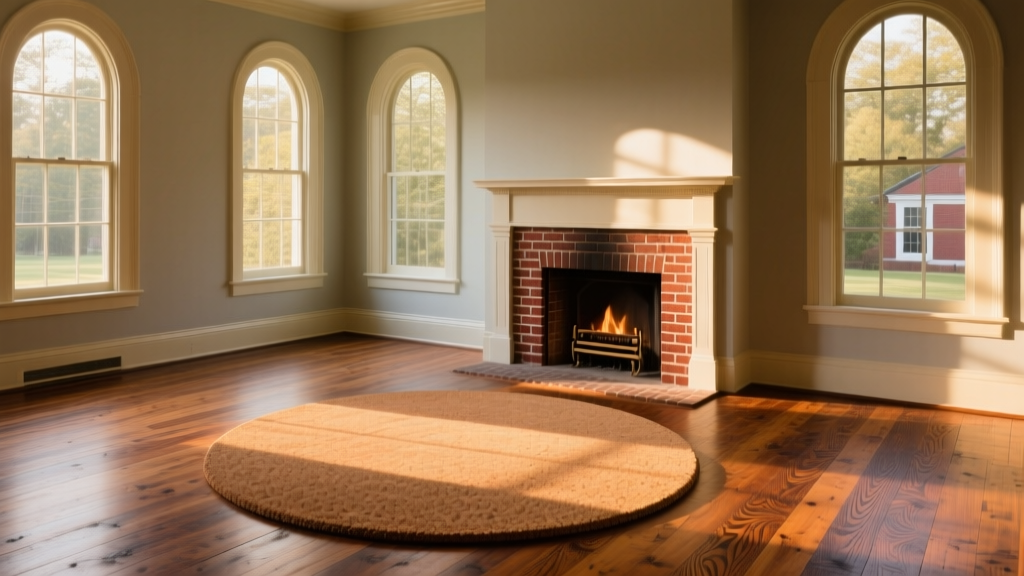
Buyers in historic districts are actively looking for materials that honor the architectural integrity of the home without introducing modern toxic off-gassing. Reclaimed heart pine bridges this gap perfectly, offering a 100% return on investment at resale, whereas synthetic 'wood-look' alternatives often trigger price negotiations downward.
— 2026 Central Virginia Green Building Market Report
Actionable Decision Framework
- If renovating a pre-1920s historic home: Choose Reclaimed Heart Pine. The high upfront cost is offset by the elimination of subfloor leveling requirements and the massive premium historic district buyers pay for authenticity.
- If building a new addition or updating a 1980s suburban home: Choose Strand-Woven Bamboo. It provides the hardness required for high-traffic family areas and handles the HVAC-induced humidity swings of modern, tightly sealed envelopes better than solid wood.
- If finishing a basement or ground-level mudroom: Choose Marmoleum. Its natural resistance to mold and moisture makes it the safest, most durable green option for below-grade or high-water-traffic entryways.
Written by
Marcus ChenMarcus Chen is a licensed structural engineer (PE) and building materials analyst with over 12 years of experience across residential, commercial, and industrial construction. He holds a Master of Science in Civil Engineering from UC Berkeley and spent six years at Thornton Tomasetti before transitioning to independent consulting and technical writing. Marcus specializes in material selection for seismic-prone regions, concrete reinforcement strategies, and lifecycle cost analysis. His work has been cited by the American Concrete Institute (ACI) and the Structural Engineers Association of California (SEAOC). When he is not on a job site or at his desk, you will find him hiking the Sierra Nevada or restoring a 1920s craftsman bungalow in Oakland, CA.
More from Marcus Chen
View all
Construction Cost
How Much Did the Eiffel Tower Cost to Build?
How much did the Eiffel Tower cost to build in 1889? We adjust for inflation and compare its budget to modern skyscraper construction.
Aug 4, 2026

Fire Resistance
What Is a Fire Resistant Material? Testing & Certification Guide
Discover what is a fire resistant material through ASTM and UL testing. Learn how fire ratings, certifications, and assemblies work in construction.
Aug 4, 2026

Construction Cost
How Much Did the Burj Khalifa Cost to Build?
How much did the Burj Khalifa cost to build? We break down the $1.5B project and extract 5 money-saving strategies for your next build.
Jul 30, 2026