Polycarbonate Roofing Material: Environmental Impact Analysis
Analyze the environmental impact of polycarbonate roofing material. Explore embodied carbon, energy savings, recyclability, and LEED benefits.

The Embodied Carbon Paradox: Weight vs. Resin Emissions
When evaluating the environmental footprint of polycarbonate roofing material, architects and sustainability consultants must navigate a fundamental paradox. Polycarbonate (PC) is a petroleum-derived thermoplastic synthesized from bisphenol A (BPA) and phosgene. The production of virgin PC resin is highly energy-intensive, generating approximately 6.5 to 7.5 kg CO2e per kilogram of resin produced. By comparison, standard float glass generates roughly 1.2 kg CO2e per kilogram.
However, a true environmental impact analysis requires calculating embodied carbon per square meter of installed roofing, not just per kilogram of raw material. Polycarbonate has a density of 1.2 g/cm³, less than half that of glass (2.5 g/cm³). A standard 16mm triple-wall polycarbonate sheet weighs approximately 2.7 kg/m², resulting in an embodied carbon footprint of roughly 18 to 20 kg CO2e/m². A comparable double-glazed insulated glass unit (IGU) weighs between 20 and 25 kg/m², pushing its embodied carbon to 50+ kg CO2e/m², excluding the heavy steel or aluminum framing required to support the dead load.
While the resin extraction and polymerization of polycarbonate carry a high carbon penalty per kilogram, its extreme strength-to-weight ratio drastically reduces structural support requirements and transportation emissions, often resulting in a lower overall embodied carbon footprint for large-span translucent roofing projects.
Operational Energy: Daylighting and Thermal Performance
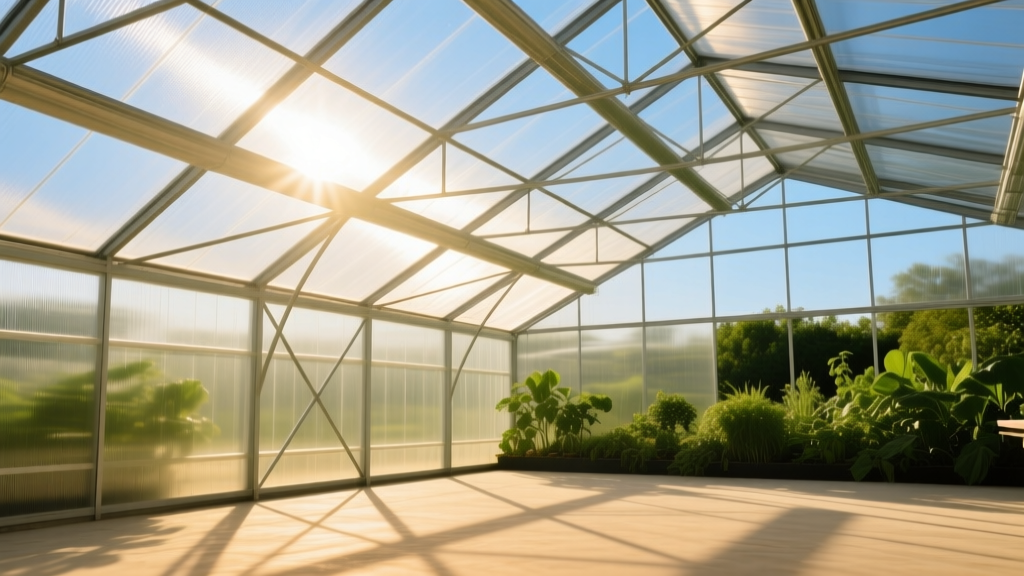
The most significant environmental advantage of polycarbonate roofing material emerges during the operational phase of a building's lifecycle. By harnessing natural daylight, multiwall PC panels drastically reduce reliance on artificial lighting. According to the U.S. Department of Energy, effective daylighting strategies can reduce lighting energy consumption by 20% to 60%. Because multiwall polycarbonate diffuses light rather than transmitting it directly, it eliminates the harsh glare and solar hot spots associated with raw glass, making it highly efficient for commercial and agricultural applications.
Thermal resistance is dictated by the panel's internal rib structure. Specifying the correct multiwall configuration is critical for minimizing HVAC loads in 2026's increasingly stringent energy codes.
| Panel Configuration | Thickness | Weight (kg/m²) | U-Value (W/m²K) | Light Transmission (Clear) | SHGC |
|---|---|---|---|---|---|
| Twin-Wall | 8 mm | 1.5 | 2.9 | 82% | 0.75 |
| Triple-Wall | 16 mm | 2.7 | 1.4 | 74% | 0.65 |
| Five-Wall (X-Structure) | 25 mm | 3.4 | 0.9 | 62% | 0.52 |
| Solid Polycarbonate | 6 mm | 7.2 | 5.4 | 88% | 0.82 |
| Double-Pane Low-E Glass | 24 mm (IGU) | 22.0 | 1.1 | 70% | 0.38 |
For unheated spaces like greenhouses or storage canopies, 8mm twin-wall is sufficient. For conditioned commercial spaces aiming for net-zero energy, the 25mm five-wall X-structure panels (such as those in the Polygal Polyshade or Palram Sunlite lines) provide a U-value of 0.9 W/m²K, rivaling standard double-pane glass at a fraction of the weight and material cost.
The UV Coating Imperative: Preventing Premature Failure
A critical vulnerability of polycarbonate is its susceptibility to ultraviolet (UV) degradation. Unprotected PC will yellow, lose light transmission, and become brittle within 24 to 36 months of outdoor exposure. This premature failure represents a massive environmental liability, as early replacement doubles the lifecycle carbon footprint.
Specification Warning: Co-extruded vs. Coated UV Protection
Never specify "surface-coated" UV protection for permanent architectural roofing. You must mandate co-extruded UV protection. Co-extrusion bonds a 40-50 micron layer of UV-absorbing resin directly into the top surface of the sheet during the manufacturing process, ensuring it cannot flake, wash off, or degrade independently of the substrate. Brands like SABIC’s LEXAN™ Thermoclear and Palram’s Suntuf utilize advanced co-extrusion that guarantees structural and optical integrity for 10 to 15 years.
End-of-Life: Recyclability and the #7 Plastic Challenge
The end-of-life phase is where polycarbonate roofing material faces its harshest environmental scrutiny. Polycarbonate is classified under Resin Identification Code #7 ("Other"), meaning it is universally rejected by municipal curbside recycling programs. According to the Environmental Protection Agency (EPA), plastics in the #7 category require specialized handling and separation to avoid contaminating primary recycling streams like PET (#1) and HDPE (#2).
When a PC roof reaches the end of its 15-year lifespan, it must be routed to specialized commercial plastics recyclers. The recycling process involves shredding the panels, washing away silicone sealants and aluminum tape residues, and pelletizing the clean flake for use in injection-molded, non-optical products (like automotive bumpers or electronic housings). If the demolition contractor fails to separate the PC from PVC flashings or EPDM gaskets, the batch is deemed contaminated and sent to the landfill. To ensure circularity, project managers must write end-of-life recycling plans directly into the construction contract, partnering with specialized brokers like Seraphim Plastics or local e-waste/commercial plastic recyclers before demolition begins.
LEED v4.1 and Green Building Certification Pathways
Integrating polycarbonate roofing material can directly contribute to multiple credits under the USGBC LEED v4.1 rating system, provided it is specified and documented correctly:
- EQ Credit: Daylight (1-3 Points): Because multiwall PC diffuses light evenly, it is highly effective at achieving the required 300 to 3,000 lux spatial daylight autonomy (sDA) thresholds without causing visual discomfort or glare, which is a common failure point with clear glass skylights.
- MR Credit: Building Product Disclosure and Optimization (1-2 Points): Sourcing PC panels from manufacturers that provide Environmental Product Declarations (EPDs) and utilize post-industrial recycled (PIR) content. Several major extruders now incorporate up to 15% PIR regrind into their multiwall sheets.
- EA Credit: Optimize Energy Performance:** Utilizing 25mm five-wall panels in conditioned atriums to lower the overall building envelope U-value, contributing to the whole-building energy simulation improvements required for this credit.
Decision Framework: When to Specify Polycarbonate
Polycarbonate is not a universal replacement for glass or metal roofing. Use this framework to determine if it aligns with your project's sustainability and performance goals.
Specify Polycarbonate When:
- Weight Restrictions Exist: You are retrofitting an older structure or designing a long-span space frame where the dead load of glass would require massive, carbon-intensive steel reinforcement.
- Diffused Light is Required: The space is a greenhouse, indoor agricultural facility, or manufacturing floor where direct solar rays would damage plants, cause material fading, or create dangerous glare for workers.
- Impact Resistance is Critical: The building is located in a region prone to severe hail, flying debris, or heavy snow loads. PC possesses an impact strength 250 times greater than glass, virtually eliminating the risk of shattering and subsequent weather damage.
Avoid Polycarbonate When:
- High Solar Heat Gain is Detrimental: Even with tinted or opal panels, PC generally has a higher Solar Heat Gain Coefficient (SHGC) than modern Low-E coated glass. In hot climates where cooling loads dominate, the solar heat admitted by PC can negate its lighting energy savings.
- Acoustic Insulation is a Priority: Multiwall polycarbonate is notoriously poor at blocking airborne noise. If the roof is situated near an airport or heavy highway, rain and external noise will easily penetrate the hollow chambers of the panels.
- Aesthetic Transparency is Required: If the architectural intent demands crystal-clear, undistorted views of the sky, solid glass is the only viable option. Multiwall PC inherently obscures vision due to its internal ribbing.
By rigorously analyzing the full lifecycle—from the petroleum extraction of the resin to the operational daylighting savings and the final recycling logistics—specifiers can accurately position polycarbonate roofing material as a highly strategic, low-carbon alternative for specific architectural applications.
Written by
Marcus ChenMarcus Chen is a licensed structural engineer (PE) and building materials analyst with over 12 years of experience across residential, commercial, and industrial construction. He holds a Master of Science in Civil Engineering from UC Berkeley and spent six years at Thornton Tomasetti before transitioning to independent consulting and technical writing. Marcus specializes in material selection for seismic-prone regions, concrete reinforcement strategies, and lifecycle cost analysis. His work has been cited by the American Concrete Institute (ACI) and the Structural Engineers Association of California (SEAOC). When he is not on a job site or at his desk, you will find him hiking the Sierra Nevada or restoring a 1920s craftsman bungalow in Oakland, CA.
More from Marcus Chen
View all
Construction Cost
How Much Did the Eiffel Tower Cost to Build?
How much did the Eiffel Tower cost to build in 1889? We adjust for inflation and compare its budget to modern skyscraper construction.
Aug 4, 2026

Fire Resistance
What Is a Fire Resistant Material? Testing & Certification Guide
Discover what is a fire resistant material through ASTM and UL testing. Learn how fire ratings, certifications, and assemblies work in construction.
Aug 4, 2026

Construction Cost
How Much Did the Burj Khalifa Cost to Build?
How much did the Burj Khalifa cost to build? We break down the $1.5B project and extract 5 money-saving strategies for your next build.
Jul 30, 2026