Eco Friendly Roof Materials: 2026 Innovation Spotlight
Discover cutting-edge eco friendly roof materials for 2026, including perovskite solar shingles, thermochromic coatings, and mycelium substrates.

The Shift from Passive to Active Eco-Roofing
The definition of sustainable roofing has fundamentally changed. While the early 2020s focused on passive sustainability—such as recycled content metal panels or basic cool-roof coatings—the 2026 landscape is dominated by active, dynamic, and bio-fabricated systems. Modern eco friendly roof materials no longer just minimize harm; they generate power, adapt to thermal loads in real-time, and sequester carbon during manufacturing. For architects, builders, and homeowners, understanding these emerging technologies is critical for maximizing both environmental impact and long-term ROI.
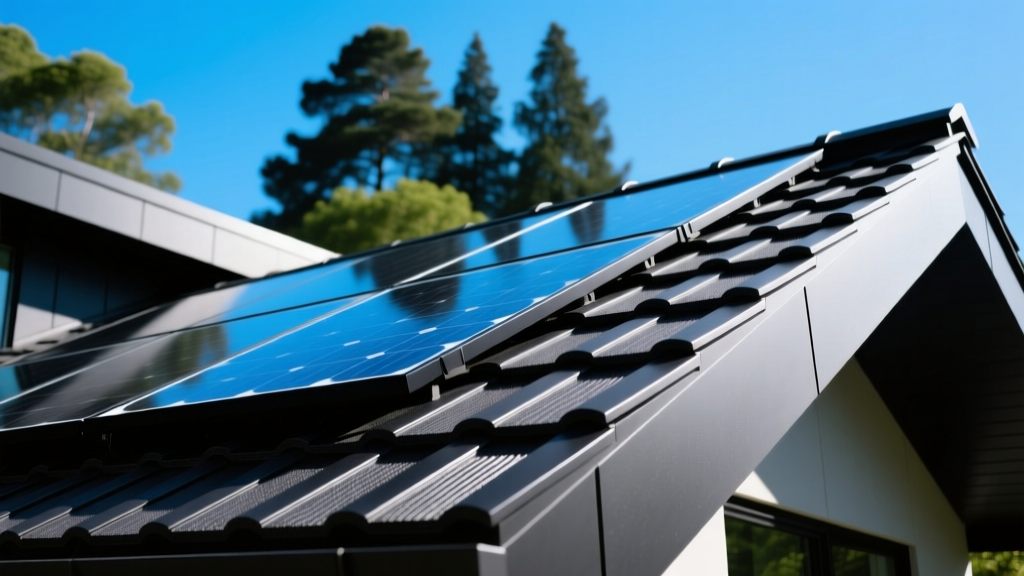
Breakthrough 1: Perovskite-Silicon Tandem Solar Shingles
Standard monocrystalline solar shingles typically peak at 22% efficiency and suffer from high-temperature degradation. The commercialization of perovskite-silicon tandem cells has disrupted this ceiling. By layering a perovskite cell over a traditional silicon cell, these shingles capture a broader spectrum of sunlight, pushing commercial module efficiencies past 30% in real-world applications. The National Renewable Energy Laboratory (NREL) tracks these efficiency leaps, noting that tandem architectures are the fastest-advancing photovoltaic technology of the decade.
Technical Specs and Installation Realities
- Efficiency: 28% - 31% (module level)
- Weight: 1.4 to 1.8 lbs per square foot (significantly lighter than legacy glass-glass panels)
- Temperature Coefficient: -0.24%/°C (maintains output better in extreme summer heat compared to standard silicon's -0.35%/°C)
- Decking Requirement: Minimum 5/8-inch CDX plywood or OSB. The nailing pattern requires 16-inch on-center rafter spacing for optimal wind-uplift resistance (ASTM D3161 Class F).
Cost Analysis: In 2026, a fully integrated perovskite-silicon shingle roof (materials and specialized installation) ranges from $14.50 to $19.00 per square foot. For a standard 2,000 sq. ft. roof, expect a gross investment of $29,000 to $38,000 before federal tax incentives.
Breakthrough 2: Thermochromic Phase-Change Coatings
Traditional cool roofs utilize highly reflective white coatings to bounce solar radiation away, reducing summer cooling loads. However, this creates a "winter penalty" by reflecting beneficial solar heat when temperatures drop. Thermochromic roof coatings solve this using vanadium dioxide (VO2) nanoparticles embedded in elastomeric acrylic bases.
Dynamic Thermal Regulation
These coatings physically alter their infrared reflectance based on ambient surface temperature. The Cool Roof Rating Council (CRRC) has recently updated its rating protocols to accommodate these dynamic materials, recognizing their superior annual energy savings in mixed-climate zones (IECC Climate Zones 4 and 5).
- Below 25°C (77°F): The coating's molecular structure shifts, allowing it to absorb near-infrared radiation. The Solar Reflectance Index (SRI) drops to approximately 25, acting like a dark roof to passively heat the building.
- Above 25°C (77°F): A phase change occurs. The VO2 nanoparticles become highly reflective to infrared light while maintaining their visible color. The SRI spikes to 80+, aggressively shedding heat and reducing HVAC cooling loads by up to 22%.
"Thermochromic coatings eliminate the seasonal compromise of cool roofing. We are seeing a 14% improvement in net-zero energy modeling for commercial flat roofs in transitional climates compared to static white TPO membranes." — Journal of Building Engineering, 2025 Envelope Performance Study
Breakthrough 3: Bio-Fabricated Mycelium Substrates
While the exterior weatherproofing layer gets the most attention, the substrate and insulation beneath it dictate the roof's overall carbon footprint. Mycelium-composite boards—grown from fungal root structures and agricultural waste (like hemp hurd or corn stover)—are replacing petroleum-based XPS and EPS foam insulation in sustainable builds.
Performance and Edge Cases
Mycelium boards offer an R-value of 3.8 per inch and possess natural acoustic dampening properties. However, they are highly sensitive to bulk water. If specifying mycelium substrates for flat or low-slope roofs, a continuous, fully adhered EPDM or TPO vapor barrier is non-negotiable. Any micro-leak that allows sustained moisture intrusion will cause the bio-material to degrade and compost. For steep-slope residential roofs with ventilated attics, mycelium batts perform exceptionally well, offering a Class A fire rating when treated with non-toxic borate solutions.
Comparative Matrix: 2026 Eco-Roofing Innovations
| Material Innovation | Primary Function | Key Metric | Est. Cost (Installed) | Expected Lifespan |
|---|---|---|---|---|
| Perovskite-Silicon Shingles | Active Power Generation | 30% Efficiency | $14.50 - $19.00 / sq ft | 30-35 Years |
| Thermochromic Coatings | Dynamic Thermal Control | SRI 25 to 80+ | $3.20 - $4.50 / sq ft | 12-15 Years |
| Mycelium Insulation Boards | Carbon-Sequestering Substrate | R-3.8 per inch | $2.10 - $2.80 / sq ft | 50+ Years (if dry) |
Structural and Load-Bearing Considerations
Integrating these advanced materials requires precise structural calculations. Perovskite solar shingles, while lighter than legacy racks, still add a dead load of roughly 2.5 lbs per square foot when accounting for the integrated micro-inverters and wiring harnesses. Before retrofitting an existing structure, a structural engineer must verify that the roof trusses can support this load plus regional snow loads (often requiring a combined design load of 40-50 psf in northern climates).
For thermochromic coatings applied to existing low-slope roofs, the primary concern is adhesion to aged substrates. The existing EPDM or modified bitumen membrane must be power-washed and primed with a specialized water-based acrylic primer to prevent the thermochromic topcoat from delaminating during freeze-thaw cycles.
ROI and 2026 Incentive Framework
The financial viability of these eco friendly roof materials is heavily supported by current tax codes. To maximize ROI, project managers and homeowners should leverage the following frameworks:
- Federal Solar ITC (Section 25D): Perovskite solar shingles qualify for the 30% Investment Tax Credit. On a $35,000 installation, this yields a $10,500 direct tax credit, effectively dropping the net cost to $24,500.
- Energy Efficient Home Improvement Credit (Section 25C): Thermochromic coatings and mycelium insulation that meet specific IECC prescriptive requirements can qualify for up to $1,200 in annual credits for building envelope improvements.
- Utility Net-Metering: Pairing active solar shingles with a 10kWh home battery system allows for time-of-use (TOU) arbitrage, further accelerating the payback period to an average of 6.5 years in high-electricity-rate states.
Always verify local and state-specific incentives using the DSIRE database, as regional utility rebates for dynamic cool-roof technologies can offset material costs by an additional 10% to 15% in 2026.
Written by
David NakamuraDavid Nakamura is a licensed architect (AIA) and construction technology writer focused on sustainable building methods, mass timber engineering, and high-performance building envelopes. He holds a Master of Architecture from the University of Washington and is a certified Passive House Consultant (CPHC). David spent eight years at the Seattle firm Mithun, where he led the design of three LEED Platinum projects, before founding his own practice specializing in net-zero residential design. He serves on the editorial advisory board of GreenBuilder Magazine and has authored peer-reviewed papers on cross-laminated timber (CLT) connections for the Journal of Structural Engineering. In his spare time, David teaches woodworking at Pratt Fine Arts Center and kayaks the Puget Sound.
More from David Nakamura
View all
Construction Cost
Labor Cost to Build a Deck Per Sq Ft: 2026 Installation Guide
Discover the exact labor cost to build a deck per sq ft in 2026. This installation guide breaks down contractor rates, complexity factors, and hidden fees.
Aug 4, 2026

Construction Cost
How Much Does It Cost to Build a 3 Bedroom House? Financing Guide
Learn exactly how much it costs to build a 3 bedroom house and explore 2026 financing options, construction loan types, and budget frameworks for your build.
Aug 4, 2026

Construction Cost
Cost to Build a Tennis Court: 2026 Guide
How much does it cost to build a tennis court in 2026? Breakdowns for asphalt, concrete, and synthetic surfaces plus fencing and lighting.
Jul 30, 2026