Life Cycle Analysis of Top Eco Flooring Options for Green Homes
Compare the true environmental impact of top eco flooring options. We analyze LCA data, carbon footprints, and VOC emissions to guide your green build.

Beyond the Green Label: Quantifying Flooring Impact
Marketing terms like 'natural' and 'sustainable' are frequently applied to flooring products with minimal regulatory oversight. For architects, builders, and eco-conscious homeowners, selecting genuinely sustainable materials requires moving past surface-level claims and examining Life Cycle Assessment (LCA) data. When evaluating eco flooring options, the true environmental cost encompasses raw material extraction, manufacturing energy, transportation emissions, indoor air quality (IAQ) impacts, and end-of-life circularity.
This analysis dissects the environmental footprint of the leading sustainable flooring categories, utilizing embodied carbon metrics (kg CO2e/m²) and volatile organic compound (VOC) emission standards to provide a scientifically grounded procurement framework.
The LCA Framework: Measuring True Environmental Impact
An Environmental Product Declaration (EPD) provides a standardized LCA for building materials. According to the International EPD System, a comprehensive flooring LCA evaluates three critical phases:
- Product Stage (A1-A3): Raw material supply, transport to the factory, and manufacturing. This is the 'embodied carbon' most commonly cited.
- Construction & Use Stage (A4-B7): Transport to the job site, installation waste, maintenance, and operational energy (e.g., thermal resistance affecting HVAC loads).
- End-of-Life Stage (C1-C4): Deconstruction, transport to waste facilities, and final disposal or recovery.
A material with low A1-A3 emissions might have catastrophic C4 impacts if it cannot be recycled or composted, ultimately generating methane in a landfill.
Deep Dive: Carbon Footprint of Leading Eco Flooring Options
Strand-Woven Bamboo
Bamboo is a rapidly renewable grass, reaching maturity in 3-5 years. However, the 'strand-woven' manufacturing process—which shreds the stalks and compresses them under extreme heat and pressure—requires significant energy and chemical binders. Standard bamboo flooring often uses urea-formaldehyde (UF) resins. To ensure true sustainability, specify No Added Urea Formaldehyde (NAUF) products, such as those utilizing phenol-formaldehyde or soy-based resins. Embodied Carbon: 12-18 kg CO2e/m².
Cork
Cork is harvested from the bark of the Quercus suber (cork oak) tree every nine years without felling the tree. The bark regeneration process actively sequesters carbon. However, because commercial cork is almost exclusively grown in the Iberian Peninsula (Portugal and Spain), the A4 transportation emissions to North American or Asian job sites are substantial. Products like Wicanders or Amorim cork utilize water-based acrylic binders to maintain low VOC profiles. Embodied Carbon: 8-14 kg CO2e/m² (net negative at harvest, positive post-transport).
Linoleum (Marmoleum)
Often confused with vinyl (PVC), true linoleum is a bio-based product composed of oxidized linseed oil, pine rosin, wood flour, and a jute backing. Forbo Marmoleum remains the industry benchmark. Linoleum is naturally bacteriostatic and antistatic, reducing the need for harsh chemical cleaners during the B2 (Maintenance) phase. Embodied Carbon: 10-15 kg CO2e/m².
Reclaimed Hardwood
Salvaging wood from decommissioned barns, factories, or riverbeds bypasses the A1 (raw material extraction) carbon cost of virgin timber milling. The primary environmental impact stems from the energy-intensive de-nailing, kiln-drying, and re-milling processes. Ensure the supplier is certified by the Forest Stewardship Council (FSC) for chain-of-custody verification. Embodied Carbon: 5-10 kg CO2e/m².
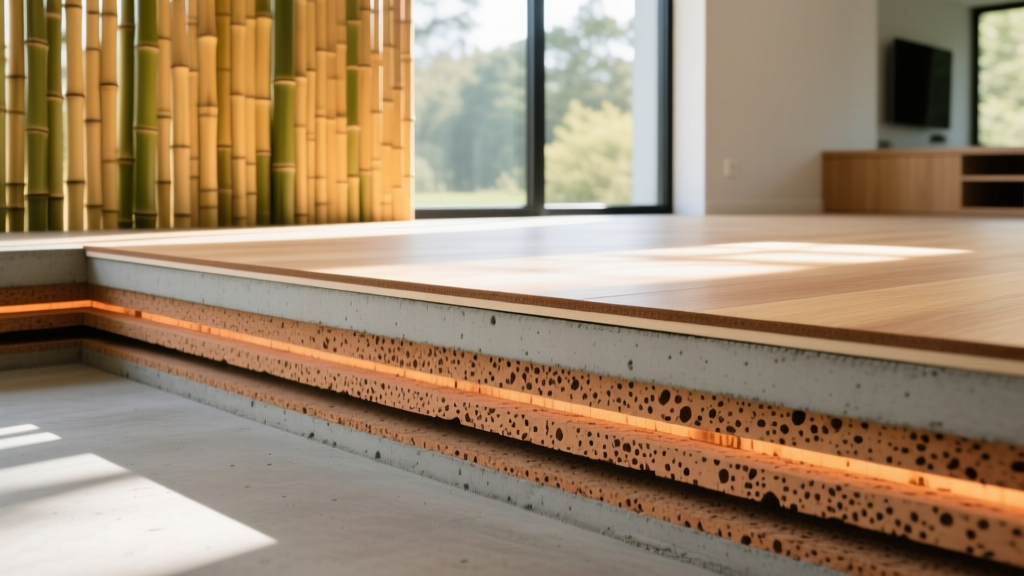
LCA Metrics and Cost Comparison Matrix
| Material Type | Embodied Carbon (kg CO2e/m²) | Expected Lifespan | End-of-Life Route | Avg. Installed Cost (2026) |
|---|---|---|---|---|
| Reclaimed Hardwood | 5 - 10 | 50+ Years | Downcycling / Biomass | $14.00 - $22.00 / sq ft |
| Cork (Glue-Down) | 8 - 14 | 30 - 40 Years | Commercial Composting | $8.00 - $13.00 / sq ft |
| Linoleum (Marmoleum) | 10 - 15 | 30 - 40 Years | Commercial Composting | $7.00 - $11.00 / sq ft |
| Strand-Woven Bamboo | 12 - 18 | 25 - 30 Years | Landfill / Incineration | $9.00 - $15.00 / sq ft |
Thermal Dynamics: Operational Energy and Radiant Heating
The B6 (Operational Energy Use) phase of an LCA is heavily influenced by flooring thermal conductivity. In passive house designs or homes utilizing hydronic radiant heating, the flooring material acts as either a thermal bridge or an insulator.
- Cork: With an R-value of approximately 1.25 per inch, cork is a natural thermal insulator. While this keeps floors warm to the touch, it actively resists heat transfer from embedded radiant heating pipes, forcing the boiler to work harder and increasing operational energy consumption.
- Linoleum & Bamboo: Both exhibit high thermal conductivity, making them highly efficient for radiant heat transfer. Linoleum's dimensional stability under temperature fluctuations makes it a superior choice for passive solar homes where floor temperatures swing drastically between day and night.
When specifying eco flooring options for radiant subfloors, always cross-reference the material's thermal resistance (R-value) with the HVAC engineer's load calculations to prevent systemic energy penalties.
The Adhesive and Underlayment Trap: Hidden IAQ Impacts
Specifying a zero-VOC eco floor is rendered useless if it is installed over a petrochemical-based underlayment or using high-VOC mastic. According to the U.S. Environmental Protection Agency (EPA), indoor VOC levels can be up to ten times higher than outdoor levels, largely driven by flooring adhesives and sealants.
Actionable Fix: Mandate adhesives that comply with CDPH Standard Method v1.2 (the strictest California IAQ standard). For glue-down cork or linoleum, specify Bostik GreenForce or Taylor 2071, which exhibit VOC emissions below 50 µg/m³. Avoid any adhesive containing N-methyl-2-pyrrolidone (NMP).
End-of-Life and Circularity Analysis
The construction industry generates over 600 million tons of debris annually in the U.S. alone. Flooring circularity is rarely discussed during procurement but dictates the C4 (disposal) LCA phase.
- Linoleum & Cork: Both are fully biodegradable. At the end of their 40-year lifespan, they can be processed in commercial composting facilities, returning nutrients to the soil without leaching microplastics.
- Bamboo: Despite being a natural grass, the thermoset resins used in strand-woven bamboo prevent it from biodegrading or being easily recycled. It typically ends up in a landfill or is incinerated for waste-to-energy recovery.
- Reclaimed Wood: Can be re-milled a third time, chipped for MDF manufacturing, or used as biomass fuel, maintaining a closed-loop carbon cycle.
The Procurement Decision Framework
Use this sequential checklist to validate eco flooring options for your next project:
- Demand the EPD: Do not accept generic 'green' certificates. Request a Type III Environmental Product Declaration that explicitly lists the Global Warming Potential (GWP) for stages A1-A3.
- Verify Chemical Transparency: Require a Health Product Declaration (HPD) or a Declare Label. Ensure the product is GREENGUARD Gold certified, which limits formaldehyde emissions to ≤ 7.3 µg/m³.
- Calculate A4 Transport Emissions: If building in North America, prioritize domestically sourced reclaimed wood or regionally manufactured bamboo over European cork to minimize freight-related carbon spikes.
- Audit the Installation System: Pair the flooring with a recycled-content acoustic underlayment (e.g., EcoSound) and a CDPH v1.2 compliant adhesive. Factor the adhesive's cost and VOC profile into the total project bid.
'True sustainability in flooring is not just about the origin of the raw material; it is about the chemical binders that hold it together and the biological pathways available to it when the building is eventually deconstructed.'
Written by
David NakamuraDavid Nakamura is a licensed architect (AIA) and construction technology writer focused on sustainable building methods, mass timber engineering, and high-performance building envelopes. He holds a Master of Architecture from the University of Washington and is a certified Passive House Consultant (CPHC). David spent eight years at the Seattle firm Mithun, where he led the design of three LEED Platinum projects, before founding his own practice specializing in net-zero residential design. He serves on the editorial advisory board of GreenBuilder Magazine and has authored peer-reviewed papers on cross-laminated timber (CLT) connections for the Journal of Structural Engineering. In his spare time, David teaches woodworking at Pratt Fine Arts Center and kayaks the Puget Sound.
More from David Nakamura
View all
Construction Cost
Labor Cost to Build a Deck Per Sq Ft: 2026 Installation Guide
Discover the exact labor cost to build a deck per sq ft in 2026. This installation guide breaks down contractor rates, complexity factors, and hidden fees.
Aug 4, 2026

Construction Cost
How Much Does It Cost to Build a 3 Bedroom House? Financing Guide
Learn exactly how much it costs to build a 3 bedroom house and explore 2026 financing options, construction loan types, and budget frameworks for your build.
Aug 4, 2026

Construction Cost
Cost to Build a Tennis Court: 2026 Guide
How much does it cost to build a tennis court in 2026? Breakdowns for asphalt, concrete, and synthetic surfaces plus fencing and lighting.
Jul 30, 2026