Evaluating Recycled Materials in Green Decking Products
Analyze recycled materials in green decking products, comparing HDPE composites, PVC, and rice hulls for LEED certification and long-term durability.

The Anatomy of Sustainable Decking: What Is Actually Inside?
The transition from old-growth timber to composite and PVC alternatives has fundamentally altered the outdoor construction market. However, not all synthetic decking is created equal. When evaluating recycled materials in green decking products, contractors and architects must look beyond marketing claims and examine the core polymer matrix, the encapsulation technology, and the specific post-consumer waste streams utilized. In 2026, the most advanced decking boards divert millions of pounds of high-density polyethylene (HDPE), polyvinyl chloride (PVC), and agricultural byproducts from landfills, transforming them into high-performance building materials that meet stringent ASTM D7032 standards for structural integrity and moisture resistance.
Post-Consumer HDPE and Plastic Films
Premium wood-plastic composites (WPC) rely heavily on HDPE—commonly sourced from recycled milk jugs, detergent bottles, and post-industrial plastic films. During the manufacturing process, these plastics are cleaned, shredded, and melted down to form a continuous polymer matrix. Top-tier manufacturers now achieve up to 95% recycled content in the core of their composite boards. The primary advantage of HDPE is its high strength-to-density ratio, which provides excellent impact resistance. However, uncapped HDPE composites are prone to UV degradation and moisture absorption, which is why modern green decking products utilize a co-extruded polymer cap stock to seal the recycled core.
Agricultural Waste and Mineral-Based Cores
While traditional composites use reclaimed wood flour (sawdust from furniture mills) as a filler, newer sustainable iterations are incorporating agricultural waste like rice hulls, or entirely replacing organic fillers with inorganic minerals. Rice hulls are naturally resistant to moisture, rot, and insects due to their high silica content. Mineral-based composites (MBC), on the other hand, blend polypropylene with calcium carbonate or other stone-based fillers. This eliminates organic matter entirely, resulting in a board that exhibits virtually zero water absorption and significantly less thermal expansion than traditional wood-plastic composites.
Specification Callout: Capped vs. Uncapped Composites
Never specify uncapped composite decking for commercial or high-moisture residential applications. Uncapped boards allow water to penetrate the recycled wood-flour core, leading to swelling, mold growth, and structural failure. Always require a fully encapsulated, co-extruded polymer shield (often made from recycled ASA or Surlyn) that covers all four sides of the board.
2026 Market Matrix: Top Recycled Decking Products
The following matrix compares leading sustainable decking lines available in 2026, focusing on their recycled content, core composition, and current material costs. Pricing reflects bulk contractor rates for standard 16-foot grooved boards.
| Brand & Model | Core Material | Recycled Content % | Est. Cost / Sq. Ft. | Max Joist Span |
|---|---|---|---|---|
| Trex Transcend Lineage | HDPE & Reclaimed Wood | Up to 95% | $11.50 - $13.00 | 16" on center |
| TimberTech Advanced PVC | Recycled PVC & Acrylic | Up to 85% | $12.00 - $14.50 | 16" on center |
| Deckorators Vault (MBC) | Polypropylene & Mineral | Varies by run | $9.50 - $11.50 | 16" on center |
| Fiberon Promenade PVC | Recycled PVC | Up to 90% | $11.00 - $13.50 | 16" on center |
Securing LEED v4.1 Credits with Recycled Decking
For commercial projects and high-performance residential builds, specifying recycled decking can directly contribute to certification points. Under the U.S. Green Building Council's LEED framework, decking materials can help secure points in the Materials and Resources (MR) category, specifically under Building Product Disclosure and Optimization - Sourcing of Raw Materials.
- Option 2: Leadership Extraction Practices. Products that contain a minimum of 25% post-consumer recycled content by weight can contribute to this credit. The contractor must document the exact percentage via an Environmental Product Declaration (EPD) or a certification from an approved third party like SCS Global Services.
- Regional Materials Bonus. If the recycled plastics and manufacturing facility are located within 100 miles of the project site, the product's contribution to the credit is multiplied by 2x, incentivizing localized circular economies.
- Construction Waste Management. Many leading composite manufacturers offer take-back programs for job-site cutoffs. Returning clean composite scraps to the manufacturer for re-pelletization can help achieve the Construction and Demolition Waste Management credits.
Installation Edge Cases: Thermal Dynamics and Fastening
Recycled plastics behave fundamentally differently than natural timber when exposed to temperature fluctuations. Ignoring these thermal dynamics is the leading cause of fastener failure, board buckling, and voided warranties in green decking installations.
The 3/16-Inch Rule for Temperature Swings
Wood-plastic composites expand and contract primarily along their length. A standard 16-foot composite board can expand by up to 3/16 of an inch over a 40-degree Fahrenheit temperature swing. If a contractor installs boards end-to-end on a 50°F morning in early spring, they must leave a precise 3/16-inch gap between the board ends. If installed tight, the boards will crush against each other and buckle upward when summer temperatures reach 90°F. PVC decking, which lacks wood fiber reinforcement, expands even more aggressively and requires strict adherence to manufacturer-specified expansion gaps at all end-joints and perimeter edges.
Hidden Fasteners vs. Face Screws
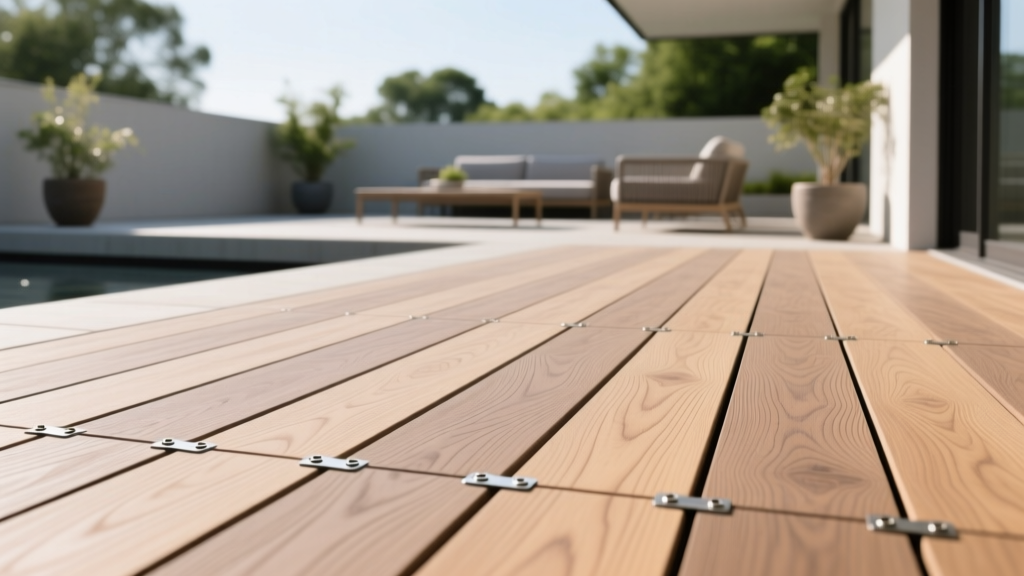
Because recycled composite and PVC boards expand and contract, they must be allowed to slide slightly along the joist. Hidden metal clip systems (such as Trex Hideaway or TimberTech CONCEALoc) are mandatory for grooved boards. These clips lock the board in place laterally while permitting longitudinal movement. Face-screwing composite boards locks them rigidly to the joist; when the board attempts to expand, the screw acts as a pivot point, leading to catastrophic stress fractures around the screw head or severe board warping.
Heat Retention and the Infrared Reflective Solution
A historical drawback of recycled plastic decking has been heat retention. Dark-colored HDPE and PVC boards can reach surface temperatures exceeding 150°F in direct summer sunlight, making them unusable for barefoot traffic. In response, manufacturers have developed advanced infrared-reflective pigments embedded directly into the polymer cap stock. Products like the Trex Transcend Lineage series utilize specialized acrylic capping that reflects solar radiation rather than absorbing it, reducing surface temperatures by up to 40°F compared to legacy composites. When specifying green decking for south-facing or unshaded commercial plazas, always require independent solar reflectance index (SRI) data from the manufacturer to ensure pedestrian comfort and safety.
Lifecycle Cost Analysis: Composite vs. Pressure-Treated Lumber
While the upfront material cost of recycled composite decking ($9.50 to $14.50 per square foot) is significantly higher than pressure-treated southern yellow pine ($3.50 to $5.00 per square foot), the 25-year lifecycle cost heavily favors sustainable composites. According to data aligned with the EPA's Comprehensive Procurement Guidelines for plastic lumber, recycled composites eliminate the need for annual chemical staining, sealing, and power washing. When factoring in the cost of specialized deck stains ($60-$80 per gallon), professional labor for re-sealing every two years, and the inevitable board replacement due to rot and splintering, pressure-treated lumber becomes the more expensive option by year seven. Furthermore, at the end of its lifecycle, PVC and HDPE decking can be milled and re-pelletized, maintaining its value in the circular economy, whereas chemically treated lumber must be sent to specialized hazardous waste landfills.
"The true cost of a deck is not calculated at the lumber yard; it is calculated over twenty summers of maintenance. Recycled composites shift the financial burden from ongoing operational labor to a single, upfront capital expenditure." — Senior Building Envelope Consultant, 2026 Sustainable Construction Summit
Contractor Sourcing and Verification Checklist
To ensure the materials specified actually meet sustainability and performance benchmarks, procurement managers and general contractors should require the following documentation before approving a submittal:
- SCS Recycled Content Certification: Verify the exact post-consumer vs. post-industrial recycled content percentages. Post-consumer waste carries more weight for LEED credits.
- ASTM D7032 Test Reports: Confirm the specific product line has passed standardized testing for flexural strength, moisture absorption, and accelerated weathering.
- EPD (Environmental Product Declaration): Request a current, third-party verified EPD that details the product's global warming potential (GWP) and cradle-to-gate carbon footprint.
- Take-Back Program Documentation: Secure written confirmation of the manufacturer's job-site scrap recycling program to ensure zero composite waste ends up in local landfills.
Written by
Priya KapoorPriya Kapoor is a real estate market analyst and construction economics researcher with expertise in housing affordability, development feasibility, and infrastructure investment. She holds a Master of Regional Planning from Cornell University and previously worked as a senior analyst at CBRE's Investment Properties group, where she modeled returns for $4B in mixed-use development pipelines. Priya now runs an independent research practice advising developers, municipalities, and REITs on construction cost forecasting and market timing. She publishes the quarterly "BuildMat Market Pulse" report tracking material price indices across 12 commodity categories. Based in Austin, TX, Priya serves on the board of Habitat for Humanity Austin and is a marathon runner.
More from Priya Kapoor
View all
Construction Cost
Cost to Build a 1600 Sq Ft Home in 2026: Full Breakdown
Accurate 2026 cost to build a 1600 sq ft home—material, labor, and regional pricing breakdowns included. Plan your budget with real-time estimates.
Aug 11, 2026

Wood & Lumber
Name the Types of Wood for Pressure Treatment and Preservation
Learn how to name the types of wood best suited for pressure treatment. Compare species treatability, chemical retention levels, and 2026 preservation costs.
Aug 4, 2026

Stone & Masonry
Stone Veneer Suppliers Lindenhurst: 2026 Cost Analysis
Analyze 2026 stone veneer costs in Lindenhurst, NY. Compare local supplier pricing, delivery fees, and Suffolk County installation labor rates.
Aug 4, 2026