Evaluating Eco-Friendly Flooring Options: A Selection Guide
Learn the exact selection criteria for eco-friendly flooring options, including VOC limits, FSC certifications, lifecycle costs, and durability metrics.

The Core Metrics of Sustainable Flooring Selection
Selecting sustainable flooring requires looking past surface-level marketing labels to evaluate embodied carbon, chemical off-gassing, and lifecycle durability. In 2026, the most rigorous green building standards, including LEED v5 and the latest CALGreen code updates, mandate a holistic approach to material selection. Evaluating eco-friendly flooring options effectively means analyzing three primary metrics: Environmental Product Declarations (EPDs) for embodied carbon, third-party indoor air quality certifications for volatile organic compounds (VOCs), and physical durability ratings that dictate replacement cycles.
Decoding Certifications: What Actually Matters
Not all certifications carry the same weight. When filtering eco-friendly flooring options, prioritize certifications that test the final assembled product, including factory-applied finishes, rather than just the raw material. According to the U.S. Environmental Protection Agency, indoor VOC levels can be up to ten times higher than outdoor levels, making rigorous emissions testing non-negotiable for residential and commercial interiors.
| Certification | Focus Area | Selection Requirement |
|---|---|---|
| FloorScore | Indoor Air Quality (VOCs) | Mandatory for hard surface. Verify via the SCS Global Services active directory. |
| FSC (Forest Stewardship Council) | Chain of Custody & Forestry | Require "FSC 100%" or "FSC Mix Credit" for hardwoods and bamboo. Check FSC US certification databases. |
| Cradle to Cradle (C2C) | Material Health & Circularity | Look for Gold or Platinum levels to ensure zero hazardous chemical inputs and end-of-life recyclability. |
| GREENGUARD Gold | Strict VOC Emissions | Essential for schools, healthcare, and highly sensitive occupants. Tests for over 360 VOCs. |
Material-Specific Selection Criteria
Each sustainable material class has unique failure modes and technical specifications that dictate its suitability for your specific subfloor and climate zone.
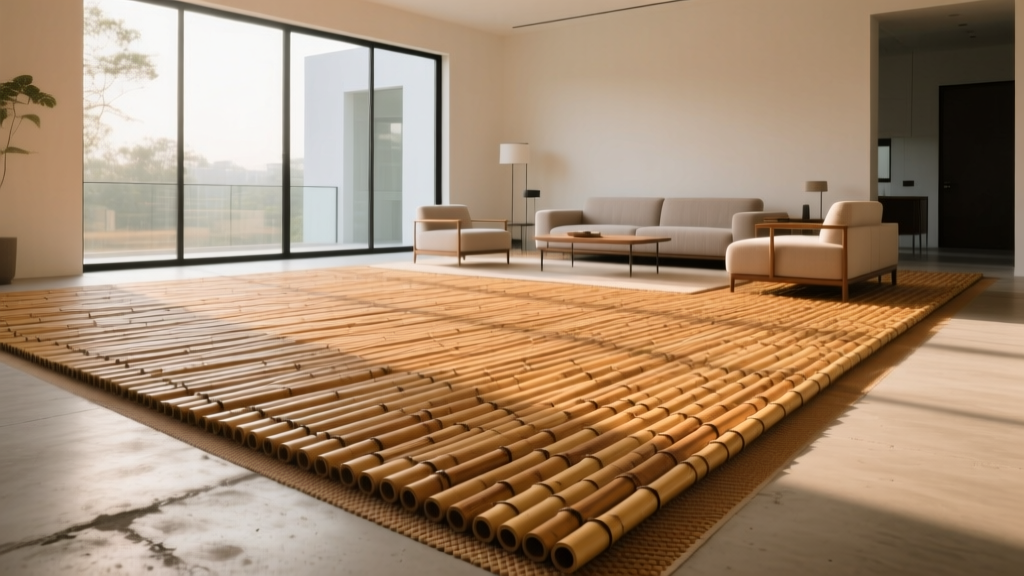
Bamboo: Strand-Woven vs. Traditional Milling
While bamboo is a rapidly renewable grass (harvested every 3-5 years), traditional horizontal or vertical bamboo is relatively soft (Janka hardness of 1,300-1,400 lbf) and highly susceptible to denting. For high-traffic residential or light commercial applications, specify strand-woven bamboo. This manufacturing process compresses bamboo fibers with resins under extreme heat and pressure, yielding a Janka hardness rating exceeding 3,000 lbf—harder than most domestic hardwoods.
Critical Specification: You must verify the binder resin. Historically, cheap strand-woven bamboo utilized urea-formaldehyde (UF) resins, which off-gas heavily. Require manufacturers to provide third-party lab results proving the use of phenol-formaldehyde (PF) or polymeric diphenylmethane diisocyanate (pMDI) binders, which emit negligible VOCs.
Cork: Density and Moisture Tolerance
Cork is harvested from the bark of the Quercus suber (cork oak) tree without killing it, making it highly renewable. However, cork's durability is entirely dependent on its manufacturing density. Standard residential cork flooring often falls in the 280-320 kg/m³ range, which compresses permanently under heavy furniture.
Critical Specification: Specify a minimum density of 400 kg/m³ to 450 kg/m³ for residential use, and up to 500 kg/m³ for commercial applications. Additionally, because cork is hygroscopic, it requires a site-applied, water-based polyurethane finish (like Bona Traffic HD) if installed in areas with humidity fluctuations exceeding 30%-60% RH ranges.
True Linoleum vs. Luxury Vinyl Tile (LVT)
Do not confuse linoleum with vinyl. LVT is composed of polyvinyl chloride (PVC), a petrochemical plastic that releases dioxins during production and requires toxic plasticizers (often phthalates) for flexibility. True linoleum, pioneered by brands like Forbo Marmoleum, is composed of oxidized linseed oil, pine rosin, wood flour, and jute backing.
Critical Specification: When evaluating sheet linoleum, ensure the subfloor is perfectly level (tolerance of 3/16 inch over a 10-foot radius). Linoleum is semi-rigid and will telegraph any subfloor imperfections, leading to premature cracking. Furthermore, specify a factory-applied top-shield finish (like Topshield pro) to eliminate the need for high-VOC waxing and stripping maintenance cycles.
Installation Adhesives: The Hidden VOC Culprit
A FloorScore-certified floor becomes a health hazard if installed with a high-VOC adhesive. The adhesive layer represents a massive surface area for off-gassing. When selecting eco-friendly flooring options, the installation system must be evaluated as a single unit.
- Moisture Vapor Transmission Rate (MVTR): Before applying any adhesive to a concrete slab, test the MVTR using a calcium chloride test (ASTM F1869) or an in-situ relative humidity probe (ASTM F2170). If the MVTR exceeds 3 lbs/1,000 sq ft/24 hours, you must apply a low-VOC moisture mitigation system (such as Bostik MVP4) before the flooring adhesive.
- Adhesive Selection: Use 100% solids urethane adhesives or low-VOC silane-modified polymers (SMP). Products like Bostik GreenForce or MAPEI Ultrabond ECO 995 offer high shear strength while maintaining VOC levels well below the South Coast Air Quality Management District (SCAQMD) Rule 1168 limits of 50 g/L.
📊 20-Year Lifecycle Cost Analysis (LCCA) Snapshot
While initial material costs vary, true sustainability accounts for maintenance and replacement. Below is a projected 20-year cost per square foot (including material, professional installation, and required maintenance) based on 2026 national averages:
- Strand-Woven Bamboo: $11.50 - $16.00 / sq ft (Requires refinishing at year 12-15)
- High-Density Cork: $14.00 - $19.50 / sq ft (Requires resealing every 5-7 years)
- Sheet Linoleum (Marmoleum): $9.50 - $14.00 / sq ft (Lowest maintenance; 25+ year lifespan without refinishing)
- FSC-Certified Engineered Oak: $18.00 - $26.00 / sq ft (Can be refinished 2-3 times depending on wear layer thickness)
Final Selection Checklist for Specifiers and Homeowners
Before finalizing your purchase order or contractor bid, run your selected eco-friendly flooring options through this technical checklist:
- Verify EPDs: Request the manufacturer's Type III Environmental Product Declaration to confirm the embodied carbon (kgCO2e/m²) aligns with your project's net-zero or low-carbon goals.
- Audit the Wear Layer: For engineered woods, ensure the top veneer is at least 3mm thick to allow for at least one full sand-and-refinish cycle, extending the product lifecycle by 15+ years.
- Check Acclimation Protocols: Sustainable materials like bamboo and cork are highly reactive to ambient moisture. Ensure the contract specifies a minimum 72-hour acclimation period in the installation space with HVAC running at normal occupancy settings.
- Demand Chain-of-Custody Documentation: For FSC-certified products, the invoice must explicitly state the manufacturer's FSC license code and the specific claim (e.g., FSC 100%, FSC Mix) to qualify for LEED Materials and Resources credits.
- Specify Transition Moldings: Ensure T-moldings and stair nosings are manufactured from the same sustainable material and finished with the same low-VOC sealants as the field flooring to maintain uniform indoor air quality.
Written by
David NakamuraDavid Nakamura is a licensed architect (AIA) and construction technology writer focused on sustainable building methods, mass timber engineering, and high-performance building envelopes. He holds a Master of Architecture from the University of Washington and is a certified Passive House Consultant (CPHC). David spent eight years at the Seattle firm Mithun, where he led the design of three LEED Platinum projects, before founding his own practice specializing in net-zero residential design. He serves on the editorial advisory board of GreenBuilder Magazine and has authored peer-reviewed papers on cross-laminated timber (CLT) connections for the Journal of Structural Engineering. In his spare time, David teaches woodworking at Pratt Fine Arts Center and kayaks the Puget Sound.
More from David Nakamura
View all
Construction Cost
Labor Cost to Build a Deck Per Sq Ft: 2026 Installation Guide
Discover the exact labor cost to build a deck per sq ft in 2026. This installation guide breaks down contractor rates, complexity factors, and hidden fees.
Aug 4, 2026

Construction Cost
How Much Does It Cost to Build a 3 Bedroom House? Financing Guide
Learn exactly how much it costs to build a 3 bedroom house and explore 2026 financing options, construction loan types, and budget frameworks for your build.
Aug 4, 2026

Construction Cost
Cost to Build a Tennis Court: 2026 Guide
How much does it cost to build a tennis court in 2026? Breakdowns for asphalt, concrete, and synthetic surfaces plus fencing and lighting.
Jul 30, 2026