Next-Gen Eco Friendly Building Materials: 2026 Innovations
Discover cutting-edge eco friendly building materials for 2026. We analyze mycelium composites, carbon-injected concrete, and prefab hempcrete blocks.

The Embodied Carbon Mandate in Modern Construction
The transition toward net-zero construction has shifted the industry's focus from purely operational energy efficiency to embodied carbon reduction. As the 2026 International Energy Conservation Code (IECC) and updated LEED v5 frameworks enforce stricter lifecycle assessments, architects and general contractors are moving beyond basic recycled steel and FSC-certified timber. The current frontier of eco friendly building materials is defined by bio-fabrication, carbon mineralization, and prefabricated bio-aggregates. This innovation spotlight examines three advanced material systems that are currently reshaping commercial and high-performance residential specifications, detailing their technical properties, procurement costs, and failure modes.
Mycelium Composites: Acoustic and Thermal Performance
Mycelium—the vegetative root structure of fungi—has evolved from a niche packaging alternative into a high-performance architectural material. By inoculating agricultural waste (such as hemp hurds or corn stover) with specific fungal strains, manufacturers grow dense, interlocking chitin matrices that are subsequently baked to halt biological activity. The result is a lightweight, hydrophobic, and inherently fire-resistant composite.
Technical Specifications and Applications
In 2026, mycelium composites are primarily specified for interior acoustic baffling, non-load-bearing partition infill, and ceiling tiles. Leading bio-fabricators like Ecovative Design produce panels that achieve a Noise Reduction Coefficient (NRC) of 0.85 to 0.95, outperforming traditional mineral wool in mid-to-high frequency sound absorption. Thermally, mycelium insulation offers an R-value of approximately 3.8 to 4.0 per inch, comparable to expanded polystyrene (EPS) but with a negative carbon footprint.
- Fire Rating: Class A (ASTM E84) when treated with non-toxic borate solutions.
- Compressive Strength: 15 to 25 psi (suitable for semi-rigid panels, not structural loads).
- Cost: $5.50 to $7.25 per square foot for 2-inch thick acoustic panels.
Carbon-Injected Concrete: Optimizing the Ready-Mix Ticket
Concrete remains the most consumed human-made material on Earth, and its Portland cement binder is responsible for roughly 8% of global CO2 emissions. Carbon-injection technology, pioneered by companies like CarbonCure, addresses this by injecting captured industrial CO2 directly into the ready-mix concrete during batching.
The Mineralization Process and Mix Optimization
When CO2 is injected into the wet mix, it reacts with calcium ions to form calcium carbonate (CaCO3) nanoparticles. These nanoparticles act as nucleation sites, increasing the early-age compressive strength of the concrete. This strength gain is the critical innovation: it allows ready-mix producers to reduce the Portland cement content by 5% to 8% while maintaining the exact same 28-day PSI targets required by the structural engineer.
For a standard 5,000 PSI commercial slab, a CarbonCure-optimized mix typically sequesters roughly 25 pounds of CO2 per cubic yard, while the cement reduction eliminates an additional 60 to 80 pounds of embodied carbon. The net result is a 5% to 7% reduction in the concrete's overall carbon footprint without compromising workability, slump, or set times.
Procurement and Pricing
Carbon-injection is not a material you buy off a shelf; it is a service integrated at the batch plant. In 2026, the technology is widely available across North American ready-mix networks. Expect a licensing premium of $3.00 to $5.00 per cubic yard added to the concrete ticket. However, because the producer is simultaneously reducing the volume of expensive Portland cement, the net cost to the general contractor is often neutral, or yields a slight savings of 1% to 2% on the total pour.
Prefabricated Hempcrete: Solving the Cure-Time Bottleneck
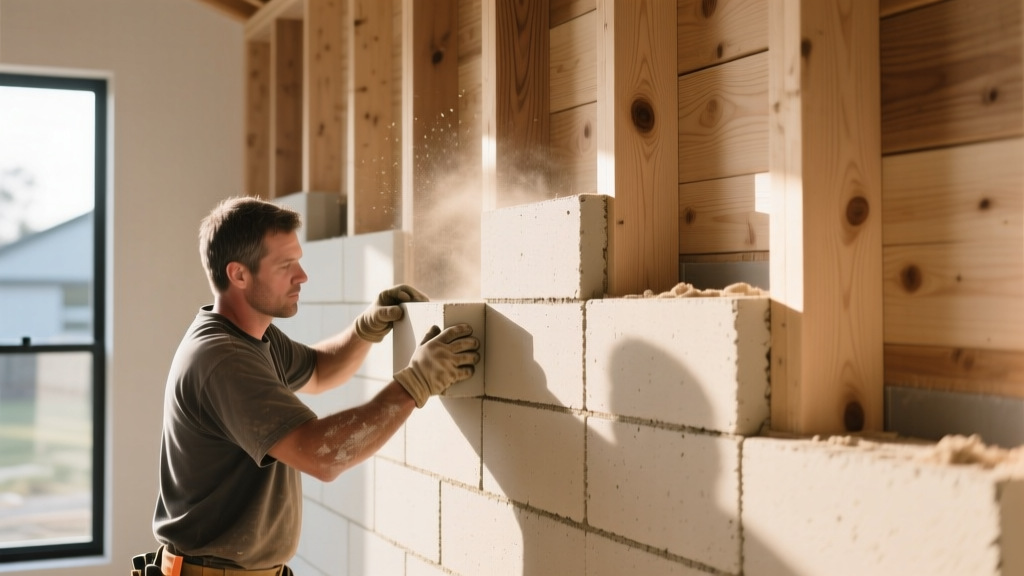
Hempcrete—a biocomposite of hemp hurds, a lime-based binder, and water—has long been praised for its carbon-negative profile and excellent moisture-buffering capabilities. However, traditional cast-in-place hempcrete requires specialized formwork and takes 28 to 60 days to cure sufficiently before finishes can be applied, making it unviable for tight commercial schedules. The 2026 solution is the widespread adoption of prefabricated, interlocking hempcrete blocks.
Block Dimensions and Structural Integration
Modern prefab hempcrete blocks (such as those modeled after IsoHemp's systems) are manufactured in controlled factory environments where forced-air kilns reduce curing times to under 72 hours. Standard blocks measure 500mm x 300mm x 250mm (approx. 19.7 x 11.8 x 9.8 inches) and feature tongue-and-groove interlocking joints.
These blocks are non-load-bearing and are laid using a specialized thin-bed lime mortar. A standard 8-inch thick hempcrete block wall provides an R-value of roughly 2.4 per inch (Total R-19.2) and offers exceptional thermal mass and hygroscopic regulation, keeping interior relative humidity between 45% and 55% without mechanical intervention.
| Material System | Primary Application | Embodied Carbon | Key Performance Metric | 2026 Est. Installed Cost |
|---|---|---|---|---|
| Mycelium Panels | Interior Acoustics / Ceilings | Negative (-2.1 kgCO2e/m2) | NRC 0.90 / Class A Fire | $14.00 - $18.50 / sq ft |
| CarbonCure Mix | Flatwork / Foundations | Reduced (approx. 280 kgCO2e/m3) | 5,000+ PSI at 28 days | $165 - $190 / cubic yard |
| Prefab Hempcrete | Exterior Infill Walls | Negative (-35 kgCO2e/m2) | R-2.4/inch / Vapor Permeable | $22.00 - $28.00 / sq ft |
Code Compliance and MasterFormat Integration
Specifying innovative eco friendly building materials requires navigating local building codes and standardizing documentation. In the United States, the International Code Council Evaluation Service (ICC-ES) provides critical validation for non-standard materials.
Specifying for the Bidding Phase
When drafting project manuals, architects must place these materials in the correct CSI MasterFormat divisions to ensure accurate bidding and contractor compliance:
- Division 04 00 00 (Masonry): Use this section for prefabricated hempcrete blocks. Specify the exact block density (typically 350-400 kg/m3) and require the manufacturer's ICC-ES evaluation report confirming compliance with IBC Section 2105 for masonry construction.
- Division 09 80 00 (Acoustic Insulation): Mycelium acoustic panels belong here. Specifications must mandate ASTM C423 testing reports for NRC ratings and ASTM E84 for surface burning characteristics.
- Division 03 30 00 (Cast-in-Place Concrete): Carbon-injection should be specified as an admixture or batch-plant process modification. Require the ready-mix supplier to provide a CO2 sequestration certificate and third-party verification of the optimized cementitious content.
"The greatest barrier to sustainable material adoption is no longer performance; it is the specifier's familiarity with the product. Integrating bio-materials into standard MasterFormat divisions bridges the gap between sustainable intent and actual procurement." — 2025 AIA Materials Knowledge Working Group
Decision Framework: Which Innovation Fits Your Build?
Selecting the right eco friendly building material depends on your project's specific carbon-reduction targets, structural requirements, and climate zone.
Choose Mycelium If:
Your project is a commercial interior fit-out, a recording studio, or an open-plan office requiring high acoustic performance. It is ideal when you need to eliminate volatile organic compounds (VOCs) associated with synthetic acoustic foams and want to achieve LEED v5 Materials & Resources credits for bio-based content.
Choose CarbonCure If:
You are executing a large-scale concrete pour (flatwork, mat foundations, or tilt-up panels) and need to reduce embodied carbon without altering the structural engineer's slab thickness or rebar schedule. It is the lowest-friction intervention for heavy civil and commercial structural work.
Choose Hempcrete If:
You are designing a high-performance residential envelope or a wellness facility in a mixed-humid climate. The hygroscopic nature of hempcrete eliminates the need for complex mechanical dehumidification, provided the exterior cladding is detailed with a ventilated rainscreen to allow the wall assembly to breathe.
By moving past rudimentary recycling metrics and embracing bio-fabricated and mineralized systems, the construction industry can fundamentally alter the carbon trajectory of the built environment. The materials detailed above are no longer experimental prototypes; they are code-compliant, commercially available solutions ready for immediate integration into 2026 project specifications.
Written by
Elena RodriguezElena Rodriguez is a civil engineer and technical writer specializing in concrete technology, masonry systems, and ASTM/ACI compliance. She earned her B.S. in Civil Engineering from Texas A&M University and spent a decade at a materials testing laboratory, performing over 2,000 concrete compressive strength tests and masonry prism evaluations. Elena is an ACI-certified Field Testing Technician (Grade I) and a member of ASTM Committee C12 on Natural Building Stone. She currently consults on forensic engineering cases involving concrete failures and moisture intrusion. Based in San Antonio, TX, Elena is a proud member of the Society of Women Engineers (SWE) and coaches her daughter's FIRST Robotics team.
More from Elena Rodriguez
View all
Walls & Panels
Cost Analysis: Light Gauge Steel Framing Advantages and Disadvantages
Evaluate light gauge steel framing advantages and disadvantages through a strict cost analysis lens, comparing material, labor, and lifecycle expenses.
Aug 4, 2026

Walls & Panels
Gypsum Board Types: Exact Specifications, Thickness & Dimensions
Compare standard, Type X, and moisture-resistant gypsum board types. Get exact specifications, thicknesses, dimensions, and ASTM standards for your project.
Aug 4, 2026

Fire Resistance
Best Fire-Resistant Outdoor Decking Materials: 2026 Buyer Guide
Discover the best fire-resistant outdoor decking materials for 2026. Compare Class A PVC, aluminum, and hardwood options for WUI compliance and safety.
Aug 4, 2026