Ranking the Most Sustainable Building Materials by Lifecycle Impact
Analyze the most sustainable building materials through lifecycle assessment. Compare embodied carbon, EPDs, and low-carbon alternatives for green builds.
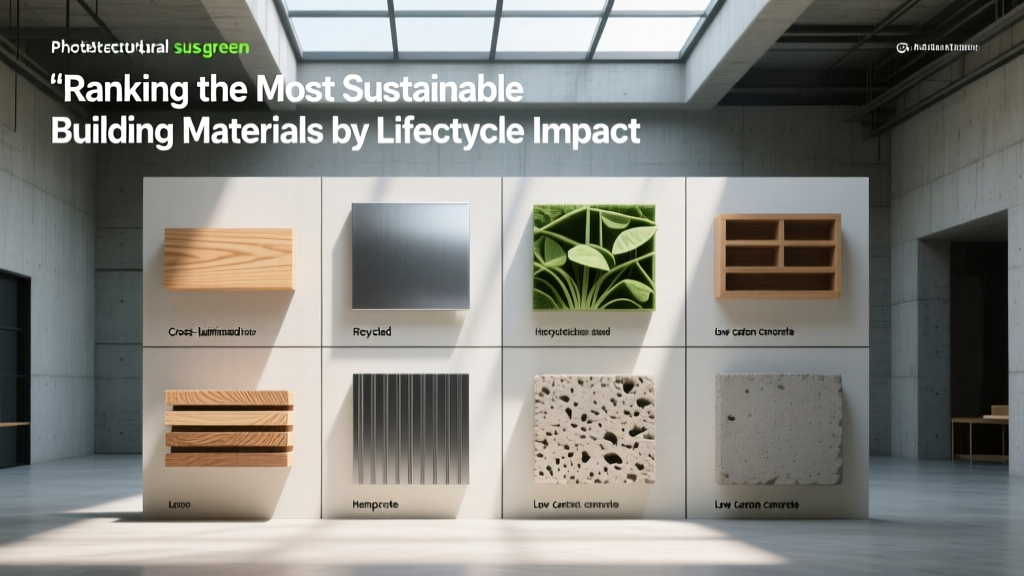
The Shift from Operational to Embodied Carbon
For the past two decades, green building standards focused predominantly on operational energy—optimizing HVAC efficiency, improving thermal envelopes, and integrating renewable power. However, as building grids decarbonize and operational efficiencies plateau, the environmental impact of construction has shifted dramatically toward embodied carbon. According to UNEP's comprehensive report on building materials and climate, the manufacturing and processing of construction materials account for roughly 11% of global greenhouse gas emissions. To accurately identify the most sustainable building materials, architects and engineers must now rely on rigorous Lifecycle Assessments (LCA) rather than superficial eco-labels.
Decoding Environmental Product Declarations (EPDs)
The term "sustainable" is functionally meaningless in procurement without standardized data. The industry standard for measuring environmental impact is the Type III Environmental Product Declaration (EPD), governed by ISO 14025 and EN 15804+A2. An EPD acts as a nutrition label for building materials, detailing impacts across specific lifecycle modules:
- Module A1-A3 (Cradle-to-Gate): Covers raw material extraction, transport to the factory, and manufacturing. This is the most universally available data point.
- Module A4-A5 (Gate-to-Site): Accounts for transport to the construction site and the installation process, including waste generated during assembly.
- Module B1-B7 (Use Stage): Captures maintenance, repair, and replacement cycles over the building's assumed 50- or 60-year lifespan.
- Module C1-C4 (End-of-Life): Evaluates deconstruction, transport to waste facilities, and final disposal or recycling processing.
- Module D (Beyond Lifecycle): Calculates the potential environmental benefits of reuse, recovery, or recycling potential outside the system boundary.
When evaluating the most sustainable building materials, prioritize EPDs that cover A1-A5 (Cradle-to-Grave) rather than just A1-A3. A material with a low manufacturing footprint but high installation waste or short replacement cycles will skew long-term LCA results.
Lifecycle Carbon Matrix: Material Comparison
The following matrix compares standard and advanced building materials using Global Warming Potential (GWP) measured in kilograms of CO2 equivalent (kgCO2e). Data represents typical industry averages derived from verified EPDs and the ICE (Inventory of Carbon and Energy) database.
| Material | GWP (kgCO2e/kg) | Biogenic Carbon Storage | Primary Structural Application |
|---|---|---|---|
| Ordinary Portland Cement (OPC) | 0.93 | None | Foundations, structural slabs |
| LC3 (Limestone Calcined Clay) | 0.45 | None | Low-carbon concrete mixes |
| Virgin Structural Steel | 1.85 | None | Beams, columns, reinforcement |
| EAF Recycled Steel (90%+ scrap) | 0.60 | None | Rebar, light-gauge framing |
| Cross-Laminated Timber (CLT) | -0.90 (Net Negative) | ~1.4 kgCO2e/kg stored | Mass timber floors, shear walls |
| Hempcrete (Lime binder) | -0.15 (Net Negative) | High (hemp hurd + carbonation) | Non-load-bearing insulation walls |
| Stabilized Rammed Earth | 0.04 | None | Thermal mass walls, facades |

Deep Dive: Top Performers in Low-Carbon Construction
Mass Timber and Cross-Laminated Timber (CLT)
Cross-Laminated Timber has fundamentally altered the structural capabilities of wood, allowing for multi-story commercial construction. From an LCA perspective, CLT is unique because it sequesters biogenic carbon. Trees absorb CO2 during growth; when harvested and manufactured into CLT under standards like ANSI/APA PRG-320, that carbon remains locked within the building fabric for its lifespan. While the manufacturing process (drying, gluing, pressing) generates emissions (Modules A1-A3), the sheer volume of stored biogenic carbon typically results in a net-negative cradle-to-gate footprint. To maximize this benefit, specify CLT sourced from forests certified under FSC or SFI standards, ensuring the carbon sink is actively replenished.
Hempcrete and Bio-Based Insulation
Hempcrete is a bio-composite made from the inner woody core of the hemp plant (hurd) mixed with a lime-based binder and water. It is not a structural material but serves as an exceptional insulating and moisture-regulating infill. The environmental impact analysis of hempcrete reveals a dual-carbon benefit: the rapid growth cycle of industrial hemp sequesters significant atmospheric CO2, and the lime binder naturally reabsorbs CO2 from the air as it cures and carbonates over decades. According to EPA guidelines on green building materials, bio-based products must demonstrate verified agricultural sourcing to qualify for federal green procurement. When specifying hempcrete, ensure the binder utilizes naturally hydraulic lime (NHL 3.5 or NHL 5) rather than Portland cement blends, which would immediately negate the carbon-negative properties.
Low-Carbon Concrete Alternatives: LC3 and SCMs
Concrete remains the most consumed material on Earth, making its decarbonization critical. Ordinary Portland Cement (OPC) requires heating limestone to 1,450°C, a process that releases massive amounts of process emissions alongside fuel combustion emissions. The most viable scalable alternative is LC3 (Limestone Calcined Clay Cement). By replacing up to 50% of the clinker with calcined kaolinite clay and ground limestone, LC3 reduces embodied carbon by roughly 40% while maintaining comparable compressive strength and durability profiles. For projects where LC3 is unavailable, specify high-volume Supplementary Cementitious Materials (SCMs) such as ground granulated blast-furnace slag (GGBS) or Class F fly ash, pushing the clinker substitution rate above 60% where structural engineering permits.
"The most sustainable material is not just the one with the lowest factory emissions, but the one that survives the longest without replacement, minimizing Module B impacts over a 60-year lifecycle."
The "Local Sourcing" Multiplier: Transportation's Impact
A common pitfall in sustainable specification is selecting a low-carbon material manufactured thousands of miles away. Module A4 (Transport to Site) can easily eclipse the manufacturing savings of a green product. Heavy, low-density materials like rammed earth or stone are particularly sensitive to transport emissions. As a practical rule of thumb for environmental impact analysis, prioritize materials sourced within a 500-mile (800 km) radius of the project site. The Architecture 2030 embodied carbon guidelines emphasize that optimizing structural design to use less material overall often yields greater carbon reductions than switching to a slightly greener material shipped internationally.
Practical Framework: Specifying for LEED v4.1 and BREEAM
To translate LCA data into actionable procurement, integrate the following steps into your project workflow:
- Mandate Type III EPDs: Include a specification clause requiring all structural and envelope materials to submit cradle-to-gate (minimum) EPDs conforming to ISO 14025.
- Utilize the EC3 Tool: Use the Embodied Carbon in Construction Calculator (EC3) to benchmark proposed materials against regional baselines. Set project-specific GWP limits that are 10-20% below the EC3 median for each material category.
- Target LEED MR Credit: Under LEED v4.1 Building Product Disclosure and Optimization (Environmental Product Declarations), projects earn points by sourcing at least 20 permanently installed products from 5 different manufacturers with verified EPDs.
- Evaluate Module D: Design for deconstruction. Select mechanical fasteners over chemical adhesives where possible to ensure materials can be recovered and recycled at the end of the building's life, maximizing Module D benefits.
Frequently Asked Questions on Material LCAs
Is recycled plastic a sustainable building material?
Recycled plastics (like HDPE lumber or PET insulation) divert waste from landfills, but their LCA profile is complex. While they reduce the need for virgin petroleum extraction, plastics often contain toxic flame retardants and cannot be easily recycled again at the end of the building's life (Module C). They are best used in highly durable, low-maintenance applications like exterior decking or sub-slab vapor barriers where their longevity offsets their end-of-life disposal impacts.
How do I verify if an EPD is legitimate and up-to-date?
Legitimate EPDs must be verified by an independent third-party program operator, such as UL Solutions, ASTM International, or the International EPD System. Check the document for the verifier's signature, the specific Product Category Rules (PCR) used, and the expiration date (EPDs are typically valid for five years). Avoid industry-average EPDs when trying to optimize a specific product line; always request product-specific EPDs for precise LCA modeling.
Does mass timber pose a fire risk that increases insurance and lifecycle costs?
Mass timber performs exceptionally well in fire conditions due to the predictable charring rate of thick wood sections (typically 1.5 inches per hour for CLT). Under ASTM E119 testing, encapsulated or appropriately sized exposed mass timber assemblies easily achieve 1-hour and 2-hour fire resistance ratings. While initial insurance premiums for mass timber have historically been higher due to underwriter unfamiliarity, the widespread adoption of the 2021 and 2024 IBC codes (allowing up to 18 stories) has normalized risk models, bringing insurance costs in line with traditional concrete and steel structures.
Written by
Priya KapoorPriya Kapoor is a real estate market analyst and construction economics researcher with expertise in housing affordability, development feasibility, and infrastructure investment. She holds a Master of Regional Planning from Cornell University and previously worked as a senior analyst at CBRE's Investment Properties group, where she modeled returns for $4B in mixed-use development pipelines. Priya now runs an independent research practice advising developers, municipalities, and REITs on construction cost forecasting and market timing. She publishes the quarterly "BuildMat Market Pulse" report tracking material price indices across 12 commodity categories. Based in Austin, TX, Priya serves on the board of Habitat for Humanity Austin and is a marathon runner.
More from Priya Kapoor
View all
Construction Cost
Cost to Build a 1600 Sq Ft Home in 2026: Full Breakdown
Accurate 2026 cost to build a 1600 sq ft home—material, labor, and regional pricing breakdowns included. Plan your budget with real-time estimates.
Aug 11, 2026

Wood & Lumber
Name the Types of Wood for Pressure Treatment and Preservation
Learn how to name the types of wood best suited for pressure treatment. Compare species treatability, chemical retention levels, and 2026 preservation costs.
Aug 4, 2026

Stone & Masonry
Stone Veneer Suppliers Lindenhurst: 2026 Cost Analysis
Analyze 2026 stone veneer costs in Lindenhurst, NY. Compare local supplier pricing, delivery fees, and Suffolk County installation labor rates.
Aug 4, 2026