Innovation Spotlight: Next-Gen Renewable Building Materials
Discover the latest renewable building materials transforming construction in 2026. Explore mycelium insulation, hempcrete blocks, and mass timber.

The Shift from Extraction to Cultivation
The construction industry is undergoing a fundamental pivot from high-embodied-carbon extraction to bio-based cultivation. In 2026, renewable building materials are no longer niche architectural experiments; they are code-compliant, commercially scaled alternatives to concrete, steel, and fiberglass. Driven by stringent embodied carbon limits in LEED v5 and the 2024/2026 International Building Code (IBC) updates, architects and builders are now specifying materials that sequester carbon rather than emit it. According to Architecture 2030, embodied carbon will account for nearly half of total new construction emissions between now and 2050, making the specification of bio-based, renewable materials a critical lever for decarbonization.
This innovation spotlight examines the technical specifications, real-world failure modes, and integration strategies for the most advanced renewable building materials currently reshaping the built environment.
Mycelium Composites: Grown, Not Manufactured
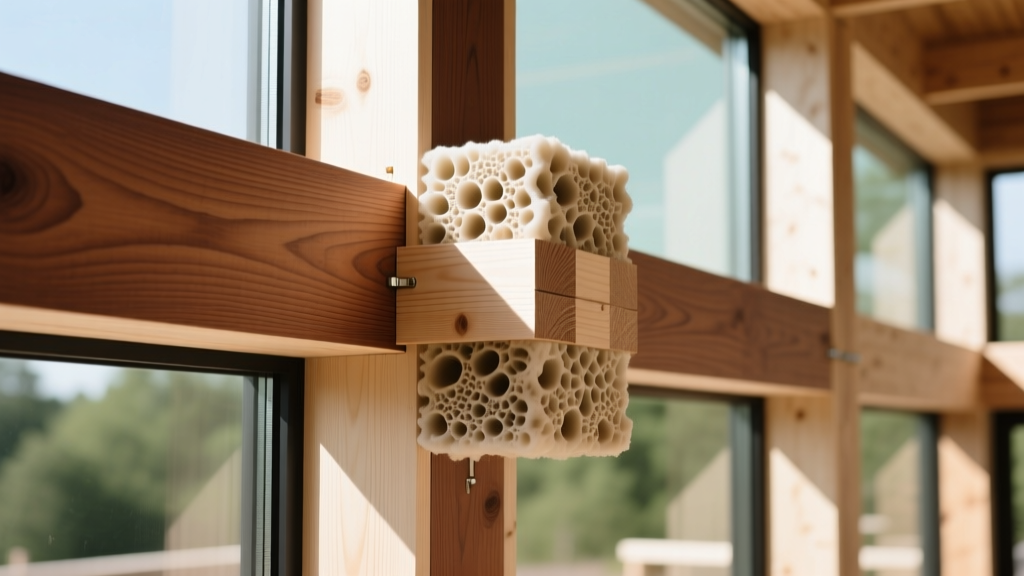
Mycelium—the vegetative root structure of fungi—has evolved from a packaging novelty into a high-performance building material. Companies like Ecovative Design and Mogu are utilizing agricultural waste (such as hemp hurds or corn stalks) inoculated with mycelium to grow acoustic panels, insulation batts, and structural composites in custom molds.
Technical Specifications and Performance
- Thermal Resistance: R-3.8 to R-4.2 per inch, comparable to expanded polystyrene (EPS).
- Acoustic Performance: Noise Reduction Coefficient (NRC) of 0.85 to 0.95, making it superior to mineral wool for interior acoustic baffling.
- Fire Resistance: Naturally Class A fire-rated when fully dried and heat-pressed; the material chars rather than melts or off-gases toxic fumes.
Installation Gotchas and Failure Modes
The primary failure mode for mycelium insulation is moisture exposure during the framing stage. While fully cured mycelium composites are hydrophobic, raw or partially cured batts can harbor mold if left exposed to rain before the weather-resistant barrier (WRB) is installed. Builders must store mycelium products in climate-controlled, above-grade environments and treat them similarly to unprotected drywall during the construction sequence.
Hemp-Based Insulation and Structural Blocks
Industrial hemp is a hyper-accumulator that sequesters up to 1.63 tons of carbon per ton of hempcrete. In 2026, the market has bifurcated into two primary hemp applications: flexible batt insulation and rigid structural blocks.
HempWool Batts vs. Hempcrete Blocks
HempWool (Flexible Insulation): Brands like Hempitecture produce hemp fiber batts treated with borates for pest and fire resistance. With an R-value of 3.7 per inch and a density of 2.5 lbs/ft³, HempWool offers excellent thermal mass and hygroscopic properties. It actively buffers indoor humidity, keeping it between 40% and 60%, which reduces the latent load on HVAC systems. Pricing currently averages $2.85 per square foot for 5.5-inch batts—a 30% premium over Rockwool, but offset by labor savings since it requires no PPE for installation.
Hempcrete Blocks (Structural/Infill): Pre-cast hempcrete blocks (like Just BioFiber) eliminate the 28-day curing time associated with cast-in-place hempcrete. These blocks interlock and are post-tensioned or grouted, offering a compressive strength of 100-150 psi. While not suitable for high-rise load-bearing walls, they are ideal for residential infill and thermal mass walls.
Comparative Matrix: Bio-Based Material Selection
| Material | Best Application | R-Value / Inch | Carbon Profile | 2026 Est. Cost |
|---|---|---|---|---|
| Mycelium Composite | Interior acoustic panels, non-loadbearing insulation | R-4.0 | Carbon Negative | $3.50 - $4.20 / sq ft |
| HempWool Batts | Wood-framed wall cavities, roof assemblies | R-3.7 | Carbon Negative | $2.85 / sq ft (5.5") |
| Cross-Laminated Timber (CLT) | Mid-to-high rise structural floors, shear walls | R-1.25 (per inch) | Carbon Negative | $8.50 - $12.00 / bd ft |
| Engineered Bamboo | Tensile structural members, high-wind shear panels | N/A (Structural) | Carbon Neutral | $6.00 - $9.00 / bd ft |
Mass Timber and Engineered Bamboo
Mass timber, specifically Cross-Laminated Timber (CLT) and Glued Laminated Timber (Glulam), continues to dominate the commercial renewable materials sector. According to data from the WoodWorks Mass Timber Expertise portal, CLT panels can span up to 40 feet without intermediate support, drastically reducing the need for steel beams.
Fire Performance and the Charring Rate
The most common objection to mass timber is fire risk. However, engineered timber performs predictably under fire conditions. CLT exhibits a charring rate of approximately 1.5 inches per hour. Structural engineers calculate the required panel thickness by adding the structural depth needed for load-bearing to the sacrificial char layer required for the building's fire rating. A 5-ply CLT panel (approx. 6.8 inches thick) can easily achieve a 2-hour fire resistance rating without the need for sprayed fire-resistive materials (SFRM) or gypsum encapsulation, provided the connections are properly fire-stopped.
"Engineered bamboo represents the next frontier in tensile renewable materials. With a tensile strength of 28,000 psi—surpassing many grades of rebar—bamboo composites are being tested for post-tensioning applications in low-rise concrete alternatives."
— Dr. Elena Rostova, Journal of Bio-Composites in Structural Engineering
Hygrothermal Modeling: The Hidden Requirement
The most frequent cause of failure in bio-based wall assemblies is improper moisture management. Unlike foam insulations that act as vapor barriers, mycelium, hemp, and mass timber are highly vapor-open (hygroscopic). They absorb and release moisture based on ambient conditions.
If a builder installs hemp insulation in a cold climate (IECC Zones 5-8) and pairs it with an interior Class I vapor retarder (like 6-mil polyethylene), moisture migrating from the interior will condense on the cold side of the poly, trapping water inside the hemp cavity. This leads to interstitial condensation and eventual rot.
2026 Code Compliance and IBC Updates
Integrating these materials requires navigating the latest building codes. The 2024 IBC, widely adopted by municipalities entering 2026, introduced three new construction types for mass timber: Type IV-A, IV-B, and IV-C. Type IV-A allows mass timber buildings up to 18 stories and 270 feet in height, provided the timber is fully encapsulated in non-combustible materials. Type IV-B allows up to 12 stories with exposed timber ceilings, while Type IV-C permits up to 9 stories with fully exposed interior timber elements.
For non-structural bio-materials like hempcrete and mycelium, code compliance relies on alternative material provisions (IBC Section 104.11). Builders must provide the local Authority Having Jurisdiction (AHJ) with third-party testing reports (such as ICC-ES Evaluation Reports) demonstrating that the material meets ASTM E84 for surface burning characteristics and ASTM E119 for fire resistance. Organizations like the USDA Forest Products Laboratory continuously publish updated fire and structural testing data that AHJs rely on to approve these alternative assemblies.
Strategic Sourcing and Lead Times
While the performance of renewable building materials is proven, the supply chain remains constrained compared to conventional materials. Mass timber and pre-cast hempcrete blocks are typically manufactured on a made-to-order basis. Lead times for CLT panels currently range from 12 to 16 weeks from the time shop drawings are approved. Mycelium acoustic panels require 8 to 10 weeks for custom mold fabrication and biological growth cycles.
To mitigate schedule risks, project managers must involve bio-material suppliers during the schematic design phase. Early engagement allows manufacturers to optimize panelization, reduce off-cuts, and secure agricultural feedstocks (like hemp hurds) before seasonal shortages impact pricing. By treating renewable materials as integrated structural systems rather than drop-in commodity replacements, construction teams can fully realize the carbon, aesthetic, and performance benefits of the bio-based building revolution.
Written by
James ThorntonJames Thornton is a construction industry veteran with 25 years of hands-on experience in wood framing, lumber grading, and residential building codes. He started as a framing carpenter in rural Oregon, earned his ICC Residential Building Inspector certification, and eventually became a senior plan reviewer for the City of Portland Bureau of Development Services. James holds a B.S. in Wood Science & Technology from Oregon State University and is a certified lumber grader through the West Coast Lumber Inspection Bureau (WCLIB). He has inspected over 3,000 residential construction sites and authored the city's internal guide on advanced framing techniques (2x6 at 24" O.C.). James lives in Bend, OR, where he builds custom timber-frame cabins and competes in lumberjack sports.
More from James Thornton
View all
Insulation
Best Home Insulation Materials: Complete 2026 Guide
Compare top home insulation materials for 2026. Find R-values, installed costs per square foot, and best uses for fiberglass, spray foam, and mineral wool.
Aug 4, 2026

Sustainable Building
Certify Your Green Building Material for LEED and WELL
Step-by-step guide to certifying a green building material for LEED v5 and WELL v2. Master EPDs, HPDs, and VOC limits for 2026 project specifications.
Aug 4, 2026

Stone & Masonry
Veneer Stacked Stone Panels: Interior Design & Style Showcase
Discover how veneer stacked stone panels transform interiors. Explore modern design profiles, material pairings, and technical installation specs.
Aug 4, 2026