Unsustainable Building Materials vs Eco-Friendly Alternatives
Compare the lifecycle costs, embodied carbon, and performance of unsustainable building materials against modern eco-friendly alternatives.

The Hidden Liability of Legacy Construction Materials
The built environment generates nearly 40% of global carbon emissions. While operational carbon (heating, cooling, lighting) has historically dominated green building conversations, embodied carbon—the greenhouse gases emitted during the extraction, manufacturing, transportation, and disposal of building materials—now accounts for 11% of global emissions. Specifying unsustainable building materials locks projects into decades of environmental liability, higher lifecycle maintenance costs, and increasing regulatory penalties.
As building codes tighten and carbon taxation frameworks expand globally in 2026, architects and general contractors are aggressively auditing material schedules. The transition away from high-carbon, toxic, or resource-depleting materials is no longer just an environmental preference; it is a financial imperative. Below, we break down the technical specifications, lifecycle costs, and performance metrics of common unsustainable building materials compared to their modern, high-performance eco-friendly alternatives.
Lifecycle Cost & Carbon Matrix: Legacy vs. Modern Materials
Upfront material costs often obscure the true financial and environmental impact of a build. The following matrix compares standard unsustainable building materials with their direct sustainable counterparts, factoring in 2026 market pricing and embodied carbon data as tracked by the Carbon Leadership Forum.
| Material Category | Unsustainable Baseline | Eco-Friendly Alternative | Upfront Cost Delta | Embodied Carbon Reduction | Lifespan / Durability |
|---|---|---|---|---|---|
| Structural Concrete | 100% OPC (ASTM C150) | Geopolymer / High-Slag Mix | +15% to +22% | 60% - 80% reduction | Equal or superior sulfate resistance |
| Exterior Cladding | Vinyl (PVC) Siding | Fiber Cement (Autoclaved) | +45% to +60% | 50% reduction (toxicity eliminated) | 25 years vs. 50+ years |
| Cavity Insulation | Fiberglass Batts (R-13) | Dense-Pack Cellulose | +10% to +15% | 85% reduction (recycled content) | Equal R-value, superior acoustics |
| Interior Flooring | Virgin Nylon Carpet | Linoleum / Marmoleum | +20% to +30% | 90% reduction (bio-based) | 10 years vs. 30-40 years |
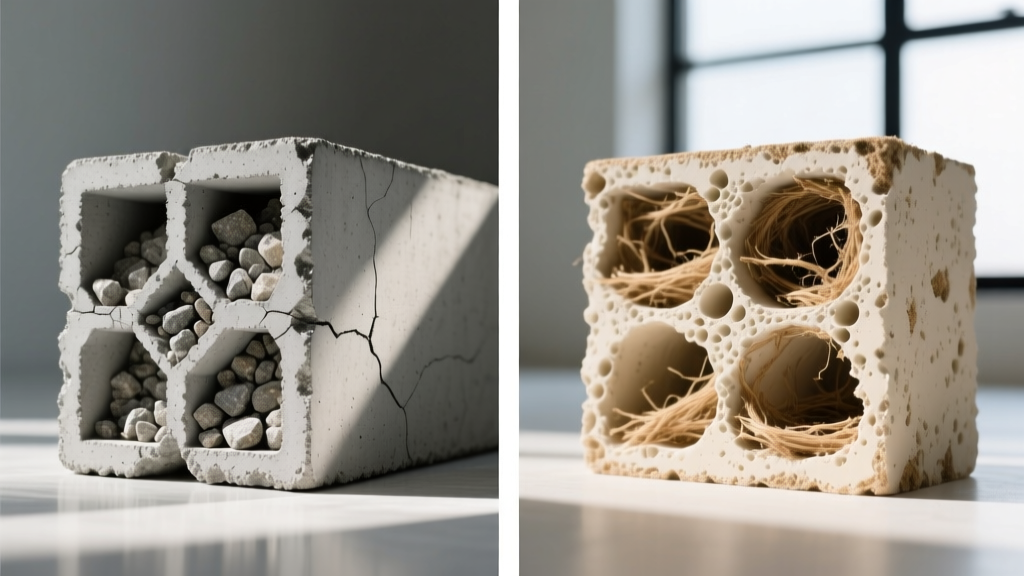
Ordinary Portland Cement (OPC) vs. Geopolymer Binders
Traditional concrete relies on Ordinary Portland Cement (OPC), governed by ASTM C150. The calcination process required to produce OPC clinker releases approximately 900 kg of CO2 per metric ton of cement. For a standard 2,000-square-foot commercial foundation, this equates to tens of thousands of pounds of upfront carbon emissions before the building is even occupied.
The Geopolymer Advantage
Geopolymer concrete replaces OPC with industrial byproducts like fly ash (Class F) and ground granulated blast-furnace slag (GGBFS), activated by alkaline solutions such as sodium silicate. According to the U.S. EPA Embodied Carbon Guidelines, high-volume fly ash or slag mixes can reduce embodied carbon by up to 80%.
- Compressive Strength: Geopolymers routinely achieve 4,000 to 6,000 psi at 28 days, matching or exceeding OPC.
- Curing Profile: Geopolymers cure faster in high-temperature environments but require strict moisture control during the initial 48 hours to prevent efflorescence.
- Cost Reality: In 2026, OPC averages $135–$150 per cubic yard. Geopolymer mixes range from $160–$185 per cubic yard. However, the reduced need for chemical surface hardeners and the material's inherent resistance to sulfate attack (eliminating the need for epoxy coatings in below-grade applications) frequently offsets the initial premium by year three.
Vinyl (PVC) Cladding vs. Fiber Cement
Polyvinyl chloride (PVC) siding remains prevalent in residential construction due to its low upfront cost ($4.00–$7.00 per square foot installed). However, PVC is fundamentally unsustainable. Its manufacturing process releases dioxins and furans—highly toxic, persistent organic pollutants. Furthermore, PVC becomes brittle under prolonged UV exposure, leading to cracking, and it releases hydrogen chloride gas when exposed to fire.
The Fiber Cement Alternative
Fiber cement siding (such as JamesHardie HardiePlank) is composed of Portland cement, silica sand, and cellulose fibers. While it still contains some cement, its lifecycle profile vastly outperforms PVC.
- Fire Resistance: Fiber cement carries a Class A fire rating per ASTM E84, meaning it will not ignite or contribute fuel to a structure fire. PVC melts and drips, accelerating fire spread.
- Dimensional Stability: Fiber cement exhibits a thermal expansion coefficient of roughly 0.0000075 in/in/°F, compared to PVC's 0.000045 in/in/°F. This means PVC siding requires significant overlap and joint spacing to prevent buckling in summer heat, whereas fiber cement installs tightly and remains dimensionally stable.
- End-of-Life: PVC is rarely recycled and sits in landfills indefinitely. Fiber cement can be crushed and repurposed as road base aggregate.
While fiber cement costs $8.00–$12.00 per square foot installed and requires specialized fiber-cement shears and dust-management protocols during cutting, its 50-year lifespan and minimal maintenance requirements yield a lower total cost of ownership than replacing PVC twice over the same period.
Fiberglass Batts vs. Dense-Pack Cellulose
Fiberglass batt insulation is the default choice for many tract builders. While modern batts have largely eliminated formaldehyde binders, they remain problematic from a performance and sustainability standpoint. Fiberglass loses up to 50% of its stated R-value in extreme cold due to convective looping within the batt. Furthermore, it offers virtually no acoustic damping and is easily compromised by compression around electrical boxes and plumbing lines.
Cellulose and Mineral Wool Upgrades
Blown-in, dense-pack cellulose (such as Applegate or Nu-Wool) is manufactured from 85% post-consumer recycled newsprint, treated with borates for fire and pest resistance. The Department of Energy highlights cellulose for its superior air-sealing properties when installed at the correct density.
- Thermal Performance: Dense-pack cellulose provides an R-value of 3.7 to 3.8 per inch. More importantly, it eliminates the convective air currents that degrade fiberglass performance, resulting in a wall assembly that performs closer to its theoretical whole-wall R-value.
- Acoustic Damping: Cellulose reduces sound transmission by up to 60% more than fiberglass batts in standard 2x4 wall assemblies, a critical factor for multi-family residential builds.
- Moisture Management: Unlike fiberglass, which traps moisture against wood framing (leading to rot), cellulose is hygroscopic and can safely absorb and redistribute minor moisture leaks, protecting the structural sheathing.
"The shift from cavity batts to continuous exterior insulation combined with dense-pack cellulose is the single most effective envelope upgrade a builder can make to bridge the gap between code-minimum and net-zero-ready performance."
Specifier Decision Framework: When to Swap
Use the following decision matrix when reviewing material submittals to identify high-impact substitution opportunities without derailing the project schedule.
If the project requires...
High-Early Strength Concrete (for fast-track scheduling):
Do NOT use: OPC with calcium chloride accelerators (causes rebar corrosion).
Swap to: Geopolymer mixes, which naturally achieve high early strength without corrosive chloride additives.
Wildland-Urban Interface (WUI) Fire Compliance:
Do NOT use: Vinyl siding, wood-plastic composites, or PVC trim.
Swap to: Autoclaved fiber cement, stucco, or mineral wool continuous insulation (which is non-combustible and melts at temperatures exceeding 1,800°F).
Acoustic Separation in Multi-Family Units:
Do NOT use: Standard R-13 or R-15 fiberglass batts in party walls.
Swap to: Dense-pack cellulose or mineral wool batts (e.g., ROCKWOOL Safe'n'Sound) paired with resilient channel isolation.
Moving Beyond Code Minimums
Eliminating unsustainable building materials from project specifications requires looking past the initial line-item cost on the estimate. By evaluating materials through the lens of embodied carbon, lifecycle durability, and end-of-life toxicity, specifiers can design structures that are not only environmentally responsible but financially superior over a 30-to-50-year holding period. As supply chains for geopolymer binders, bio-based insulations, and fiber cement scale up through 2026, the cost premiums associated with these alternatives continue to shrink, making sustainable material selection the baseline standard for modern construction.
Written by
Sarah WhitfieldSarah Whitfield is a chartered quantity surveyor (MRICS) and construction cost analyst with 15 years of experience in material pricing, procurement strategy, and project budgeting. She earned her degree in Construction Management from the University of Reading (UK) and has worked on projects ranging from $2M custom homes to $180M mixed-use developments across North America and Europe. Sarah currently leads cost estimating for BuildMat Insight, maintaining a proprietary database of 4,000+ material price points updated quarterly. She is a frequent contributor to RSMeans cost data panels and has presented at the International Cost Engineering Council (ICEC) congress. Based in Denver, CO, Sarah is an avid trail runner and volunteer mentor for Women in Construction.
More from Sarah Whitfield
View all
Wood & Lumber
What Are the Different Types of Wood? A Builder's Guide
Compare structural softwoods, finish hardwoods, and engineered lumber. Analyze Janka ratings, MOE values, and 2026 pricing for construction.
Aug 4, 2026

Walls & Panels
Steel Framing vs Wood Framing: Corrosion and Moisture Defense
Compare steel framing vs wood framing for moisture resistance. Learn about galvanized coatings, condensation risks, and corrosion protection strategies.
Jul 21, 2026

Stone & Masonry
How to Cut Stone Veneer: Wet Saw vs Grinder Comparison
Compare the best tools for cutting stone veneer. We review wet saws, angle grinders, and chop saws to help you achieve clean, chip-free cuts.
Jul 21, 2026