Comparing Eco Friendly Building Materials for Houses in 2026
Compare the top eco friendly building materials for houses in 2026. Analyze costs, R-values, and embodied carbon for framing, walls, and insulation.

The Metric That Matters: Embodied Carbon vs. Operational Energy
Selecting eco friendly building materials for houses requires moving beyond basic recycling metrics. In 2026, the primary benchmark for sustainable residential construction is the balance between embodied carbon (the greenhouse gas emissions generated during material extraction, manufacturing, and transport) and operational energy efficiency. According to Architecture 2030, embodied carbon will be responsible for nearly half of total new construction emissions between now and 2050. Therefore, a truly green material must sequester carbon or require minimal energy to produce, while simultaneously reducing the home's long-term heating and cooling loads.
Structural Framing: Mass Timber vs. FSC-Certified Light Wood
The structural skeleton accounts for a massive portion of a home's upfront carbon footprint. While steel and concrete dominate commercial builds, residential eco-construction relies heavily on advanced wood products.
| Material | Estimated Cost (per sq ft) | Embodied Carbon Profile | Structural Span & Labor |
|---|---|---|---|
| Cross-Laminated Timber (CLT) | $14.00 - $19.50 | Net-negative (sequesters ~1.1 tons CO2 per cubic meter) | Long spans, requires crane; specialized carpentry labor. |
| FSC-Certified Dimensional Lumber | $7.50 - $11.00 | Low (carbon stored in wood, but higher processing/transport emissions than local CLT) | Standard 16ft spans; ubiquitous framing labor. |
| Cold-Formed Steel (Recycled) | $9.00 - $13.00 | High (energy-intensive smelting, even at 90% recycled content) | Standard spans; requires specialized fastening and thermal breaks. |
Edge Cases and Failure Modes in Timber Framing
When sourcing Forest Stewardship Council (FSC) certified lumber, verify the chain-of-custody documentation. A common failure mode in 2026 supply chains is the mixing of FSC and non-certified wood at the distributor level. For CLT panels, moisture management during the construction phase is critical. If CLT panels are exposed to rain without a temporary roof for more than 48 hours, the outer lamellas can delaminate or harbor mold, requiring costly sanding and epoxy consolidation before enclosure.
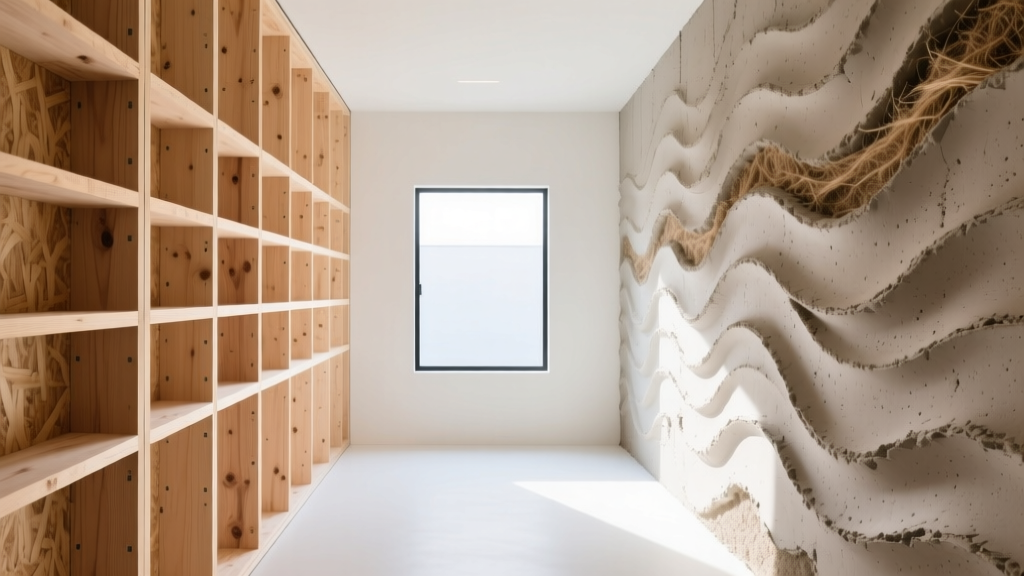
Wall Envelope Systems: Hempcrete vs. Rammed Earth
For the building envelope, mass wall systems offer distinct thermal and environmental advantages over traditional stick-frame-and-batts assemblies.
Hempcrete (Hemp-Lime Composite)
Composition: Hemp hurd, lime binder, and water.
- Pros: Highly vapor-permeable (prevents trapped moisture), carbon-negative (lime carbonation + hemp growth sequesters CO2), excellent acoustic dampening (STC 50+).
- Cons: Low compressive strength (cannot bear structural roof loads without a separate frame), requires a 28-day curing period before applying exterior renders.
- Cost: $18.00 - $26.00 per sq ft of wall area.
Rammed Earth
Composition: Damp subsoil (clay, sand, gravel) compacted in forms, sometimes stabilized with 5-8% Portland cement.
- Pros: Exceptional thermal mass (smooths out diurnal temperature swings), zero VOCs, virtually maintenance-free interior finishes.
- Cons: Extremely poor insulator (R-value of ~0.25 per inch), requires rigid foam or mineral wool inserts in cold climates to meet energy codes, very high labor cost.
- Cost: $28.00 - $42.00 per sq ft of wall area.
Insulation Showdown: Dense-Pack Cellulose vs. Stone Wool
Insulation dictates the operational carbon of the house. The U.S. Department of Energy emphasizes that proper installation is just as critical as the material's rated R-value.
Dense-Pack Cellulose (e.g., Applegate, GreenFiber)
Manufactured from 80% post-consumer recycled newsprint treated with borates for fire and pest resistance.
Performance: R-3.7 to R-3.9 per inch.
Installation Reality: Must be blown at a density of 3.5 lbs per cubic foot to prevent settling. If the installer nets the wall cavities improperly or fails to use a moisture meter to verify density, the cellulose will settle over the first two years, leaving uninsulated gaps at the top of the wall plates. It is highly hygroscopic; it will wick liquid water from roof leaks and hold it against structural framing, accelerating rot.
Stone Wool / Mineral Wool (e.g., Rockwool Comfortbatt)
Manufactured from basalt rock and slag spun into fibers.
Performance: R-4.2 to R-4.3 per inch.
Installation Reality: Hydrophobic (repels liquid water) while remaining vapor-permeable. It is non-combustible and provides superior fire-stopping at rim joists and penetrations. The primary drawback is the high embodied energy required to melt the basalt in a cupola furnace, which offsets some of its operational carbon savings compared to cellulose.
Climate-Specific Decision Framework
Do not apply a blanket 'green' strategy across all regions. Match the material physics to the local climate zone:
- Hot-Humid (Zones 1-3): Prioritize vapor-permeable walls (Hempcrete) and stone wool insulation. The hydrophobic nature of stone wool prevents mold growth in high-humidity environments where air conditioning creates condensation planes inside the wall.
- Mixed / Temperate (Zones 4-5): FSC-certified light wood framing with dense-pack cellulose. The moderate temperature swings allow cellulose to dry out safely if minor moisture intrusion occurs, maximizing the use of recycled content.
- Cold / Very Cold (Zones 6-8): CLT panels paired with exterior continuous mineral wool insulation. The thermal mass of the CLT combined with the high R-value of exterior stone wool prevents thermal bridging and keeps the structural timber well above the dew point.
Sourcing and Certifications to Demand in 2026
When specifying eco friendly building materials for houses, require Environmental Product Declarations (EPDs) from your suppliers. An EPD is a third-party verified document that quantifies the exact global warming potential (GWP) of a specific product batch. Reject generic 'green' marketing claims; if a manufacturer cannot provide a current, product-specific EPD, their embodied carbon data is likely outdated or averaged across less efficient product lines.
Written by
Priya KapoorPriya Kapoor is a real estate market analyst and construction economics researcher with expertise in housing affordability, development feasibility, and infrastructure investment. She holds a Master of Regional Planning from Cornell University and previously worked as a senior analyst at CBRE's Investment Properties group, where she modeled returns for $4B in mixed-use development pipelines. Priya now runs an independent research practice advising developers, municipalities, and REITs on construction cost forecasting and market timing. She publishes the quarterly "BuildMat Market Pulse" report tracking material price indices across 12 commodity categories. Based in Austin, TX, Priya serves on the board of Habitat for Humanity Austin and is a marathon runner.
More from Priya Kapoor
View all
Construction Cost
Cost to Build a 1600 Sq Ft Home in 2026: Full Breakdown
Accurate 2026 cost to build a 1600 sq ft home—material, labor, and regional pricing breakdowns included. Plan your budget with real-time estimates.
Aug 11, 2026

Wood & Lumber
Name the Types of Wood for Pressure Treatment and Preservation
Learn how to name the types of wood best suited for pressure treatment. Compare species treatability, chemical retention levels, and 2026 preservation costs.
Aug 4, 2026

Stone & Masonry
Stone Veneer Suppliers Lindenhurst: 2026 Cost Analysis
Analyze 2026 stone veneer costs in Lindenhurst, NY. Compare local supplier pricing, delivery fees, and Suffolk County installation labor rates.
Aug 4, 2026