Vinyl Siding Material Cost Per Square Foot: 2026 Installation Guide
Learn how to accurately calculate vinyl siding material cost per square foot for your installation, including hidden expenses, trim, and waste factors.

Deconstructing the Base Material Costs
Accurately estimating the vinyl siding material cost per square foot requires moving beyond the big-box store sticker price. The base panel cost is only the starting point. In 2026, PVC resin pricing has stabilized following previous supply chain disruptions, but premium profiles and insulated backings command a significant premium. When contractors quote a flat rate without breaking down the profile type, thickness, and insulation, margin erosion is almost guaranteed.
Standard hollow-back vinyl siding typically ranges from $2.50 to $4.20 per square foot, while insulated vinyl siding—which features an integrated EPS (expanded polystyrene) foam backing—ranges from $5.50 to $8.50 per square foot. The thickness of the vinyl, measured in mils (thousandths of an inch), directly impacts both the price and the panel's rigidity. A premium 0.046-inch panel will resist wind loading and impact far better than a builder-grade 0.038-inch panel, but it will increase your base material cost by roughly 15% to 20%.
| Siding Profile & Type | Brand / Line Example | Thickness (Mils) | Cost Per Sq Ft | Cost Per Square (100 Sq Ft) |
|---|---|---|---|---|
| Standard Hollow-Back Clapboard | CertainTeed MainStreet | 0.038" - 0.042" | $2.50 - $3.40 | $250 - $340 |
| Premium Hollow-Back Dutch Lap | Mastic Quest | 0.044" - 0.048" | $3.50 - $4.80 | $350 - $480 |
| Insulated Vinyl Siding | Alside Prodigy / Variform | 0.046" + EPS Foam | $5.50 - $8.50 | $550 - $850 |
| Architectural Shakes / Shingles | Novik Hand-Split Shake | 0.050"+ | $6.00 - $10.50 | $600 - $1,050 |
| Vertical Board & Batten | Royal Building Products | 0.040" - 0.046" | $4.00 - $6.50 | $400 - $650 |
The Hidden Multipliers: Trim, Accessories, and Waste
The most common error in calculating the vinyl siding material cost per square foot is ignoring the accessory multiplier. Trim pieces are sold by the linear foot, not the square foot, yet they can account for 12% to 18% of your total material budget. If you only calculate the field panels, your final per-square-foot cost will be artificially low, leading to severe underbidding.
For every 1,000 square feet of wall area, expect to use approximately 450 to 600 linear feet of trim (including J-channel, starter strips, utility trim, and outside corners). Budget an additional $0.40 to $0.75 per wall square foot specifically for trim and accessories to protect your margins.
Waste factor is the second hidden multiplier. Vinyl siding panels come in standard lengths (typically 12 to 12.5 feet). When siding a home with multiple windows, doors, and complex rooflines, the offcuts from these panels cannot always be reused. According to Angi's vinyl siding cost guide, failing to account for proper waste factors is a primary reason DIYers and novice contractors run out of material mid-project, forcing them to buy retail-quantity bundles at a premium.
Assigning the Correct Waste Factor
- Simple Box/Gable Homes (10% Waste): Long, uninterrupted wall runs with minimal penetrations. Offcuts are easily reused above and below windows.
- Standard Suburban Homes (12% - 15% Waste): Multiple gables, standard window/door placements, and some architectural breaks.
- Complex Custom Homes (15% - 20% Waste): Multiple hips, valleys, dormers, bay windows, and short wall segments where standard 12-foot panels yield high scrap rates.
- Architectural Shakes/Scallops (20% - 25% Waste): Because shakes are often used in smaller accent areas (like gable peaks), the cut-to-fit ratio is much higher, resulting in maximum waste.
Step-by-Step Calculation Framework for Installers
To arrive at a true, fully-burdened vinyl siding material cost per square foot, follow this exact mathematical sequence during your takeoff phase. This framework ensures no material category is left unbudgeted.
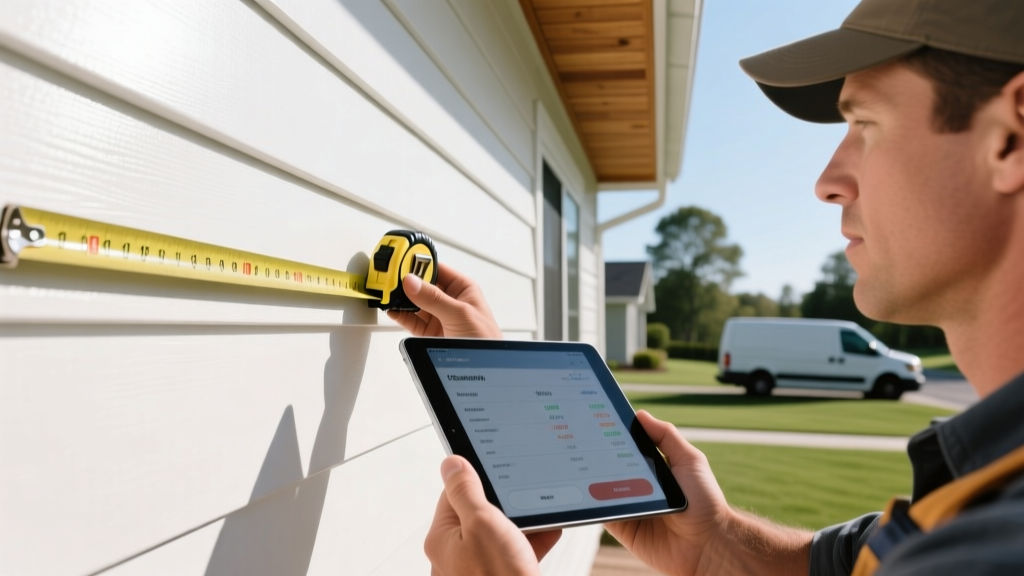
- Calculate Gross Wall Area: Measure the perimeter of the home and multiply by the wall height. Include the area of the gable triangles (Base × Height ÷ 2). Add 10% to the gable area to account for the angle cuts.
- Subtract Major Openings: Deduct the square footage of large openings (garage doors, large picture windows, sliding glass doors). Do not deduct standard single or double-hung windows; the waste generated from cutting around them offsets the material saved.
- Apply the Waste Factor: Multiply the net wall area by your chosen waste percentage (e.g., Net Area × 1.12 for a 12% waste factor). This yields your Total Required Field Area.
- Convert to Squares: Divide the Total Required Field Area by 100. Siding is ordered in "squares" (1 square = 100 sq ft). Always round up to the nearest whole square to avoid shortfalls.
- Calculate Linear Trim: Measure the perimeter for starter strips. Measure all window and door perimeters for J-channel. Measure all external and internal corners for corner posts. Measure rooflines and wall transitions for utility trim and finish trims.
- Determine the True Cost Per Square Foot: Add the total cost of the field panels, the total cost of all linear trim, the cost of fasteners (aluminum or galvanized roofing nails, approx. $0.05 per sq ft), and the cost of house wrap (if included in your material scope). Divide this grand total by the original net wall area (before waste was added). This gives you your true, fully-burdened material cost per square foot.
Regional Price Variations and Supply Chain Factors
While national averages provide a baseline, regional logistics heavily influence the final vinyl siding material cost per square foot. In 2026, freight costs remain a significant variable. Vinyl siding is highly voluminous but relatively lightweight; a truckload of insulated siding "cubes out" (fills the physical space of the trailer) long before it "weighs out" (hits the legal weight limit). This makes the cost per mile for shipping vinyl siding higher than denser materials like fiber cement or brick.
Contractors in the Northeast and Midwest typically see material costs 5% to 8% lower than those on the West Coast or in remote Mountain states, simply due to proximity to major PVC extrusion manufacturing hubs in Ohio, Pennsylvania, and Texas. When sourcing material, always factor in the delivery fee. A $350 freight charge on a $15,000 siding order adds roughly $0.15 to $0.25 per square foot to your baseline material cost.
"The longevity and low maintenance requirements of modern vinyl siding often offset the initial material investment, especially when utilizing insulated profiles that improve the home's thermal envelope," notes the Vinyl Siding Institute. However, realizing this ROI requires precise installation and accurate initial budgeting to avoid cutting corners on essential weather-resistive barriers.
Pro Tips for Minimizing Material Overruns
Protecting your estimated vinyl siding material cost per square foot requires strict job-site management. Even the most accurate takeoff will fail if the installation crew mismanages the inventory.
- Implement a "Cut Station" Protocol: Designate one specific area on the job site for making all custom cuts. This concentrates the offcuts in one pile, making it immediately obvious to the crew which scrap pieces can be used above windows or in narrow spaces, rather than cutting into full-length panels.
- Order Color-Matched Lots: Vinyl siding is extruded in batches, and slight color variations occur between production runs. Always order 100% of your field panels and trim in a single purchase order to guarantee they come from the same dye lot. Returning to the supplier for two extra squares mid-project risks a visible color mismatch on the finished wall.
- Use Coil Stock for Custom Trim: Instead of relying solely on the manufacturer's pre-formed vinyl trim (which can be expensive and limited in projection depth), invest in an aluminum coil brake. Wrapping custom fascia, soffits, and window casings with aluminum coil stock costs roughly $1.50 to $2.50 per linear foot in material, often saving 20% compared to proprietary vinyl trim systems while providing a cleaner, custom architectural look.
- Account for Fastener Corrosion: Never use standard steel nails or staples. The galvanized or electro-galvanized coatings on cheap fasteners will eventually rust, leaving permanent streaks down the vinyl panels. Specify hot-dipped galvanized or aluminum roofing nails with a minimum 3/8-inch head and 1.5-inch length. The cost difference is only pennies per square foot, but it prevents catastrophic aesthetic failures five years down the line.
Final Takeaway for Budgeting
Calculating the true vinyl siding material cost per square foot is an exercise in detail management. By moving beyond the base panel price and rigorously accounting for trim linear footage, specific waste factors based on architectural complexity, and regional freight variables, you transition from guessing to precision estimating. This level of granularity ensures your bids are both competitive in the market and profitable on the balance sheet.
Written by
Sarah WhitfieldSarah Whitfield is a chartered quantity surveyor (MRICS) and construction cost analyst with 15 years of experience in material pricing, procurement strategy, and project budgeting. She earned her degree in Construction Management from the University of Reading (UK) and has worked on projects ranging from $2M custom homes to $180M mixed-use developments across North America and Europe. Sarah currently leads cost estimating for BuildMat Insight, maintaining a proprietary database of 4,000+ material price points updated quarterly. She is a frequent contributor to RSMeans cost data panels and has presented at the International Cost Engineering Council (ICEC) congress. Based in Denver, CO, Sarah is an avid trail runner and volunteer mentor for Women in Construction.
More from Sarah Whitfield
View all
Wood & Lumber
What Are the Different Types of Wood? A Builder's Guide
Compare structural softwoods, finish hardwoods, and engineered lumber. Analyze Janka ratings, MOE values, and 2026 pricing for construction.
Aug 4, 2026

Walls & Panels
Steel Framing vs Wood Framing: Corrosion and Moisture Defense
Compare steel framing vs wood framing for moisture resistance. Learn about galvanized coatings, condensation risks, and corrosion protection strategies.
Jul 21, 2026

Stone & Masonry
How to Cut Stone Veneer: Wet Saw vs Grinder Comparison
Compare the best tools for cutting stone veneer. We review wet saws, angle grinders, and chop saws to help you achieve clean, chip-free cuts.
Jul 21, 2026