Evaluating Nichiha Shingle Siding vs. Real Cedar and Vinyl Options
Evaluating Nichiha shingle siding against real cedar and fiber cement rivals. Compare costs, fire ratings, and installation specs for 2026 projects.

The Nichiha Shingle Siding Verdict: Fiber Cement Mastery?
When architects and builders evaluate the building materials company Nichiha on shingle siding, the conversation quickly shifts from basic aesthetics to advanced material science. Nichiha, a Japanese manufacturer with a massive North American footprint, approaches fiber cement shingles differently than domestic competitors. Rather than simply stamping a wood grain into a flat panel, Nichiha utilizes a multi-layered extrusion and pressing process to create deep shadow lines and authentic, irregular textures that mimic hand-split cedar. For 2026 construction projects, particularly in regions with strict Wildland-Urban Interface (WUI) fire codes, Nichiha's shingle offerings represent a premium alternative to both natural wood and standard vinyl. However, evaluating Nichiha requires a granular look at their specific product lines, installation tolerances, and long-term moisture management compared to real Western Red Cedar and rival fiber cement brands.
Product Line Breakdown: Vintage Wood vs. Shakertown
Nichiha divides its shingle and shake portfolio into two primary architectural categories. Understanding the distinction is critical for matching the siding to the correct historical or modern architectural style.
Nichiha Vintage Wood (Cedar Shake Profile)
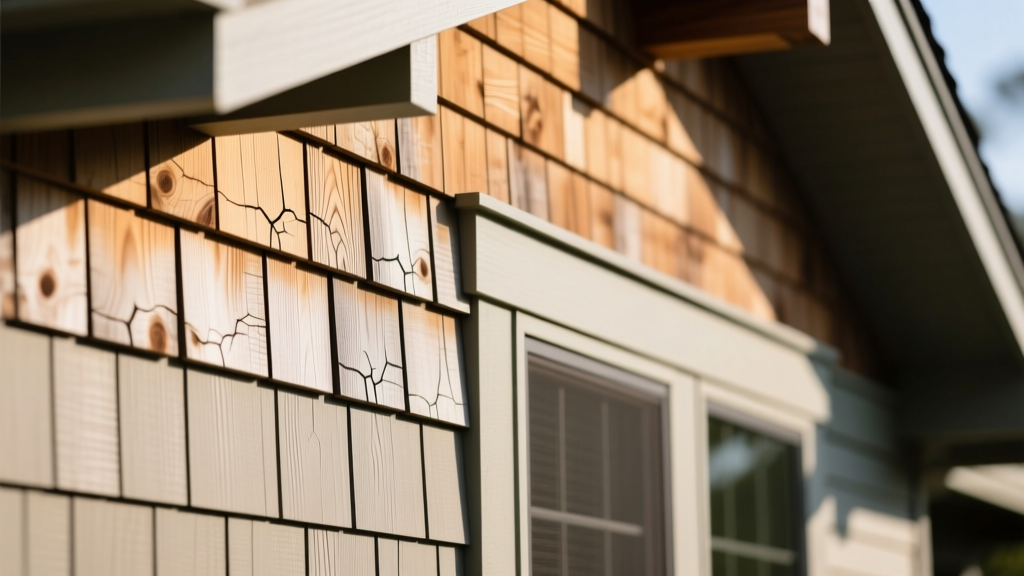
The Vintage Wood line is engineered to replicate the rugged, uneven appearance of hand-split cedar shakes. Unlike flat fiber cement panels that merely feature a printed texture, Vintage Wood utilizes varying thicknesses across the shingle face to create genuine shadow lines when the sun hits the exterior wall.
- Dimensions: Typically manufactured in 16-inch lengths with a 7-inch exposure per course.
- Texture: Deep, randomized grooves with a rough-sawn finish that varies from piece to piece, avoiding the 'stamped' repetitive pattern common in cheaper fiber cement.
- Best Application: Craftsman, Rustic, and Mountain-style homes where heavy shadow lines are architecturally required.
Nichiha Shakertown (Beveled Shingle Profile)
Shakertown offers a more refined, uniform aesthetic. It mimics traditional sawn cedar shingles rather than rustic shakes. The beveled edge provides a classic lap profile that lays flatter against the wall.
- Dimensions: Available in both individual shingles and multi-course panels (e.g., 15.25 x 48 inches) to accelerate installation on large, flat wall planes.
- Texture: Smooth to lightly textured face with precise, straight or staggered butt edges.
- Best Application: Cape Cod, Colonial, and Coastal architectures requiring a clean, tailored exterior envelope.
Head-to-Head Matrix: Nichiha vs. The Competition
To properly evaluate Nichiha's market position, we must benchmark its physical properties against James Hardie (the dominant domestic fiber cement brand), natural Western Red Cedar, and premium vinyl shakes.
| Feature | Nichiha Fiber Cement | James Hardie Shingles | Western Red Cedar | Premium Vinyl Shakes |
|---|---|---|---|---|
| Material Cost (per sq. ft.) | $6.50 - $9.00 | $4.50 - $7.00 | $7.50 - $11.50 | $3.50 - $5.50 |
| Weight (lbs per sq. ft.) | ~2.8 lbs | ~2.5 lbs | ~1.8 lbs | ~0.6 lbs |
| Fire Rating (ASTM E84) | Class A (Non-combustible) | Class A (Non-combustible) | Class C (Untreated) | Class A / B (Varies) |
| Moisture Resistance | High (Requires sealing) | High (Requires sealing) | Low (Prone to rot/cupping) | Impervious |
| Standard Warranty | 30-Year Limited / 15-Yr Finish | 30-Year Limited / 15-Yr Finish | None (Natural material) | Lifetime Limited |
| WUI Code Compliance | Approved | Approved | Restricted / Banned | Restricted |
Cost Analysis: 2026 Material and Labor Projections
Installed Cost Breakdown (Per Square Foot)
Nichiha Shingles Total Installed: $14.50 - $21.00 / sq. ft.
- Materials: $6.50 - $9.00 (Includes shingles, starter strips, and color-matched trim coils).
- Labor: $8.00 - $12.00 (Fiber cement shingles are labor-intensive. Individual shake installation requires meticulous alignment, face-nailing, and caulking, pushing labor costs 30% higher than horizontal lap siding).
Pro Tip: Opting for Nichiha's multi-course Shakertown panels instead of individual shingles can reduce labor costs by $2.00 to $3.50 per square foot while maintaining a highly authentic visual profile from street level.
Wildland-Urban Interface (WUI) Compliance and Fire Ratings
One of the most compelling reasons builders evaluate Nichiha over real wood is fire safety. According to the National Fire Protection Association (NFPA) home hardening guidelines, the exterior wall envelope is a critical vulnerability during a wildfire. Embers can easily lodge in the gaps of traditional cedar shakes, igniting the structure.
Nichiha's fiber cement shingles are composed of Portland cement, silica sand, and cellulose fibers. This mineral-heavy composition earns them a Class A fire rating under ASTM E84, meaning they are non-combustible and will not contribute fuel to an exterior fire. In strict WUI zones across California, Colorado, and Oregon, natural cedar shakes are frequently banned outright unless treated with expensive, temporary fire-retardant chemicals that wash out over time. Nichiha provides the exact architectural aesthetic of a mountain cabin or coastal retreat without violating municipal fire codes or requiring annual chemical re-treatments.
Installation Nuances and Common Failure Modes
While Nichiha's manufacturing quality is exceptional, fiber cement shingles are unforgiving during installation. The U.S. Department of Energy (Energy Saver) emphasizes that proper moisture management and clearance are non-negotiable for cementitious products. Installers must adhere to the following strict parameters to avoid voiding the 30-year warranty:
- Grade Clearance: Nichiha shingles must maintain a minimum 6-inch clearance above soil grade, and at least 2 inches above paved surfaces like concrete walkways or decks. Failure to do so results in capillary action, where the porous cement wicks ground moisture, leading to freeze-thaw spalling and edge deterioration.
- Fastening Protocol: Unlike vinyl or wood, you cannot rely on friction fits. Individual shakes require face-nailing using hot-dipped galvanized or stainless steel roofing nails (minimum 1.5-inch length). The nail head must sit flush with the surface—driving it too deep will fracture the cement matrix, while leaving it proud will trap water and cause rust streaks.
- Flashing and Kick-Outs: Where the shingle field meets a roofline or chimney, step flashing and kick-out diverters are mandatory. Fiber cement does not rot, but the wood sheathing behind it will if water is allowed to channel behind the siding courses.
- Cut Edge Sealing: Every time an installer cuts a Nichiha shingle to fit around a window or corner, the exposed silica/cement core is vulnerable to water intrusion. All field cuts must be sealed with a high-quality, paintable exterior polyurethane sealant before the next course is laid.
Addressing Efflorescence
A common, albeit cosmetic, failure mode in fiber cement is efflorescence—a white, powdery alkali deposit that appears on the surface. This occurs when moisture inside the cement migrates to the surface and evaporates, leaving calcium carbonate behind. Nichiha's factory-applied primers significantly mitigate this, but if the siding is stored uncovered in the rain on the job site before installation, efflorescence can occur. It is easily removed with a diluted white vinegar solution, but prevention via proper job-site storage is the superior strategy.
Final Evaluation Framework: Is Nichiha the Right Choice?
Evaluating the building materials company Nichiha on shingle siding ultimately comes down to balancing budget, architectural requirements, and local building codes. Use this decision matrix to finalize your material selection:
- Choose Nichiha Shingle Siding If: You are building in a WUI fire zone, you require the deep shadow lines of hand-split shakes for a Craftsman design, and you have the budget to pay for specialized fiber cement installers who understand flashing and cut-edge sealing.
- Look at James Hardie Instead If: Budget is the primary constraint. HardieShingle panels offer a very similar Class A fire rating and durability profile at a slightly lower material and labor cost, though the texture depth is marginally less pronounced than Nichiha's Vintage Wood.
- Stick to Real Western Red Cedar If: You are restoring a historical property where original materials are mandated by a preservation society, you are outside of WUI fire zones, and you are prepared for the ongoing maintenance cycle of staining and treating the wood every 3 to 5 years to prevent UV degradation and moss growth.
Written by
Marcus ChenMarcus Chen is a licensed structural engineer (PE) and building materials analyst with over 12 years of experience across residential, commercial, and industrial construction. He holds a Master of Science in Civil Engineering from UC Berkeley and spent six years at Thornton Tomasetti before transitioning to independent consulting and technical writing. Marcus specializes in material selection for seismic-prone regions, concrete reinforcement strategies, and lifecycle cost analysis. His work has been cited by the American Concrete Institute (ACI) and the Structural Engineers Association of California (SEAOC). When he is not on a job site or at his desk, you will find him hiking the Sierra Nevada or restoring a 1920s craftsman bungalow in Oakland, CA.
More from Marcus Chen
View all
Construction Cost
How Much Did the Eiffel Tower Cost to Build?
How much did the Eiffel Tower cost to build in 1889? We adjust for inflation and compare its budget to modern skyscraper construction.
Aug 4, 2026

Fire Resistance
What Is a Fire Resistant Material? Testing & Certification Guide
Discover what is a fire resistant material through ASTM and UL testing. Learn how fire ratings, certifications, and assemblies work in construction.
Aug 4, 2026

Construction Cost
How Much Did the Burj Khalifa Cost to Build?
How much did the Burj Khalifa cost to build? We break down the $1.5B project and extract 5 money-saving strategies for your next build.
Jul 30, 2026